
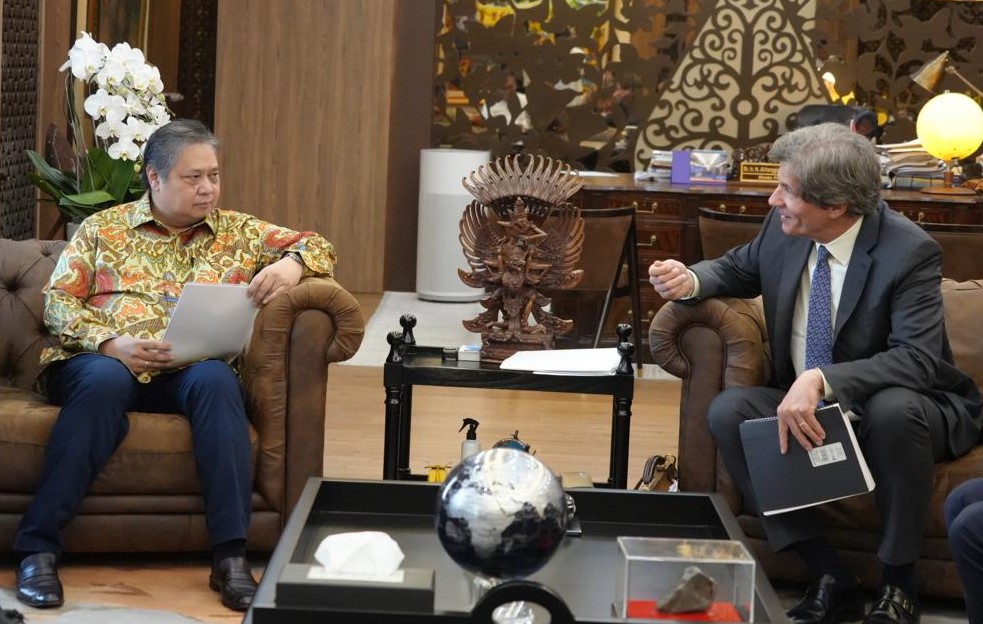
ASIATODAY.ID, JAKARTA – Coordinating Minister for the Indonesian Economy, Airlangga Hartarto met with Under Secretary for Economic Growth US Department of States Jose Fernandez on Monday, July 15 2024.
The bilateral meeting focused attention on collaborative efforts and support from the United States (US) in several sectors, including the semiconductor ecosystem, New and Renewable Energy, agriculture, and other potential cooperation.
On this occasion, Under Secretary Fernandez expressed his desire for cooperation in the field of agricultural biotechnology.
Minister Airlangga said that the Indonesian Government was open to biotechnology cooperation with the US, such as on rice, corn and sugar cane commodities. One of the collaborations has also been carried out through research in the field of biotechnology between universities in Indonesia such as the Bogor Agricultural Institute (IPB) and universities in the US.
“The government has collaborated with a number of universities to develop laboratories for several commodities such as rice, corn and sugar cane as well as the use of bio-ethanol for environmentally friendly fuel,” said Airlangga.
The government is currently also developing a number of food estates to maintain food safety throughout Indonesia.
Regarding optimizing the use of non-fossil energy as a power plant, Airlangga touched on the use of Small Modular Reactor (SMR) technology as an Electric Power Plant.
“Considering Indonesia as a large archipelagic country, an electrical energy capacity is needed that is appropriate to Indonesia’s geographical conditions. “Nuclear reactors produced through modular SMR can be used for these needs,” added Airlangga.
Furthermore, Under Secretary Fernandez said that his party would be ready to support the use of SMR and encourage the private sector to assist in the development and feasibility study for building this reactor in Indonesia. There are several business actors managing nuclear reactors for electric power who have expressed interest in collaborating in Indonesia.
Indonesia also has several nuclear laboratories for research and development activities.
Previously, the Indonesian Government itself had stipulated Presidential Decree Number 17 of 2024 concerning the National Team for Preparation and Acceleration of Indonesia’s Membership in the Organization for Economic Co-operation and Development.
“Indonesia’s accession process is expected to be able to support sustainable structural reform in Indonesia, as well as support the improvement of policies and regulations according to superior references,” stressed Airlangga.
Under Secretary Fernandez also expressed the US Government’s support and optimism that Indonesia could achieve full OECD membership in the not too distant future.
Regarding semiconductor development, the Indonesian Government has also established a Semiconductor Ecosystem Development Task Force through Decree of the Coordinating Minister for Economic Affairs Number 16 of 2024. This task force collaborates with the OECD and the US Department of State to conduct a study of the Indonesian semiconductor ecosystem.
It is hoped that Indonesia’s joining the OECD will also help with the development of the semiconductor ecosystem. Indonesia is expected to contribute to strengthening the global semiconductor supply chain through the International Technology Security and Innovation (ITSI) Fund mechanism. Apart from that, the Government is also collaborating to develop semiconductor human resources with the University of Arizona.
Apart from that, Indonesia also appreciates US leadership in the Indo-Pacific Economic Framework for Prosperity (IPEF) cooperation. As is known, Indonesia is committed to negotiating all Pillars in IPEF, encouraging flexibility in finalizing agreements, as well as signing agreements on Pillars II, III, IV and the Overarching Agreement.
Indonesia is in the process of ratifying these various agreements. There are several IPEF Cooperative Work Programs that were initiated for long-term investment and partnership opportunities to exploit the potential of renewable energy in Indonesia.
At the end of the meeting, Minister Airlangga emphasized that Indonesia will continue to continue the Government’s current priority programs, especially regarding Indonesia’s accession efforts to the OECD and Indonesia’s energy transition towards Net Zero Emissions (NZE).
The two of them also discussed critical minerals for the development of strategic minerals such as lithium, nickel, cobalt and manganese. Apart from that, discussions were also held regarding holding a mineral forum and whether it could be developed into a supply chain. (AT Network)
Follow Us at Google News and WA Channel