
ASIATODAY.ID, LONDON – The world reached a new milestone as low-carbon sources – renewables and nuclear – provided 40.9% of the world’s electricity generation in 2024, passing the 40% mark for the first time since the 1940s, according to a report by global energy think tank Ember.
In comparison, the Association of Southeast Asian Nations (ASEAN) generated just 26% of its electricity from clean sources in 2024, below the global average. In the region, just Lao and Viet Nam are above the global average, at 77% and 44% respectively, owing to their abundant hydropower.
Renewables were the main driver of overall clean growth globally, adding a record 858 TWh in 2024, 49% more than the previous high in 2022. Solar was the largest source of new power for the third year running, adding 474 TWh in 2024, as well as the fastest-growing for the 20th year in a row. Global solar generation doubled in three years to reach a share of 6.9% in 2024.
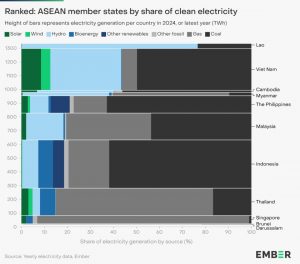
However, ASEAN’s share of solar electricity barely increased in the last three years, rising by only 0.1 percentage points from 3.1% in 2021 to 3.2% in 2024, despite the region’s enormous solar potential. Viet Nam has the highest share in the region, generating 8.5% of its electricity from solar in 2024, but its solar generation has not grown in the last three years.
“Solar power has become the engine of the global energy transition,” said Phil MacDonald, Ember’s managing director, April 08, 2025.
“Paired with battery storage, solar is set to be an unstoppable force. As the fastest-growing and largest source of new electricity, it is critical in meeting the world’s ever-increasing demand for electricity.”
Ember’s sixth annual Global Electricity Review provides the first comprehensive overview of the global power system in 2024 based on country-level data. It is published today alongside the world’s first open dataset on electricity generation in 2024, covering 88 countries that account for 93% of global electricity demand, as well as historic data for 215 countries.
ASEAN clean electricity growth is not keeping pace with demand Clean sources met 23% of ASEAN’s demand growth in 2024 — just around half the share they met over the previous five years (40%).
ASEAN has vast, largely untapped solar and wind potential, exceeding 30,000 GW and 1,300 GW respectively, yet installed capacity remains low at just 26.6 GW for solar and 6.8 GW for wind.Indonesia, ASEAN’s most populated country and the region’s top fossil fuel producer yet to fully exploit its renewables potential. In 2023, fossil fuels still generated 81% of its electricity, with emissions rising over two decades due to growing demand and coal dependence. Clean sources met 33% of Indonesia’s demand growth in the last five years. Solar and wind remain underutilised at less than 1% — far below the global average of 15% and behind its ASEAN neighbours Thailand (5%), Cambodia (7%) and Viet Nam (13%).
The report shows that, globally, clean generation growth is set to outpace faster-rising demand in the coming years, tipping the balance towards a decline in fossil generation at a global level.
“Cleantech, not fossil fuels, is now the driving force of economic development,” concluded MacDonald. “The era of global fossil growth is coming to an end, even in a world of fast-rising demand.”
“Tapping into solar and wind potential would enable ASEAN to unlock the renewable energy market needed to sustainably meet growing energy demand and climate targets,” said Dr Dinita Setyawati, Ember’s Senior Electricity Policy Analyst for Southeast Asia.
“With stronger policy support to drive renewable energy deployment, ASEAN has the potential to be at the forefront of the energy transition.”
“Asia’s clean energy transition is picking up speed, driven by record growth in solar and other renewables,” said Aditya Lolla, Ember’s Asia Programme Director.
“With electricity demand set to rise across the region, a robust clean energy market is crucial for the continued expansion of clean power. This will not only strengthen energy security and economic resilience, but also help emerging countries access the benefits of a new clean energy market economy.” (AT Network)
Follow Us at Google News and WA Channel