
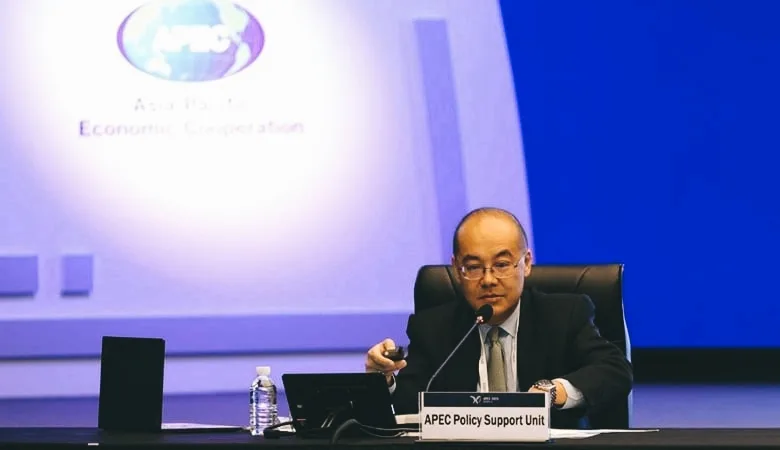
ASIATODAY.ID, GYEONGJU — The Asia-Pacific region continues to demonstrate strong economic resilience despite persistent global challenges.
According to the latest report from the APEC Policy Support Unit, economic growth across APEC economies is projected to reach 3.1 percent in 2025, slightly higher than the earlier forecast of 3.0 percent.
The upward revision is driven by robust trade activity and solid demand for high-tech goods, as detailed in the newly released APEC Regional Trends Analysis, launched on the sidelines of the APEC Ministerial Meeting in Gyeongju.
Growth Momentum Expected to Ease in 2026
While the 2025 outlook remains positive, APEC economists warn that growth momentum will likely slow in 2026, moderating to 2.9 percent as public debt rises, trade performance weakens, and temporary growth drivers—such as advance shipments and inventory buildup—fade.
“APEC economies and businesses have shown remarkable agility in adapting to shifting trade and policy conditions,” said Carlos Kuriyama, Director of the APEC Policy Support Unit on October 30, 2025.
“However, this resilience is now being tested as deeper structural pressures—like rising debt and slowing trade—begin to take hold.”
Kuriyama noted that while trade-facilitating measures are increasing, the combined effects of rising trade restrictions and trade remedies are creating new frictions that could hinder regional growth.
Trade Expansion Driven by Temporary Factors
Merchandise trade across APEC economies remained solid in the first half of 2025, with export values up 6.5 percent and imports rising 6.1 percent. Export and import volumes also grew by 8.8 percent and 8.5 percent, respectively.
However, according to Glacer Niño A. Vasquez, a researcher and co-author of the report, much of this momentum was due to firms rushing to export before new trade restrictions took effect. He expects export growth to slow to about 1.1 percent in 2026, as these transitory factors fade and trade tensions persist.
Fiscal Pressures Mount as Public Debt Surges
The report also warned of growing fiscal vulnerabilities across the APEC region, with total government gross debt projected to exceed 110 percent of GDP by 2026—a significant increase from earlier forecasts.
This rise reflects lingering pandemic-related expenditures, slow revenue recovery, and increased spending to sustain growth and social services amid aging populations.
“Fiscal space is shrinking just as economies need to invest more in innovation, infrastructure, and human capital,” said Rhea C. Hernando, an analyst with the Policy Support Unit and co-author of the report.
“Reforms that strengthen fiscal frameworks and improve public spending efficiency are urgently needed to build resilience against future shocks.”
Inflation Moderates, Creating Policy Space
Inflation across the APEC region continued to moderate, averaging 2.2 percent in the third quarter of 2025, supported by improved supply conditions and relatively stable commodity prices. This provided central banks with room to ease policy rates and stimulate economic activity, although maintaining a delicate balance remains essential to keep price pressures under control.
Regional Cooperation Key to Sustaining Growth
The report underscored that regional cooperation remains the cornerstone of economic stability in the Asia-Pacific. As trade frictions intensify and global uncertainties persist, maintaining a predictable policy environment and open dialogue among APEC economies will be critical to restoring confidence and sustaining long-term growth.
“APEC must navigate a delicate path that preserves economic stability while advancing bold reforms to strengthen resilience,” Kuriyama said.
“Adaptive regional cooperation is essential, and this is where APEC plays a vital role—by providing a platform for open dialogue and shared solutions that promote predictable, transparent, and sustainable frameworks for trade and investment.” (AT Network)
Follow Us at Google News and WA Channel