
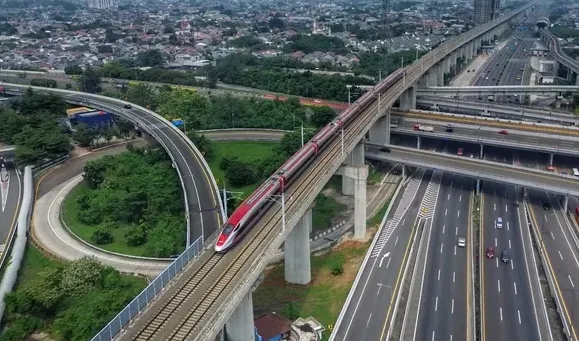
ASIATODAY.ID, JAKARTA — When Indonesia inaugurated the Jakarta–Bandung High-Speed Rail (KCJB), branded as Whoosh, in October 2023, it was hailed as a milestone of national progress — Southeast Asia’s first bullet train, symbolizing technological advancement and modern connectivity.
But behind the sleek 350 km/h train and the political fanfare lies a far more complicated truth: Indonesia’s deepening debt exposure to China and the long-term economic implications that come with it.
The Beginning: Ambition Meets Geopolitical Competition
The high-speed rail project began as part of President Joko Widodo’s grand infrastructure vision — to modernize Indonesia and boost economic growth through world-class connectivity. In 2015, two Asian powers, Japan and China, competed fiercely to secure the contract.
Japan offered a lower-interest loan backed by a sovereign guarantee, while China proposed a different model — a corporate-to-corporate joint venture financed by China Development Bank (CDB), with no direct government guarantee.
Jakarta ultimately sided with Beijing, forming PT Kereta Cepat Indonesia China (KCIC), a joint venture between Indonesian state-owned enterprises and China Railway International Co. Ltd. The total project was initially valued at US$6 billion, financed through a US$4.55 billion loan from CDB.
Yet as construction progressed, costs spiraled out of control. By 2023, the project’s total cost had surged to around US$7.2 billion (approximately IDR 115 trillion), driven by land acquisition delays, design changes, and inflation in raw material and logistics costs — particularly during the pandemic.
From “No State Burden” to Fiscal Liability
When first announced, the government insisted the project would not use state funds and would not burden the national budget (APBN).
But that promise quickly eroded. As costs ballooned, the Indonesian government was forced to inject more than IDR 8 trillion (around US$500 million) in state capital (PMN) to cover the shortfall.
Moreover, part of the CDB loan is now backed by a limited sovereign guarantee, effectively transferring some corporate risks onto the state’s fiscal shoulders. What began as a “no government guarantee” project has turned into a partial state liability, creating long-term exposure for public finances.
The Financial Trap: High Costs, Low Returns
KCIC now faces a severe cash flow challenge. Despite initial enthusiasm, ridership rates for the Whoosh train remain below projections. Ticket prices — starting from IDR 150,000 to 300,000 (US$9–18) — are significantly higher than alternative transport modes, reducing demand among the middle class.
Meanwhile, the company carries massive debt exceeding IDR 90 trillion, with interest rates between 2% and 3.4% annually. Even with long maturities, interest accruals continue to rise.
If KCIC’s revenue fails to meet debt obligations — a highly plausible scenario — the state may once again be forced to bail out the project through fiscal transfers or loan restructuring.
This raises a fundamental concern: Is Indonesia building modern infrastructure at the cost of financial sovereignty?
A Broader Pattern: China’s “Debt-Trap Diplomacy”
The KCJB case fits into a larger global pattern — China’s Belt and Road Initiative (BRI), which extends massive infrastructure loans to developing nations under the banner of connectivity and partnership.
But many of these projects have evolved into debt traps.
Sri Lanka was forced to hand over its Hambantota Port to China for 99 years after failing to repay loans.
Pakistan’s CPEC project plunged the country into a fiscal crisis.
Zambia and Kenya have faced similar challenges linked to Chinese debt exposure.
Indonesia has not reached that level of distress, but the warning signs are clear. The Whoosh project’s technological and operational dependence on Chinese systems — from rail technology and signaling to maintenance and spare parts — risks creating a long-term dependency loop.
This isn’t just about financing; it’s about strategic leverage. Control over critical infrastructure often translates into influence over national decision-making — a subtle yet potent form of modern geopolitics.
Political Economy: Between National Pride and Fiscal Reality
Undeniably, the Jakarta–Bandung high-speed rail is a technological milestone. Indonesia can proudly claim the first high-speed rail in Southeast Asia. But pride comes with a price.
Politically, the project became part of President Jokowi’s legacy narrative — a symbol of progress and modernization. Economically, however, it is a ticking fiscal time bomb that future administrations, including President Prabowo Subianto’s government, will have to manage.
China, meanwhile, has expanded its economic foothold in Indonesia through multiple sectors — nickel smelters, energy, and now transport infrastructure. The Whoosh project is as much a diplomatic victory for Beijing as it is an engineering feat for Jakarta.
The Path Forward: Transparency, Accountability, and Economic Sovereignty
The KCJB experience underscores one key lesson: transparency must accompany ambition. Every infrastructure megaproject involving foreign loans should disclose its full financial structure — interest rates, maturity, guarantees, and contingent liabilities.
Indonesia must also invest in domestic technological capacity to avoid long-term dependency. Building local expertise in railway engineering, manufacturing, and project management will reduce future reliance on foreign contractors.
Otherwise, high-speed trains like Whoosh may become “monuments of debt” — impressive to behold, yet financially unsustainable.
Between Speed and Prudence
The Jakarta–Bandung High-Speed Rail stands as both a triumph and a warning. It embodies Indonesia’s aspiration for rapid modernization, but also reveals the dangers of hasty decision-making in global finance.
In the grand chessboard of geopolitics, debt has become the new instrument of influence — quieter than guns, subtler than treaties, yet equally powerful.
Indonesia must now find the balance between ambition and caution, between partnership and sovereignty. For in this century, the true measure of progress is not how fast a nation can move — but how wisely it chooses its path. (Newsroom)
Follow Us at Google News and WA Channel