
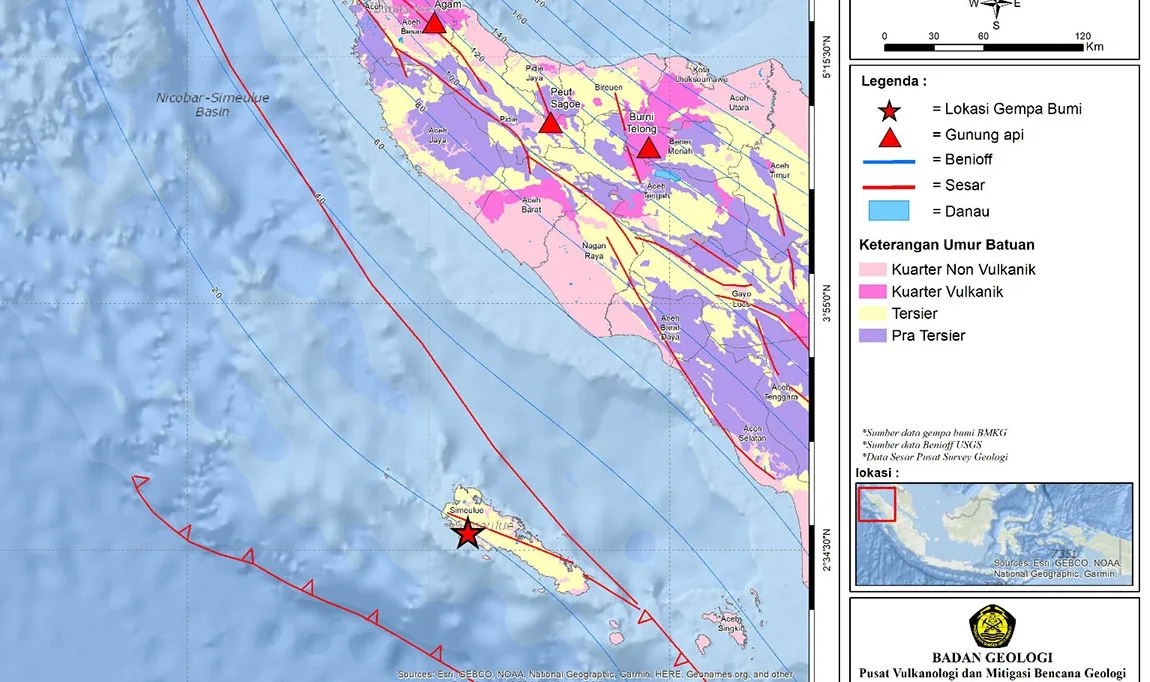
ASIATODAY.ID, JAKARTA – A powerful magnitude 6.3 earthquake struck the Sinabang region of Aceh on Thursday afternoon November 27, 2025, prompting widespread concern among residents and reviving painful memories of the province’s long and tragic tsunami history.
The Center for Volcanology and Geological Hazard Mitigation (PVMBG), under the Geological Agency of the Ministry of Energy and Mineral Resources, reported that the earthquake occurred at 11:56:24 WIB, with a shallow 10 km depth and an epicenter located 62 km northwest of Sinabang, onshore. Strong shaking was felt across Simeulue Island and along parts of Aceh’s western coastline.
PVMBG Technical Assessment: A High-Seismic-Intensity Zone
In an official statement, PVMBG Chief Hadi Wijaya confirmed that the earthquake’s epicenter was located at 2.67°N – 95.84°E, in an area dominated by rolling plains and hilly terrain—landforms that influence how seismic waves propagate and are felt by surrounding communities.
PVMBG noted that Simeulue and the west coast of Aceh fall within a High Earthquake Hazard Zone, based on the Geological Agency’s Earthquake Hazard Map. Despite the strength of the quake, Hadi stressed that there was no tsunami threat associated with this event.
The soil structure around the epicenter consists of:
Class E (soft soil) at points closest to the source
Class D (medium-density soil) dominating the coastal zone
Class C (dense soil and soft rock) across most of Simeulue and the broader west coast of Aceh
These geological classifications are crucial for estimating potential building damage. Based on source parameters and depth, PVMBG confirmed that the quake exhibited a thrust-fault mechanism, consistent with the subduction of the Indo-Australian Plate beneath the Eurasian Plate—a tectonic zone historically responsible for major earthquakes.
PVMBG urged residents to remain calm, stay away from cliffs that may be prone to landslides, and follow instructions from regional disaster agencies. No signs of secondary hazards—such as major ground fissures, liquefaction, or land subsidence—have been detected.
BNPB Report: Public Facilities Damaged, 12 People Injured
Shortly after PVMBG’s statement, the National Disaster Management Agency (BNPB) released its initial impact report. Strong shaking caused damage to several public facilities, the collapse of multiple residential structures, and a fire at a kerosene storage warehouse belonging to a local resident.
BNPB spokesperson Abdul Muhari stated that 12 people were injured across different districts and cities in Aceh, including:
East Aceh
West Aceh
Aceh Besar
Banda Aceh
South Aceh
Nagan Raya
Southeast Aceh
Simeulue
Most injuries were caused by falling debris as residents rushed to escape buildings. As of Thursday evening, official data on casualties, displaced residents, and material losses was still being consolidated.
BNPB confirmed that the Simeulue Regional Disaster Management Agency (BPBD), together with relevant local institutions, had activated emergency response measures, including rapid field assessments, coordination with local authorities, and documentation of structural damage and community needs.
Aceh’s Tsunami History: Why Every Earthquake Triggers Heightened Anxiety
Although Thursday’s earthquake did not generate a tsunami, Aceh’s population remains deeply sensitive to strong tremors due to the province’s catastrophic tsunami history. Aceh sits atop one of the world’s most active tectonic collision zones—the Sunda megathrust, where the Indo-Australian Plate plunges beneath the Eurasian Plate.
On 26 December 2004, a magnitude 9.1–9.3 megathrust earthquake ruptured off the coast of Aceh, unleashing a towering tsunami that devastated coastal communities within minutes. Waves reaching over 30 meters destroyed entire towns.
The disaster resulted in:
More than 160,000 deaths in Aceh and Nias
Hundreds of thousands of homes destroyed
Banda Aceh and Aceh Besar nearly wiped out
Critical infrastructure—schools, hospitals, ports—severely damaged
Permanent reshaping of Aceh’s coastline
The 2004 tsunami remains one of the deadliest natural disasters in modern human history, and it catalyzed sweeping changes in Indonesia’s disaster management system, including the establishment of BNPB and the enhancement of tsunami early warning systems across the Indian Ocean.
Simeulue and the “Smong” Tradition
Simeulue Island holds a unique place in tsunami history. Its people preserve a traditional disaster wisdom known as “Smong”, a local term describing a tsunami and the behaviors associated with recognizing its signs. Passed down through generations, the Smong story teaches residents to immediately flee to higher ground when a strong earthquake is followed by receding seawater.
This local wisdom saved thousands of lives in 2004, where only a small number of casualties were recorded on the island—far fewer than in other affected regions. As a result, any significant earthquake in Simeulue is automatically followed by heightened vigilance among its residents.
Government Response and Renewed Calls for Preparedness
PVMBG, BNPB, and local BPBD offices have urged the public to remain cautious but avoid panic, emphasizing reliance on official information channels. Residents are advised to stay away from steep slopes prone to landslides, particularly during heavy rain and potential aftershocks.
Authorities confirmed that they will continue to monitor tectonic activity in Aceh closely, given the region’s long-standing vulnerability to major earthquakes and tsunamis. (AT Network)
Follow Us at Google News and WA Channel