
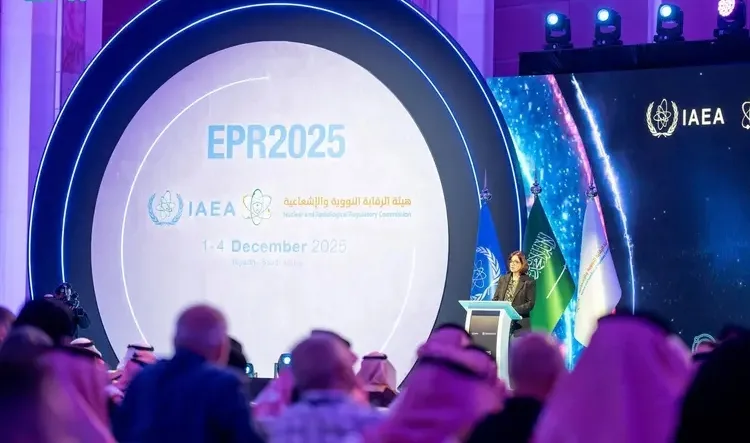
ASIATODAY.ID, RIYADH — The world’s nuclear emergency community gathered in Riyadh on Monday, December 1, 2025 as the International Conference on Preparedness and Response to Nuclear and Radiological Emergencies (EPR2025) officially opened. The four-day summit, organized by the International Atomic Energy Agency (IAEA) in partnership with Saudi Arabia’s Nuclear and Radiological Regulatory Commission (NRRC), brings together more than 700 global experts, over 120 scientific papers, and representatives from more than 100 countries.
Held under the theme “Building the Future in an Evolving World,” EPR2025 marks a historic milestone as the first-ever IAEA nuclear emergency conference held outside the agency’s headquarters. The event signals Riyadh’s rising role in shaping the global nuclear safety and emergency preparedness agenda.
A High-Stakes Gathering Amid Global Nuclear Uncertainty
With geopolitical tensions, nuclear modernization, and radiological threats on the rise, the Riyadh conference arrives at a critical moment. Delegates are set to discuss:
Best practices in nuclear emergency response
Strengthening national and international preparedness mechanisms
New technologies for real-time detection and crisis management
Frameworks for global coordination during cross-border nuclear events
A large parallel exhibition showcases innovative nuclear safety technologies, emergency response tools, and international best practices from leading governmental institutions and global companies.
Saudi Arabia’s Expanding Role in Nuclear Safety
In the opening ceremony, the NRRC emphasized how the concept of emergency preparedness is rapidly evolving due to emerging global realities. The commission highlighted the importance of proactivity, rapid communication, and integrated coordination among national institutions to build strong, future-ready nuclear safety systems.
Saudi Arabia’s selection as host underscores its growing international reputation in nuclear regulation and emergency readiness, supported by significant advancements in its national nuclear safety framework.
IAEA Calls for Stronger Global Cooperation
The IAEA stressed the necessity for countries to develop sustainable national capacities, strengthen local and international response systems, and deepen technical cooperation. The agency also pointed to the importance of real-time information exchange, updated regulatory instruments, and broader participation in international emergency response networks.
These platforms, in which Saudi Arabia plays an active role, are considered essential for raising global readiness levels and ensuring coordinated action during nuclear or radiological crises.
A New Era of Global Nuclear Preparedness
EPR2025 is expected to set new benchmarks for international nuclear emergency cooperation. Delegates will examine innovative strategies, review operational challenges, and reinforce mechanisms that link national efforts with global emergency response systems.
As nuclear risks continue to shape global security conversations, Riyadh’s hosting of EPR2025 places the Kingdom at the forefront of international initiatives aimed at minimizing the impact of nuclear and radiological emergencies—and strengthening collective global resilience. (AT Network)
Follow Us at Google News and WA Channel