
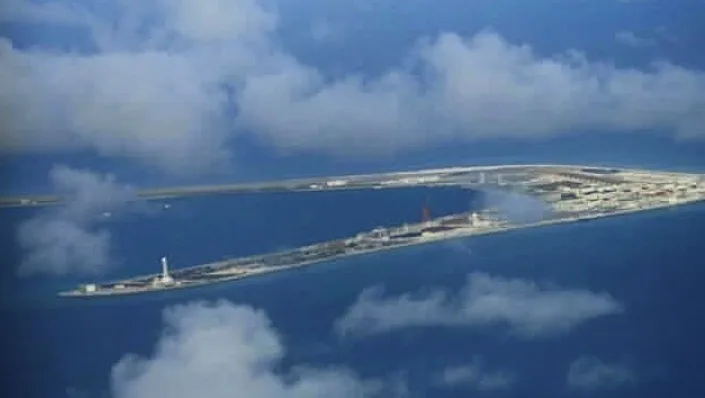
ASIATODAY.ID, JAKARTA — New satellite imagery analysis has intensified regional concerns after revealing that China has been steadily expanding its military infrastructure across the South China Sea.
Over the past few years, Beijing’s three largest artificial islands in the Spratly archipelago have undergone rapid development, featuring new facilities that significantly enhance intelligence, surveillance, electronic warfare, and layered defense capabilities — including those positioned close to sea lanes frequently used by Indonesia.
Recent satellite images captured between 2023 and 2024 show how far China has transformed previously submerged reefs into full-fledged military outposts. Long runways, deep-water ports, advanced radar systems, and hardened defense structures now dominate Fiery Cross Reef, Mischief Reef, and Subi Reef.
China’s “Historical Rights” Claim vs. the 2016 Arbitration Ruling
Beijing continues to assert control over nearly the entire South China Sea based on what it calls “historical rights”. This claim, however, was ruled to have no legal basis by the Permanent Court of Arbitration (PCA) in The Hague in 2016. China has rejected the ruling outright.
“The so-called ruling is nothing more than a piece of waste paper—illegal, invalid, and non-binding,” China’s Foreign Ministry spokesperson reiterated in July, insisting that the decision will not alter Beijing’s maritime claims.
New Military Facilities: Radomes, Radar, and Weapons Emplacements
The Asia Maritime Transparency Initiative (AMTI) at the Center for Strategic and International Studies (CSIS) has identified several key developments across China’s forward bases:
Subi Reef: Two newly installed radomes with designs identical to those at Fiery Cross Reef and Mischief Reef since 2017. These structures are believed to offer wide and overlapping ISR (intelligence, surveillance, reconnaissance) coverage across the South China Sea.
Mischief Reef: Satellite imagery reveals three sets of three hardened emplacements built in 2023. Analysts believe these positions are suitable for mobile artillery or rocket launchers, significantly boosting the outpost’s defensive power.
Fiery Cross Reef: Continues to function as China’s main command center, equipped with a 3,000-meter runway and long-range radar arrays, all of which have undergone incremental upgrades.
“AMTI underscores that the ongoing upgrades are not simply new construction projects but an integrated strategy to establish unmatched ISR dominance in the South China Sea, while also providing Beijing with the ability to disrupt electromagnetic spectrum use by other militaries in the event of conflict,” AMTI stated quoted on Sunday, December 7, 2025.
Rising Tensions: U.S., Philippines, Vietnam — and Indonesia Watches Closely
China’s military expansion has prompted responses from several countries. The United States continues to conduct Freedom of Navigation Operations (FONOPs), while strengthening joint patrols with the Philippines amid escalating confrontations with the China Coast Guard.
Vietnam, meanwhile, has also expanded land reclamation on its occupied features in the Spratly Islands. Beijing has protested these moves, calling them construction activities on “illegally occupied” islands and reefs.
For Indonesia, the growing military footprint lies close to strategic maritime routes near the North Natuna Sea. Although Indonesia is not a claimant in the Spratly dispute, any escalation or militarization in the area directly affects its maritime security environment.
The latest satellite imagery confirms that the South China Sea is becoming one of the most militarized zones in Asia. With rapidly expanding bases, layered defense networks, and wide-area surveillance capabilities, China is reinforcing a position that allows it to project power, monitor regional military activity, and defend its sweeping maritime claims — including areas uncomfortably close to Indonesia’s waters. (AT Network)
Follow Us at Google News and WA Channel