
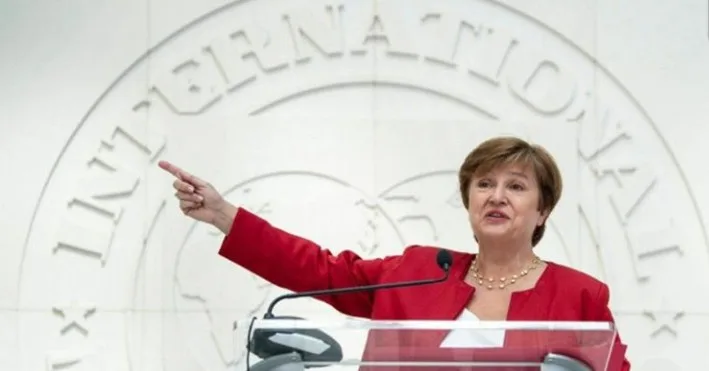
ASIATODAY.ID, SHANGHAI — In a bold and forward-looking address, IMF Managing Director Kristalina Georgieva declared that Asia is on track to become the new intellectual powerhouse of global economics.
The statement was delivered during the inauguration of the China–IMF Capacity Development Center—an ambitious research hub designed to strengthen Asia’s role in shaping economic policy worldwide.
Speaking at the opening ceremony on December 8, 2025, Georgieva emphasized that the Center is not merely a building, but a strategic bridge of knowledge, connecting global expertise with Asia’s dynamic academic community.
Overlooking the scenic Huangpu River, she described the Center as the ideal environment for developing the next generation of policy ideas that can respond to global challenges.
Asia as the IMF’s New Global Laboratory
Georgieva said the launch comes at a time of massive global transformation—driven by shifting geopolitics, rapid technological advances, demographic transitions, and the accelerating climate crisis. These changes, she stressed, demand innovative, research-backed policy frameworks.
“To truly understand today’s economic transformations, the IMF must be deeply connected to policy debates on the ground,” she noted.
The new Center will significantly enhance IMF engagement across the Asia-Pacific region, producing high-quality macroeconomic research tailored to the needs of emerging markets and middle-income economies.
Asia’s Growth Engines—And the New Challenges Ahead
Reflecting on Asia’s remarkable economic achievements, Georgieva highlighted three key drivers of the region’s decades-long success:
1. A rapidly expanding labor force, which is now slowing;
2. A shift toward greater private-sector participation as governments scaled back direct economic control;
3. A massive reallocation of labor from low-productivity sectors like agriculture to high-productivity industries such as manufacturing and services.
This transformation cut poverty at a record pace and delivered a better life for billions.
But as populations age and growth patterns shift, Georgieva stressed the urgent need for a new model driven by higher productivity and more efficient resource allocation.
A New Research Agenda: AI, Regulatory Reform, and Global Trade
The Managing Director outlined three central research pillars that will guide the Center’s work—domains that hold the key to future growth and stability:
1. Business Climate and Regulatory Reform
The IMF will explore how economies can unlock private-sector dynamism by removing bureaucratic obstacles and outdated regulations that no longer serve their purpose. Georgieva described regulatory modernization as an essential act of “economic self-help.”
2. Harnessing Advanced Technologies and AI
Artificial intelligence, she noted, could add 0.1 to 0.8 percentage points to annual global growth. Yet AI also presents risks, including labor market disruption and inequality. Policies must ensure that benefits are widely shared, and research will help determine how countries can manage this transition.
3. Sustaining Trade Amid Global Shifts
With global trade patterns evolving, deeper regional integration is essential. In Asia, reducing non-tariff barriers alone could boost GDP by up to 1.8% in the long term. Identifying and addressing the precise obstacles to trade will be a core research priority.
Asia’s “Triple Transformation”
According to Georgieva, Asia is undergoing a rare convergence of three structural shifts: demographic change, a reconfigured global trade landscape, and the rise of artificial intelligence.
Understanding how policies should adapt to this triple transformation will be one of the Center’s most important contributions.
A Two-Way Channel of Global Knowledge
Georgieva reiterated that the Center will serve as a two-way transmission line, where the IMF not only shares global best practices but also learns from the experiences of Asian economies.
“I have the highest hopes for this Center,” she said. “It will deepen our understanding of economic challenges and help us deliver the best possible analysis and advice to our members—across emerging Asia and beyond.”
She concluded by dedicating the Center to the pursuit of wisdom, envisioning it as a collaborative space for intellectual exploration and a source of solutions to some of the world’s most pressing economic problems. (AT Network)
Follow Us at Google News and WA Channel