
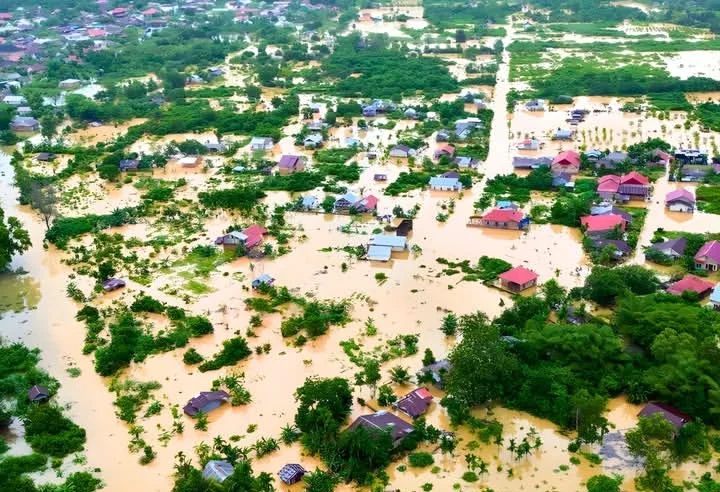
ASIATODAY.ID, GENEVA – The world is still dangerously unprepared for escalating climate and weather extremes.
A new joint report from the World Meteorological Organization (WMO) and the United Nations Development Programme (UNDP) exposes the urgent need for countries to shift from reactive disaster response to proactive, risk-informed development backed by hard data.
The publication, Mapping the Impact and Informing Economic Resilience: An Analysis of Post-Disaster Needs Assessment (PDNAs), responds to growing global demand for sector-specific, credible, and standardized evidence to accelerate recovery and strengthen national resilience systems.
Disasters Are Intensifying — But the Data Gap Is Widening
Drawing on 91 PDNAs from 2000 to 2024, the report analyzes the devastating impacts of tropical cyclones, floods, and droughts across critical sectors including agriculture, housing, transport, education, health, industry, and water and sanitation.
Covering Africa, Asia-Pacific, the Americas, and Europe, the report presents a rare cross-regional view of where losses are concentrated and which systems remain critically exposed.
“The rising frequency and intensity of weather, climate, and water-related hazards are shaking the foundations of global development,” writes WMO Deputy Secretary-General Ko Barrett on December 11, 2025.
“No sector is spared from the rapidly growing risks of a changing climate.”
Key findings reveal:
The heaviest economic losses consistently affect agriculture, housing and settlements, and transport.
Huge disparities in the quality, consistency, and completeness of disaster loss data.
Only 20% of PDNAs involved National Meteorological and Hydrological Services (NMHSs)—a major gap in scientific grounding.
Urgent need for standardized hazard attribution and sectoral impact classification to strengthen recovery planning.
Rebuild Faster, But Also Stronger: The Call to Break the Cycle
A central message of the report is clear: many countries remain trapped in a destructive loop of “damage, rebuild, repeat” because recovery efforts prioritize speed over long-term resilience.
The report urges governments to:
Align reconstruction with national climate adaptation and development plans.
Adopt safer construction standards and climate-resilient infrastructure.
Support diversified, climate-resilient livelihoods.
Integrate impact-based forecasting and climate services into every recovery decision.
These measures help countries reduce long-term losses, protect critical assets, and prepare systems to withstand more frequent and severe climate shocks.
NMHSs: The Scientific Backbone of Recovery — Still Overlooked
One of the most alarming findings is the limited involvement of National Meteorological and Hydrological Services in PDNAs. Despite being the authoritative source of early warnings, hazard attribution, climate services, and risk modeling, NMHSs are often left out of national recovery processes.
Their limited engagement results in: weaker scientific accuracy of disaster impact assessments, misaligned recovery investments, and missed opportunities to build climate-resilient development pathways.
The report calls for:
Systematic and mandatory integration of NMHSs into assessment and recovery frameworks,
Greater investments in observation networks, forecasting technologies, and data systems,
Expanded use of socioeconomic benefit analyses,
Closer collaboration between NMHSs, sector ministries, and local authorities.
Fully empowered NMHSs can transform PDNAs from backward-looking damage reports into forward-looking resilience strategies rooted in science.
Five Global Lessons for a More Resilient Future
1. Sectoral impacts are predictable and preventable. Agriculture, housing, and transport should be top priorities for risk reduction.
2. “Build Back Better” must be a universal recovery principle. Resilient reconstruction saves money and lives.
3. NMHSs must be central to national planning. Their data strengthens the accuracy, credibility, and effectiveness of PDNAs.
4. Early warning systems are non-negotiable. They save lives, protect livelihoods, and reduce economic losses.
5. Global standards for hazard and sectoral data are essential. Better data leads to better decisions.
Together, these insights provide a clear, practical roadmap for countries seeking to safeguard development gains in an era of escalating climate and disaster risks. (AT Network)
Follow Us at Google News and WA Channel