
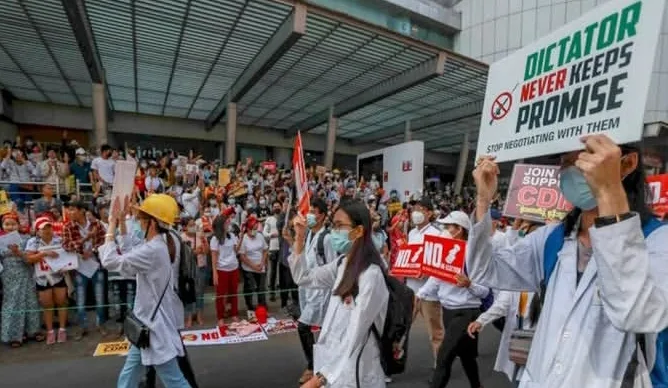
ASIATODAY.ID, YANGON — Myanmar’s military-controlled elections, scheduled for 28 December 2025, are unfolding in an atmosphere of fear, violence, and systematic repression, with civilians coerced from all sides, the United Nations has warned.
According to the UN, voters are being forced by the military to participate, while armed opposition groups are threatening violence against those who take part, creating what human rights officials describe as a climate incompatible with any form of free or credible democratic process.
UN High Commissioner for Human Rights Volker Türk issued a stark warning, saying the elections are taking place under conditions that strip citizens of their most basic political freedoms.
“These elections are clearly taking place in an environment of violence and repression,” Türk said on December 23, 2025.
“There are no conditions for the exercise of the rights to freedom of expression, association, or peaceful assembly.”
The first phase of voting is being organized by Myanmar’s military authorities more than four years after the 2021 coup, which saw the junta seize power, dissolve major political parties, and imprison thousands of political opponents.
Key democratic leaders, including former State Counsellor Aung San Suu Kyi, remain behind bars.
Since the coup, Myanmar has plunged into widespread armed conflict, economic collapse, and mass displacement, a crisis further exacerbated by devastating earthquakes in March 2025, which deepened humanitarian suffering across large swathes of the country.
Dissent Criminalised, Sentences Stretching for Decades
The UN human rights office (OHCHR) reports that dozens of people have recently been detained under a newly enacted “election protection law” for expressing dissent.
In some cases, punishments have been extraordinarily severe. In Yangon’s Hlaingthaya Township, three young people were sentenced to between 42 and 49 years in prison for hanging anti-election posters.
Prominent cultural figures have also been targeted. Film director Mike Tee, actor Kyaw Win Htut, and comedian Ohn Daing were each sentenced to seven years in prison for “undermining public trust” after criticising a pro-election propaganda film.
For internally displaced people (IDPs), the pressure has been even more extreme. The UN has received reports from displacement camps in the Mandalay region that residents were warned their homes would be confiscated or airstrikes would continue if they failed to return to vote.
“Forcing displaced people to undertake unsafe and involuntary returns constitutes a serious human rights violation,” Türk said.
Threats from Armed Opposition Groups
At the same time, armed groups opposing the military have issued their own threats against election participation.
In mid-November, nine women teachers travelling to attend election training in Myanmar’s Mon region were reportedly abducted and later released with explicit warnings not to engage in the voting process.
In Yangon, a self-declared group calling itself the “Yangon Army” bombed local administrative offices involved in election preparations, injuring election staff and vowing to continue attacks against organisers.
The UN has also expressed deep concern over the planned introduction of electronic-only voting systems, combined with expanded state surveillance using artificial intelligence and biometric technologies, warning that such measures could further erode public trust and enable political repression.
UN Pushes for an End to Violence
Speaking at UN Headquarters in New York, UN spokesperson Stéphane Dujarric said that Special Envoy Julie Bishop recently completed her third visit to Myanmar, where she again met with junta leader Senior General Min Aung Hlaing.
During the visit, Bishop stressed the urgent need for a cessation of violence to allow humanitarian access, recovery efforts, and the pursuit of a Myanmar-led, inclusive, and peaceful political solution. She has since briefed the UN Security Council in a closed-door session.
Fears of Deeper Instability
UN officials have repeatedly cautioned that elections held under the current conditions risk entrenching instability rather than restoring democracy.
In October, the UN Secretary-General warned that such polls could lead to “further exclusion and instability,” reinforcing concerns that the military’s electoral roadmap may deepen Myanmar’s political and humanitarian crisis instead of resolving it.
As violence escalates on all fronts and civilians remain trapped between coercion and retaliation, Myanmar’s elections are increasingly viewed by the international community not as a path to legitimacy—but as a catalyst for further chaos. (AT Network)
Follow Us at Google News and WA Channel