
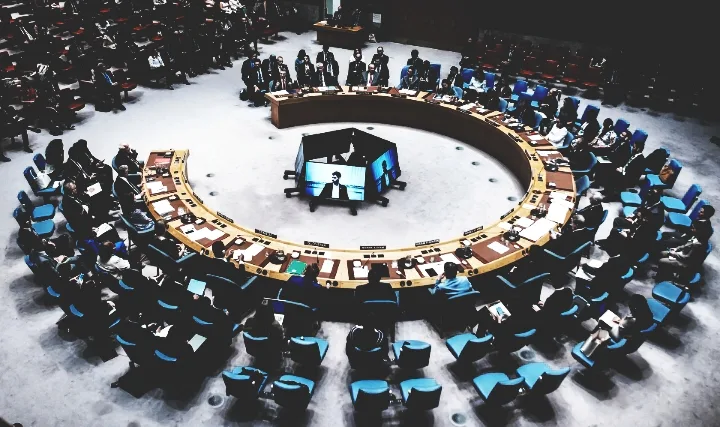
ASIATODAY.ID, NEW YORK — Five new nations took their seats at the United Nations Security Council this month, injecting fresh faces into the world’s most powerful diplomatic body.
Yet any sense of renewal is immediately overshadowed by deepening geopolitical rifts, escalating veto use, and a rapidly deteriorating humanitarian catastrophe in Gaza that continues to claim civilian lives.
Bahrain, Colombia, the Democratic Republic of the Congo, Latvia, and Liberia have begun their two-year terms as non-permanent members for 2026–2027, replacing Algeria, Guyana, the Republic of Korea, Sierra Leone, and Slovenia.
They join fellow non-permanent members Denmark, Greece, Pakistan, Panama, and Somalia, alongside the five permanent powers — China, France, Russia, the United Kingdom, and the United States — whose veto authority continues to define the Council’s limits.
The Security Council: Power, Paralysis, and the Veto
Under the UN Charter, the Security Council bears primary responsibility for maintaining international peace and security. Its resolutions are legally binding, granting it authority to impose sanctions, authorize peacekeeping missions, and, in exceptional cases, approve the use of force.
In practice, however, the Council’s effectiveness is increasingly constrained. Political divisions over Ukraine and the Middle East have fueled a sharp rise in veto use.
While vetoes were rare in the decades following the Cold War, they have surged in recent years — seven times in 2023 and eight times in 2024 — highlighting a growing inability to forge consensus.
Diplomats warn that this trend reflects a broader erosion of multilateral cooperation, leaving the Council struggling to respond decisively to global crises.
Somalia Takes the Helm
For January, Somalia assumes the rotating presidency of the Security Council. The role carries significant influence: setting the agenda, chairing meetings, and issuing statements on behalf of the Council. It also demands a delicate balance — acting as an impartial broker while advancing national interests.
After a turbulent 2025 marked by expanding warfare, shrinking humanitarian funding, and intensifying political polarization, 2026 will test whether the Council’s new configuration can break entrenched deadlock or merely manage it.
Gaza: Winter Storms Deepen Humanitarian Disaster
As diplomacy falters, conditions on the ground in Gaza continue to worsen. Severe winter storms have battered already devastated neighborhoods, flooding camps and destroying tents housing displaced families.
Humanitarian agencies estimate that more than one million people — nearly half of Gaza’s population — urgently require shelter assistance. Water, sanitation, and hygiene systems are under extreme strain, while fuel shortages and limited access to landfills have caused waste to accumulate, raising the risk of disease outbreaks.
UNICEF-supported teams remove approximately 1,000 tons of solid waste each month in an effort to protect children and vulnerable families.
In the West Bank, the demolition of 25 buildings in the Nur Shams refugee camp has displaced around 70 families, further compounding humanitarian needs amid winter conditions.
UN Warns Israeli Restrictions Risk Lives
The United Nations has issued stark warnings over new Israeli restrictions on international non-governmental organizations (NGOs), cautioning that the measures could severely undermine humanitarian operations at a moment of acute need.
UN Secretary-General António Guterres expressed deep concern, urging Israeli authorities to reverse the proposed measures. UNRWA Commissioner-General Philippe Lazzarini warned that the restrictions, coupled with legislation targeting UNRWA, form a “troubling pattern” that threatens humanitarian neutrality, independence, and effectiveness.
“People in Gaza need more aid, not less — simply to survive,” Lazzarini said, warning that further constraints could have immediate and fatal consequences for civilians dependent on humanitarian assistance.
Death Penalty Proposals Trigger Human Rights Alarm
Adding to international concern, UN High Commissioner for Human Rights Volker Türk has called on Israel to abandon draft legislation proposing mandatory death sentences that would apply exclusively to Palestinians.
Türk warned that the proposals violate international human rights and humanitarian law, undermine due process, and breach the right to life. He stressed that the UN opposes the death penalty in all circumstances, citing the irreversible risk of executing innocent individuals and the discriminatory nature of the proposed measures.
The draft laws would also allow retroactive application, a clear violation of the principle of legality under international law, according to the UN rights office.
Regional and Global Pressure Mounts
Diplomatic pressure is intensifying. Indonesia, alongside the United Arab Emirates, Jordan, Pakistan, Türkiye, Saudi Arabia, Qatar, and Egypt, issued a joint statement expressing grave concern over Gaza’s humanitarian collapse.
The ministers called for unrestricted humanitarian access, protection of UN agencies and NGOs, and full implementation of relevant UN Security Council resolutions and the comprehensive peace framework.
They emphasized that nearly 1.9 million displaced people in Gaza are exposed to flooding, cold temperatures, malnutrition, and disease, urging immediate early recovery efforts and the provision of dignified, durable shelter.
A Defining Test for Global Governance
As new members settle into the iconic horseshoe table at UN headquarters, expectations remain low but stakes could not be higher. Whether 2026 marks a turning point for the Security Council or further entrenches paralysis will be measured not by statements or resolutions alone, but by tangible action.
For Gaza’s civilians, trapped between war, winter, and political deadlock, the question is no longer about diplomacy — it is about survival. (AT Network)
Follow Us at Google News and WA Channel