
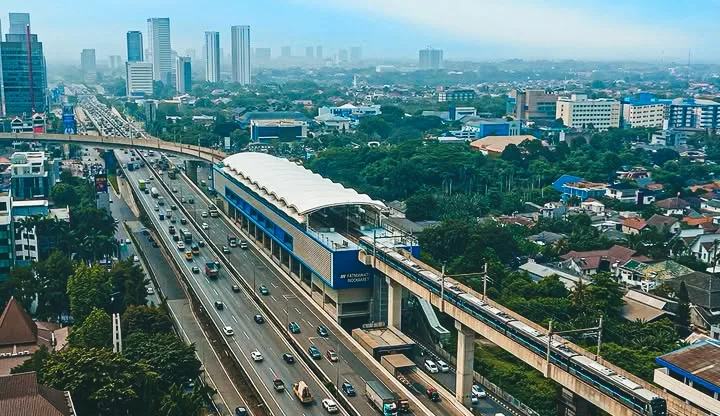
ASIATODAY.ID, JAKARTA — The dismantling of long-abandoned monorail pillars along HR Rasuna Said is a clear policy statement: Jakarta no longer needs a monorail.
Once envisioned as a modern transport solution, the monorail has become a relic of stalled ambition—overshadowed by a far more advanced, integrated, and functional public transport system now serving millions of residents every day.
Jakarta has moved on. And it has done so decisively.
A Legacy Project Left Behind
The monorail was conceived at a time when Jakarta lacked mass rapid transit, light rail, and a mature bus rapid transit system. Decades later, the project remains incomplete—entangled in regulatory disputes, financing failures, and legal uncertainty—leaving behind concrete pillars that scarred one of the capital’s most strategic corridors.
Governor Pramono Anung’s decision to remove the structures marks the end of a long policy limbo. The redevelopment of HR Rasuna Said, a core business and diplomatic district, is now proceeding under full legal supervision, signaling Jakarta’s commitment to certainty, transparency, and urban quality.
The message is unmistakable: the city is choosing functionality over nostalgia.
Jakarta’s Public Transport System Has Already Overtaken the Monorail Idea
Rather than reviving an obsolete concept, Jakarta has invested heavily in proven, high-capacity transport modes that now form the backbone of urban mobility.
MRT Jakarta: The Urban Backbone
MRT Jakarta has set a new standard for rapid transit in Indonesia. Carrying millions of passengers each month, it offers speed, reliability, and comfort comparable to metro systems in global cities such as Tokyo, Seoul, and Singapore. Ongoing network expansions further reinforce its role as Jakarta’s core mobility spine.
LRT Jakarta: Efficient Medium-Capacity Connectivity
The Light Rail Transit system complements MRT by serving medium-distance corridors and specific urban clusters. While smaller in scale, LRT continues to grow and is fully integrated with other transport modes—something the monorail never achieved.
Commuter Line (KRL): The Lifeline of Greater Jakarta
The KRL Commuter Line is indispensable. Connecting Jakarta with Bogor, Depok, Tangerang, and Bekasi, it supports millions of daily trips across the metropolitan region. Without it, Jakarta’s economy would grind to a halt—making the monorail redundant by comparison.
TransJakarta: Southeast Asia’s Largest BRT Network
TransJakarta remains the city’s most extensive and heavily used public transport system. With dozens of corridors, thousands of buses, and expanding electric fleets, its capacity, reach, and adaptability far exceed what a monorail could ever deliver.
Integration Matters More Than Adding New Modes
All these systems—MRT, LRT, KRL, TransJakarta, feeder buses, and microtrans—are unified under Jak Lingko, Jakarta’s integrated transport ecosystem. One fare system, seamless transfers, and coordinated planning have transformed how residents move across the city.
Within this framework, a monorail would add little value: Limited route flexibility, High capital and maintenance costs, Complex integration and Lower capacity compared to MRT, KRL, or BRT.
In short, it would be an inefficient addition to an already mature system.
Public Investment Priorities Have Shifted
Jakarta’s transport budget is now focused on:
– Pedestrian-friendly and disability-inclusive sidewalks
– Road geometry improvements and drainage
– Integrated bus stops and transit hubs
– Low-emission and electric public transport
– Urban design that prioritizes people over vehicles
These priorities align with Jakarta’s ambition to become a sustainable, competitive global city, rather than one chasing prestige projects with questionable utility.
A City That Has Outgrown the Monorail
The removal of the monorail pillars is symbolic—but powerful. It marks Jakarta’s transition from speculative megaprojects to evidence-based urban mobility planning.
With an expanding MRT, a region-wide commuter rail system, a growing LRT network, and one of the world’s largest BRT systems, Jakarta is not lacking transport modes.
What it needs—and is now delivering—is integration, reliability, and long-term vision.
Jakarta does not lack transport infrastructure.
It has simply chosen to leave the monorail in the past—where it belongs. (ATN)
Follow Us at Google News and WA Channel