
ASIATODAY.ID, WASHINGTON – Indonesia is once again capturing global attention. The International Monetary Fund (IMF) has lauded Indonesia as a bright spot in a turbulent world, citing strong economic growth, controlled inflation, and solid fiscal management, while urging the country to pursue bold structural reforms to unlock its full potential as a high-income nation.
IMF Highlights Steady Growth Amid Global Uncertainty
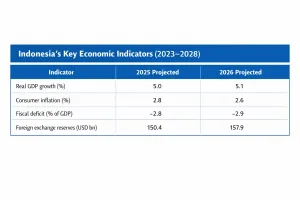
In the 2025 Article IV Consultation, the IMF Executive Board projected Indonesia’s GDP growth at 5.0% in 2025 and 5.1% in 2026, despite rising global trade tensions and financial market volatility.
Inflation is expected to remain well-anchored, while the current account deficit is forecast to stay manageable, supported by healthy foreign exchange reserves.
“Indonesia’s economic resilience is remarkable,” the IMF noted on January 22, 2026, highlighting sound fiscal and monetary policies as key drivers.
The IMF also flagged structural reforms in trade, deregulation, and private sector development as critical levers for future growth.
Prudent Policies and a Roadmap for Reform
The IMF praised Indonesia’s commitment to fiscal discipline, emphasizing the importance of carefully executed public spending, stronger revenue mobilization, and oversight of quasi-fiscal activities.
On monetary policy, the IMF noted that recent easing measures were justified to support growth, but called for a data-driven and coordinated approach with fiscal policy, while maintaining the rupiah as a shock absorber.
“Preserving policy credibility and space is crucial in today’s uncertain global environment,” the IMF said, urging Indonesia to balance stability with bold reforms.
Unlocking High-Income Potential Through Structural Change
IMF officials emphasized that ambitious structural reforms are essential for Indonesia to achieve high-income status by 2045. Key areas include:
– Deregulation to streamline business processes
– Investment in education and digital infrastructure
– Trade openness, including removal of non-tariff barriers
– Sustainable energy transition and climate policies
These reforms aim to strengthen private sector-led growth, boost productivity, and create jobs-rich, inclusive development.
Indonesia’s main exports remain base metals (18%), coal (14%), palm oil (8%), and oil & gas (8%), while private consumption and investment continue to support domestic demand.
Indonesia on the Global Stage
The IMF concludes that Indonesia continues to shine amid global challenges, but realizing its full potential will require a combination of disciplined economic management and daring reforms. With the right policies, Indonesia could emerge as a model for sustainable, inclusive growth in the 21st century, strengthening its position in the global economy. (AT Network)
Follow Us at Google News and WA Channel