
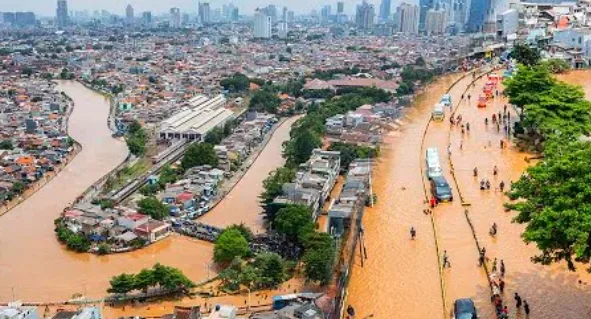
ASIATODAY.ID, JAKARTA – Every rainy season, Jakarta relives the same crisis. Rivers overflow, neighborhoods submerge, traffic collapses, and thousands of residents are displaced. Flooding has become an annual ritual rather than an emergency—an indication that the problem runs far deeper than heavy rainfall.
Jakarta’s floods are not simply natural disasters. They are the visible outcome of urban planning failures, fragmented governance, and short-term political decision-making. In a world facing accelerating climate change, cities that fail to adapt will drown—literally and figuratively.
Yet Jakarta is not alone. Many global cities face similar hydrological risks. The difference lies in how some have learned to live with water—while others continue to fight it.
Rotterdam: Designing a City That Makes Room for Water
Rotterdam, in the Netherlands, sits largely below sea level. By logic alone, it should be one of the most flood-prone cities in the world. Instead, it is a global model for flood resilience.
Rather than treating water as an enemy, Rotterdam redesigned its urban fabric to absorb, store, and delay water. Public squares double as temporary retention basins.
Parks and plazas transform into reservoirs during extreme rainfall. This water-sensitive urban design allows floods to be controlled rather than catastrophically released.
Jakarta, by contrast, continues to rely heavily on concrete embankments and river normalization. Water is forced to move faster, with nowhere to pause—eventually overwhelming neighborhoods downstream.
Tokyo: Quiet Infrastructure Beneath a Mega-City
Tokyo faces intense rainfall, dense development, and limited natural drainage—conditions strikingly similar to Jakarta. The difference lies in long-term infrastructure discipline.
Japan built one of the world’s largest underground flood control systems, known as the Metropolitan Area Outer Underground Discharge Channel (G-Cans). This massive subterranean network silently captures overflow from rivers and channels it away from populated areas.
The project is not flashy. It offers no political spectacle. But it works—because it was designed to function over decades, not election cycles.
Jakarta’s challenge is not technological incapacity. It is the absence of policy continuity and institutional consistency.
Singapore: Treating Flooding as a Governance Failure
In Singapore, flooding is treated as a systemic error, not an act of nature. Even minor waterlogging triggers investigation: Was the drainage insufficient? Was land-use regulation violated? Was maintenance neglected?
Flood management in Singapore is fully integrated with housing, transportation, green spaces, and building permits. Canals are recreational corridors. Reservoirs serve as public parks. Every new development must meet strict hydrological standards.
Jakarta still separates flood control from zoning, construction permits, and environmental protection. This fragmentation ensures that each solution cancels out another.
Seoul: Correcting the Mistakes of Modernization
Seoul offers a powerful lesson in urban humility. In the past, the city buried the Cheonggyecheon Stream under highways to symbolize progress. The consequences were severe: rising temperatures, worsening floods, and environmental degradation.
Rather than defending past mistakes, Seoul dismantled the highway and restored the river. The result was transformative—reduced flood risk, improved air quality, and revitalized public space.
Jakarta continues to debate whether rivers should be controlled or restored, while other cities have already proven that urban ecological recovery is not regression—it is resilience.
Jakarta in the Age of Climate Change
Climate change has intensified rainfall patterns, making floods more frequent and unpredictable. In this context, Jakarta’s floods are no longer local problems—they are warnings of a broader urban climate crisis.
What makes Jakarta particularly vulnerable is not rainfall alone, but institutional fragmentation. Rivers, drainage, land use, and coastal protection are governed separately, often with competing priorities. Without integrated planning, no flood control system can succeed.
Key Lessons from Flood-Resilient Cities
From cities that have significantly reduced flood risk, several principles emerge:
– Water must be given space, not merely diverted.
– Urban planning matters more than short-term engineering fixes.
– Policy consistency across administrations is essential.
– Restoring urban ecosystems is more effective than excessive concreting.
– Flooding reflects governance choices—not geographic destiny.
Jakarta possesses the technology, expertise, and financial capacity to change course. What remains uncertain is whether it has the political courage to prioritize long-term resilience over short-term convenience.
The Measure of a Modern City
In the 21st century, a city’s greatness is no longer defined by skyscrapers or megaprojects. It is defined by its ability to protect its citizens from climate extremes.
Cities around the world have demonstrated that coexistence with water is possible. Jakarta now faces a choice: continue repeating the same mistakes—or finally learn from cities that have already adapted.
Because in the era of climate change, the most successful cities are not those that conquer nature—but those that understand it. (ATN)
Follow Us at Google News and WA Channel