
ASIATODAY.ID, JAKARTA — Indonesia has reaffirmed that its transition toward a green economy must go beyond emissions reduction and environmental commitments.
The government is placing green downstreaming at the heart of its strategy to ensure that the energy transition generates industrial value, quality jobs, and long-term economic competitiveness.
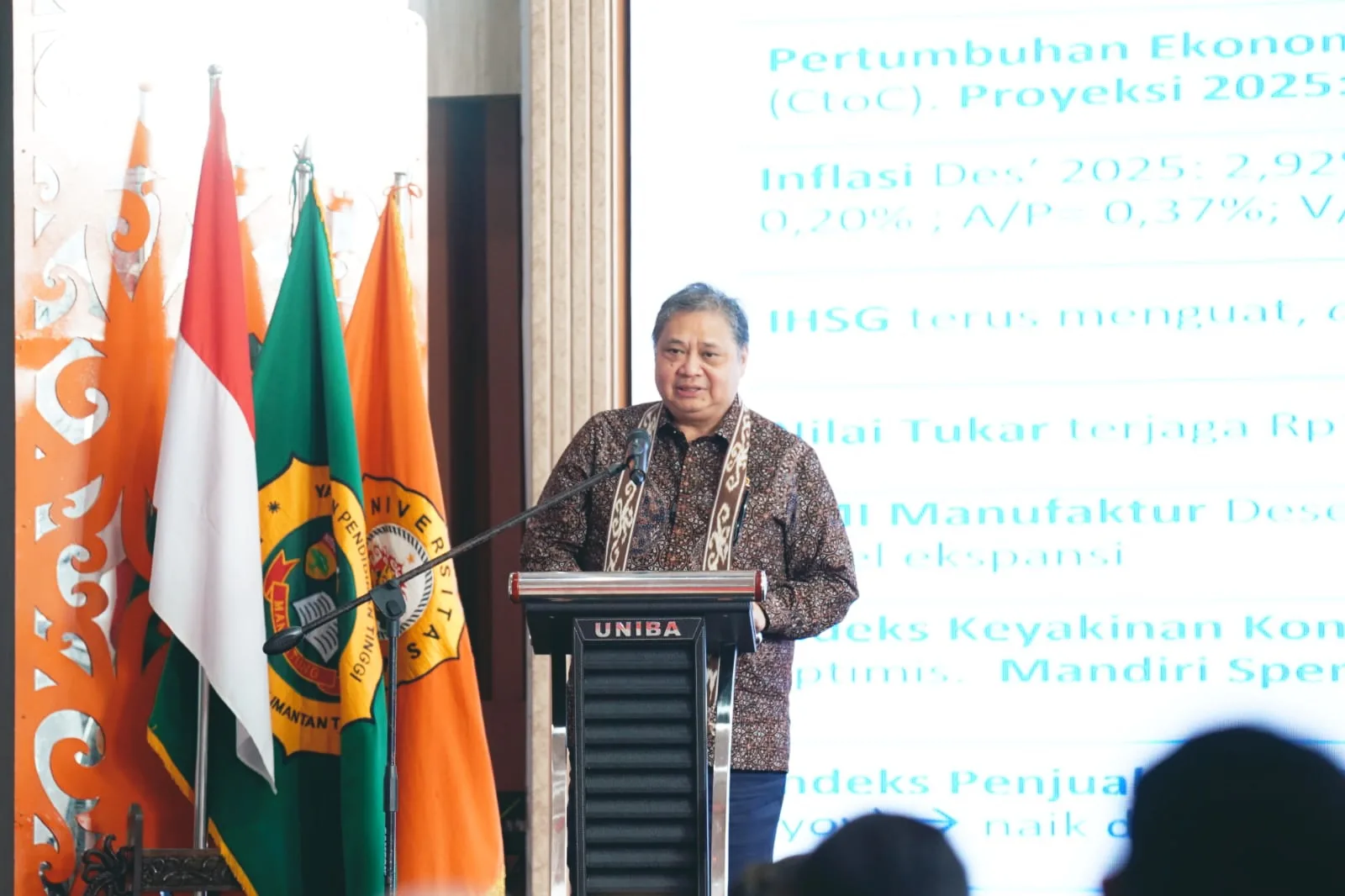
Speaking at the National Seminar on a Just Energy Transition and Opportunities for Green Jobs and the Green Economy at the University of Balikpapan on Tuesday, January 27, 2026, Coordinating Minister for Economic Affairs Airlangga Hartarto stressed that sustainability without industrial value creation would not be economically viable.
“The green transition must be supported by strong industrial downstreaming. Without value-added processing, a green economy cannot be sustainable,” Airlangga said.
Green Downstreaming as the Backbone of Economic Transformation
Aligned with Indonesia’s Asta Cita development vision and its Nationally Determined Contribution (NDC) target—cutting greenhouse gas emissions by 31.89% by 2030 through domestic efforts, and up to 43.20% with international support—the government is advancing the green economy through three main pillars: green energy, green economy, and green jobs.
Within this framework, green downstreaming is positioned as the backbone of economic transformation—shifting Indonesia away from raw material exports toward low-carbon, high–value-added manufacturing.
Key priorities include the processing of silica sand into solar panels, the utilization of nickel, cobalt, and other strategic minerals for electric vehicle (EV) batteries, and the development of integrated domestic supply chains for clean energy technologies.
“Indonesia does not want to remain a raw material exporter. Green downstreaming is our pathway to moving up the global value chain,” Airlangga emphasized.
Macroeconomic Stability Supports Green Industrialization
The push for green downstreaming is underpinned by Indonesia’s resilient macroeconomic fundamentals. Economic growth reached 5.04% year-on-year in Q3 2025, while inflation remained under control at 2.92% year-on-year in December 2025.
Investor and consumer confidence has remained strong, reflected in:
– Manufacturing PMI in expansionary territory at 51.2,
– Consumer Confidence Index at an optimistic 123.5, and
– Total foreign and domestic investment realization in 2025 reaching IDR 1,931 trillion, up 12.7% year-on-year.
These conditions provide fiscal space and financial stability to accelerate investment in green manufacturing and clean energy infrastructure.
Clean Energy to Power Value-Added Industry
Indonesia’s vast renewable energy potential—estimated at 3,686 GW, with Kalimantan contributing around 517 GW, mainly from solar—forms the foundation for green industrial hubs.
To support downstream industries, the government is advancing: A 70,000-kilometer green super grid, B40–B50 biofuel programs, Development of sustainable aviation fuel, Deployment of hydrogen, green ammonia, nuclear energy, and Carbon Capture and Storage / Utilization (CCS/CCUS) technologies to decarbonize industrial processes.
These initiatives are designed to ensure that downstream industries are powered by clean, reliable, and affordable energy, significantly reducing industrial carbon footprints.
Millions of Green Jobs Ahead
Beyond environmental benefits, green downstreaming is projected to create approximately 4.4 million new jobs by 2029. Green employment is expected to account for around 3% of Indonesia’s total workforce, particularly in renewable energy manufacturing, EV battery production, strategic mineral processing, and low-carbon technologies.
To prepare the workforce, the government has launched a National Internship Program targeting 100,000 university graduates, offering stipends equivalent to the minimum wage.
“The government is building the ecosystem and setting the policy direction. Young Indonesians must prepare themselves to take strategic roles in the green industrial economy of the future,” Airlangga concluded.
The seminar was attended by senior officials from the Coordinating Ministry for Economic Affairs, the leadership of the University of Balikpapan, the Mitra Hijau Foundation, and representatives of the Action Network South East Asia. (AT Network)
Follow Us at Google News and WA Channel