
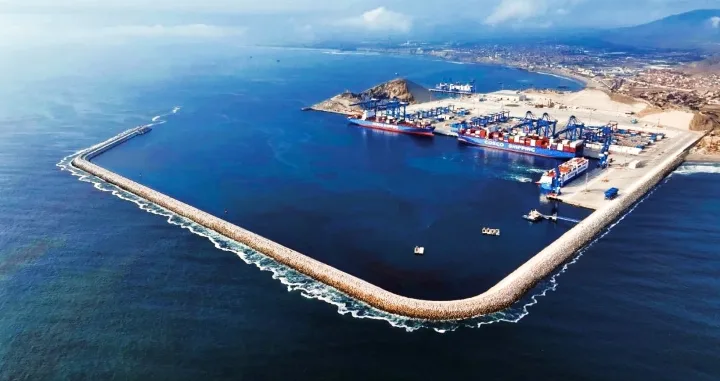
ASIATODAY.ID, WASHINGTON – Geopolitical tensions between the United States and China are escalating once again — this time over Peru’s strategic Chancay megaport.
Washington has warned that Peru risks “losing its sovereignty” due to Chinese ownership of the major Pacific port, intensifying the broader US–China rivalry across Latin America.
US Warns of ‘Predatory’ Chinese Ownership
The US State Department’s Bureau of Western Hemisphere Affairs voiced concern after a Peruvian court temporarily restricted the authority of state regulator Ositran to supervise the Port of Chancay.
The port is owned and operated by a local subsidiary of Cosco Shipping, which acquired a 60% stake in the $1.3 billion project in 2019. The facility is classified as a private port for public use rather than a state concession.
In a post on X, the bureau described the arrangement as “predatory Chinese ownership,” warning:
“Cheap Chinese money costs sovereignty.”
The remarks align with the strategic posture of US President Donald Trump, whose administration has prioritized limiting Beijing’s influence in what Washington considers its traditional sphere of influence — the Western Hemisphere.
Beijing Rejects ‘False Accusations’
China swiftly dismissed the US claims as “false accusations and disinformation.”
Cosco has emphasized that the court ruling concerns a regulatory fee dispute and “in no way involves aspects of sovereignty.” The company filed a constitutional complaint arguing that Ositran overstepped its authority by imposing charges designed for state-run concessions.
A Peruvian judge sided with the Chinese firm, temporarily curbing the regulator’s oversight.
A Strategic Trade Gateway
Chancay is Peru’s fourth-largest port and is widely seen as a transformative infrastructure project designed to strengthen trade links between South America and Asia.
China has been Peru’s largest trading partner for more than a decade, with bilateral trade expanding significantly through infrastructure investment, mining partnerships, and logistics development.
The megaport is expected to shorten shipping times to Asia and reinforce Beijing’s economic footprint in the Pacific corridor.
Part of a Broader US–China Contest in Latin America
Washington’s warning reflects a broader pattern of efforts to counter China’s expanding role in Latin America.
The US National Security Strategy explicitly calls for preventing non-Western “competitors” from owning or controlling critical infrastructure assets in the Western Hemisphere.
Critics argue that the US approach blends diplomatic pressure, economic leverage, and security rhetoric while invoking the language of sovereignty.
The Chancay dispute has thus become more than a regulatory disagreement — it represents a flashpoint in the intensifying struggle for influence over strategic infrastructure in the Americas.
As China deepens its economic engagement and the US seeks to reassert dominance, Peru now finds itself at the center of a high-stakes geopolitical contest — one that could reshape trade dynamics across the Pacific for decades to come. (RT)
Follow Us at Google News and WA Channel