
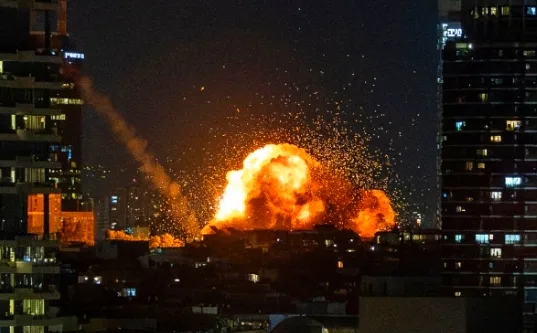
ASIATODAY.ID, TEL AVIV — Israel’s commercial capital, Tel Aviv, has been thrust into a state of emergency after a wave of Iranian ballistic missiles struck key locations and residential neighborhoods on Saturday night (February 28, 2026).
Blazing fires, collapsed buildings, and the relentless wail of air-raid sirens marked a dramatic new phase in the escalating confrontation between Israel, the United States, and Iran.
Israeli media reported extensive damage across Tel Aviv, Bat Yam, and parts of central Israel. Dozens of homes and buildings were severely damaged by the explosions.
Rescue teams worked through the night to pull victims from the rubble, including a two-month-old infant who was evacuated from a partially collapsed structure.
At least 20 people were evacuated with injuries—one in critical condition, one seriously wounded, two moderately injured, and 16 with minor injuries.
Earlier reports placed the total number of injured at 27, including seven children. A woman in her 40s was confirmed dead after a missile struck a residential block.
A paramedic from Israel’s emergency medical service described the scene as “horrific,” citing severe structural damage, thick smoke in the air, and terrified residents fleeing shattered buildings.
Retaliation for Joint US-Israeli Strikes
Iran’s missile barrage was described as a direct response to a large-scale joint Israeli-US military operation targeting Iranian military installations, missile launchers, and air defense systems in Tehran. Within the first 12 hours of the confrontation, the United States reportedly carried out nearly 900 strikes, while Iran retaliated with around 300 missiles.
Iranian projectiles were not only directed at Israel but also reportedly targeted US military bases across the Gulf region.
The Israeli military announced that it had destroyed major facilities in the heart of Tehran, including the Iranian Presidential complex and infrastructure linked to the Supreme National Security Council. Large quantities of munitions were dropped during the operation.
The situation intensified further following reports that Iran’s Supreme Leader, Ayatollah Ali Khamenei, was killed in the joint US-Israeli strike—an event that triggered vows of retaliation from Tehran.
Israel Enters “Difficult Days”
Israeli Defense Minister Yisrael Katz said the country had entered a “highly sensitive phase,” warning citizens to brace for difficult days ahead.
Schools were closed, public activities suspended except for essential services, and residents were urged to remain near bomb shelters. Older buildings lacking reinforced safe rooms were deemed particularly vulnerable.
The current escalation marks a resurgence of hostilities following the 12-day Israel-Iran conflict in June 2025. In the latest wave of attacks, Iran also reportedly struck the city of Beit Shemesh, killing at least nine people and injuring dozens.
Tehran Vows Punishment
Iranian Foreign Minister Seyed Abbas Araghchi condemned the US-Israeli strikes as illegal and unjustified, vowing that Iran would hold the “aggressors” accountable for civilian casualties, including children.
In public statements, Araghchi framed the conflict as “Netanyahu and Trump’s war against Iran,” emphasizing that Iran’s hostility was directed at governments—not the American people.
Meanwhile, US President Donald Trump warned that the confrontation could last longer than initially expected, stating that Washington was prepared for a prolonged conflict.
Is Tel Aviv Destroyed?
While parts of Tel Aviv have suffered heavy damage and the atmosphere remains tense, the city has not been completely destroyed. Critical infrastructure continues to function, but psychological pressure and the threat of further attacks have placed Israel’s economic hub under one of its most severe security crises in recent years.
With missiles still being launched, strategic facilities under fire, and rhetoric intensifying on all sides, analysts warn that the Middle East may be on the brink of a broader regional war.
The question is no longer whether the conflict will expand—but how far the flames will spread. (AT Network)
Follow Us at Google News and WA Channel