
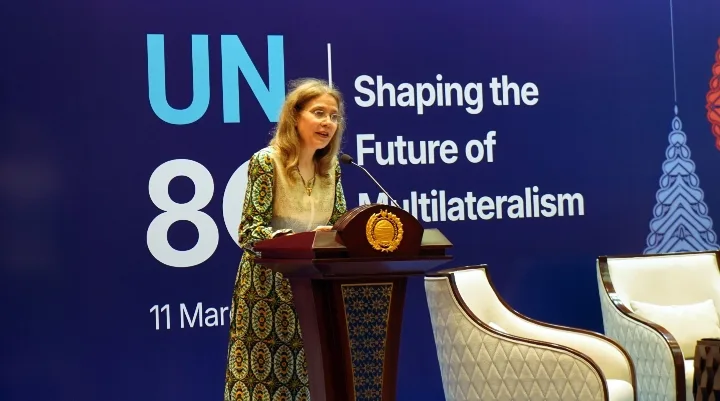
ASIATODAY.ID, JAKARTA — The Ministry of Foreign Affairs of Indonesia and the United Nations Resident Coordinator Office convened a high-level dialogue in Jakarta to reflect on the future of multilateral cooperation as the UN marks its 80th anniversary and is undergoing structural reforms.
The UN at 80: Shaping the Future of Multilateralism Seminar brought together over 120 stakeholders, including UN member states, development partners, policymakers, academics, ministries and UN leaders to discuss how the United Nations is working to respond more effectively to global challenges, while strengthening the role of multilateralism in an increasingly complex world.
Eight decades after its founding, the United Nations is undertaking a major reform effort through the UN80 Initiative, launched by Secretary-General António Guterres to build a more effective, coherent and impactful UN system.
The initiative focuses on improving operational efficiency, reviewing thousands of existing mandates, and updating how the UN system organizes and delivers its work across peace, development, humanitarian action and human rights.
Indonesia has been actively engaged in shaping the conversation on the future of multilateralism. In his opening remarks, Director-General for Multilateral Cooperation at the Ministry of Foreign Affairs, Ambassador Tri Tharyat, highlighted Indonesia’s commitment to strengthening international cooperation in a changing global landscape.
“For Indonesia, an effective, inclusive, and fit-for purpose United Nations remains indispensable. Not because multilateralism is without limitations, but because the scale and complexity of today’s challenges make collective approaches more necessary than ever”
United Nations Resident Coordinator in Indonesia, Gita Sabharwal, emphasized the continued importance of international cooperation: “At a time of growing global uncertainty, the United Nations remains an essential platform for dialogue, cooperation, and collective action. The UN80 initiative is about ensuring that the UN evolves to better serve people everywhere, delivering more effectively, more coherently, and with greater impact.”
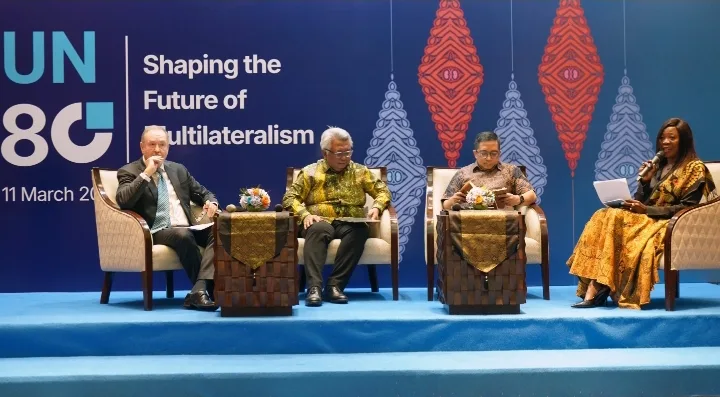
The event featured a panel discussion with David McLachlan-Karr, Asia-Pacific Regional Director of the UN Development Coordination Office; Masni Eriza, Director of the Center for Multilateral Policy Strategy at Indonesia’s Ministry of Foreign Affairs; and Philips Jusario Vermonte, Dean of the Faculty of Social Sciences at Universitas Islam Internasional Indonesia.
Panelists explored how the UN80 reform agenda can strengthen the UN system’s ability to respond to global crises, support sustainable development, and deliver results more effectively at the country level.
Participants also discussed Indonesia’s role in advancing multilateral cooperation, as well as the opportunities and challenges facing the international system as it adapts to a rapidly changing world.
The UN at 80: Shaping the Future of Multilateralism Seminar dialogue forms part of broader global consultations taking place in the lead-up to the completion of the UN80 reform process in 2026. (AT Network)
Follow Us at Google News and WA Channel