
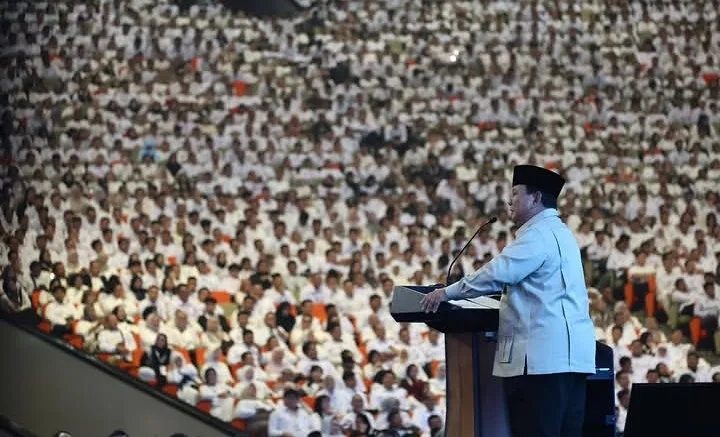
ASIATODAY.ID, BOGOR — President Prabowo Subianto has reaffirmed his administration’s commitment to Indonesia’s flagship Free Nutritious Meals Program, describing it as a long-term investment in human capital development and a catalyst for rural economic growth.
Speaking at the Building Indonesia’s Future Generations Through Nutrition event at the Sentul International Convention Center (SICC) in Bogor, West Java, on Wednesday, June 3, 2026, Prabowo said the ambitious national program is designed to tackle child malnutrition while preparing Indonesia for its vision of becoming a developed nation by 2045.
The event brought together more than 12,000 participants, including nutrition service officials, regional coordinators, school meal program managers, and thousands of private-sector partners supporting the nationwide rollout of the initiative.
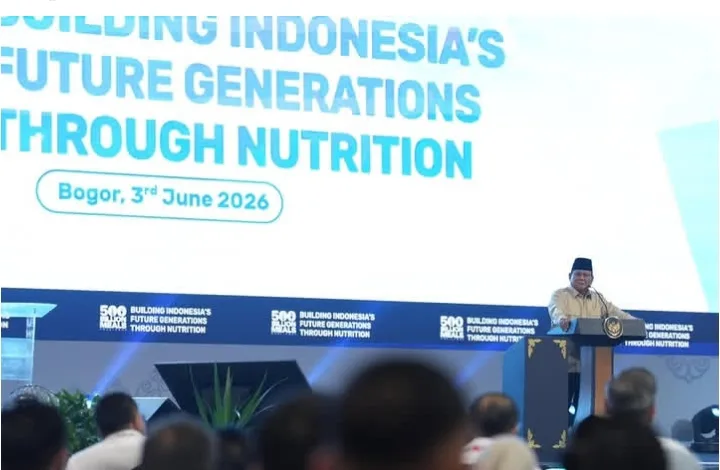
Prabowo expressed gratitude to frontline workers and nutrition service teams operating across Indonesia, including in remote and underserved regions.
“Thank you for your dedication and service in difficult and distant areas. Your commitment is vital to the success of this program,” the President said.
Tackling Child Malnutrition
Prabowo emphasized that the concept behind the Free Nutritious Meals Program is straightforward: ensuring that Indonesian children receive adequate nutrition to support healthy growth and learning.
According to the President, many children still attend school without breakfast or access to nutritious food at home. In some regions, child malnutrition rates remain above 20 percent and approach 30 percent, contributing to stunting and impaired physical and cognitive development.
“Malnutrition affects brain development, muscle growth, and bone development. It limits a child’s ability to reach their full potential,” Prabowo stated.
He warned that poor nutrition can reduce educational attainment and future economic opportunities, perpetuating cycles of poverty across generations.
More Than a Food Program
Prabowo stressed that MBG is not merely a food assistance initiative but a strategic national investment aimed at improving Indonesia’s human resources and strengthening long-term economic competitiveness.
The President noted that many developed countries have implemented similar nutrition programs to improve public welfare and enhance workforce quality.
“This program is extremely important. If it succeeds, it will bring major progress to our economy,” he said.
Driving Rural Economic Growth
Beyond its health and educational benefits, the Free Nutritious Meals Program is expected to generate significant economic opportunities, particularly in rural communities.
Prabowo explained that the network of meal-production kitchens across the country will create stable demand for agricultural products, livestock, fisheries, and other locally sourced goods. This, he said, will provide farmers and small producers with reliable markets and better incomes.
“If these kitchens operate successfully, rural economies will come alive. Farmers will earn more, gain greater certainty for their products, and improve their livelihoods,” he said.
Targeting 85 Million Beneficiaries
At full scale, the government expects the program to serve between 83 million and 85 million beneficiaries through approximately 30,000 operational kitchens nationwide.
Prabowo projected that the initiative could create around 1.5 million formal jobs, while generating another 1.5 million employment opportunities throughout rural supply chains and local economies.
“That means around three million jobs could be created. The amount of money circulating in villages will be enormous,” the President said.
Strengthening National Coordination
Head of the National Nutrition Agency (BGN), Nanik Sudaryati Deyang, said the gathering served as a national coordination forum involving nutrition service offices, regional coordinators, local program managers, and more than 5,800 program partners.
She emphasized that the meeting was intended to strengthen coordination, align implementation strategies, and ensure that the program is delivered effectively, sustainably, and on target.
Senior government officials attending the event included Coordinating Minister for Food Affairs Zulkifli Hasan, State Secretary Prasetyo Hadi, members of the Red and White Cabinet, and heads of state institutions.
With the support of thousands of nutrition workers and partners, the Indonesian government reiterated that the Free Nutritious Meals Program is not only a response to child malnutrition but also a cornerstone of its broader strategy to build a healthier, more productive, and globally competitive generation by 2045. (AT Network)
Follow Us at Google News and WA Channel