
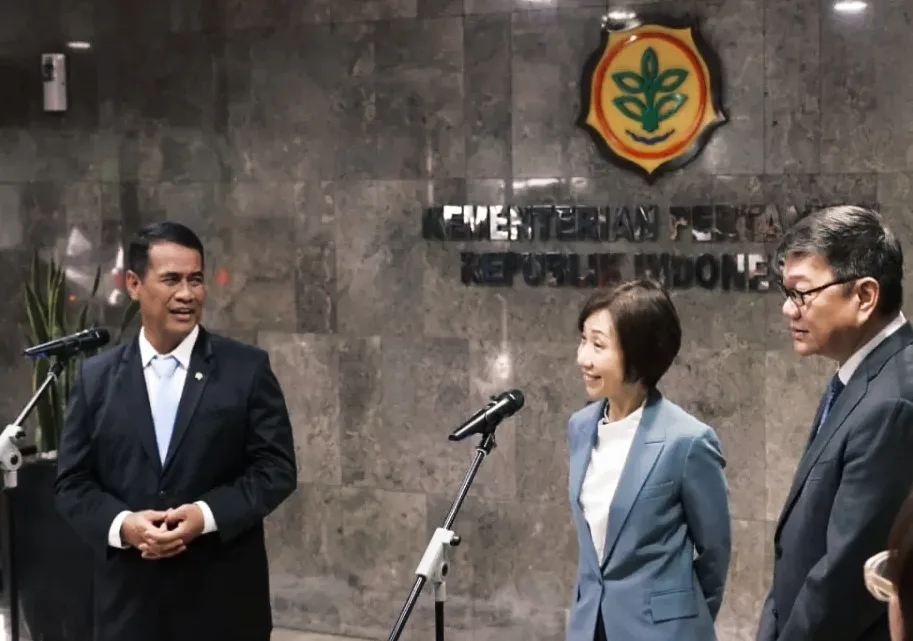
ASIATODAY.ID, JAKARTA — Indonesia has offered to export at least 10,000 metric tons of rice to Singapore after ending rice imports and building record government stockpiles, a move that could mark a significant shift in Southeast Asia’s food trade as countries across the region seek more resilient and diversified food supply chains.
The proposal reflects Indonesia’s broader ambition to transition from one of the world’s largest rice-importing nations into an emerging regional supplier. While the export plan is still under discussion, it signals a strategic shift in the country’s agricultural policy under President Prabowo Subianto, whose administration has made food security and agricultural self-sufficiency key national priorities.
According to Indonesia’s government, the country achieved rice self-sufficiency by the end of 2025, enabling it to halt imports while building the largest government-held rice reserves in its history.
Minister of Agriculture and Head of the National Food Agency, Andi Amran Sulaiman, said Indonesia’s government rice reserves have reached approximately 5.17 million metric tons—the highest level on official record. The volume exceeds the country’s storage capacity of 3 million tons, requiring authorities to lease additional warehouse space to accommodate the surplus.
Official projections estimate Indonesia produced 19.2 million metric tons of rice during the first half of 2026, compared with domestic consumption of 15.48 million metric tons, resulting in a surplus of approximately 3.72 million metric tons.
The government says the surplus has strengthened domestic food security while creating room to explore export opportunities without affecting local supply.
Despite the growing export ambitions, Indonesia continues to prioritize domestic needs through nationwide rice assistance and market stabilization programs designed to keep staple food supplies affordable and accessible.
Singapore Weighs Indonesia’s Proposal
Indonesia’s export initiative received a positive initial response from Singapore, which imports the vast majority of its food and has been actively diversifying its supply sources to strengthen long-term food security.
Singapore’s Minister for Sustainability and the Environment, Grace Fu, said Jakarta’s proposal would be reviewed with Singaporean importers before any decision is made.
“This is an idea worth exploring. We will follow up and discuss it with our importers in Singapore,” Grace Fu said after bilateral talks in Jakarta on June 29.
Grace praised Indonesia’s agricultural transformation, pointing to improvements in crop yields, productivity, research and development, seed technology, mechanization, and modern farming practices.
“I had a very productive discussion with Minister Amran. Indonesia has achieved impressive progress in agricultural productivity through sustained investment in technology, research, and innovation,” she said, adding that both countries have significant opportunities to deepen cooperation in food security.
Beyond Rice
Amran said discussions between the two countries extend beyond rice to include eggs, poultry products, palm oil, and agricultural technology cooperation, reflecting efforts to broaden bilateral agricultural trade.
He said Indonesia’s record rice reserves provide sufficient flexibility to begin exports while safeguarding domestic food supplies.
“Our warehouses are full. We currently hold around 5.1 million tons of rice reserves, making exports of at least 10,000 tons to Singapore possible,” Amran said.
The proposed exports would be conducted through commercial business-to-business arrangements involving Indonesia’s state-owned food logistics agency, Perum Bulog, and private-sector importers rather than government-to-government agreements.
A New Chapter for Asia’s Rice Trade
For decades, Indonesia relied on imports to help meet domestic rice demand, making its emergence as a potential exporter a noteworthy development for regional agricultural markets.
Although the proposed shipment to Singapore remains under negotiation, analysts are likely to view it as an early indicator of Indonesia’s evolving position in Asia’s food economy. If the country can sustain higher production while maintaining domestic food security, it could gradually become a more influential supplier in Southeast Asia’s rice market.
For a region increasingly exposed to climate change, geopolitical uncertainty, and supply-chain disruptions, Indonesia’s expanding production capacity could provide an additional source of stability.
Whether the Singapore proposal becomes a long-term trade partnership may ultimately depend on Indonesia’s ability to consistently maintain production surpluses while meeting domestic demand, but it already signals a notable shift in the regional food landscape. (AT Network)
Follow Us at Google News, WA Channel, and LinkedIn