
ASIATODAY.ID, JAKARTA – For decades, geopolitical rivalries revolved around oil.
Control over crude petroleum shaped alliances, influenced wars, and determined the fortunes of nations. From the Middle East to the Caspian Sea, energy security became synonymous with oil security.
Today, a new strategic resource has entered the geopolitical arena.
Nickel.
As the world accelerates its transition toward electric vehicles, renewable energy, and advanced battery technologies, the race for critical minerals has become one of the defining geopolitical contests of the twenty-first century.
At the center of that contest stands Indonesia.
Holding the world’s largest nickel reserves and producing well over half of global supply, Indonesia has become indispensable to the future of clean energy. Every major economic power now recognizes the same reality: whoever secures long-term access to Indonesian nickel will gain a strategic advantage in the industries of tomorrow.
The battle is no longer fought with military deployments.
It is fought through investments, industrial policy, trade agreements, and technological partnerships.
China’s Early Strategic Move
Long before critical minerals became a geopolitical buzzword, China had already identified nickel as a strategic industrial resource.
Rather than relying solely on imported refined metals, Chinese companies invested across the entire supply chain—from mining and smelting to stainless steel production, battery materials, and electric vehicle manufacturing.
Indonesia became the centerpiece of that strategy.
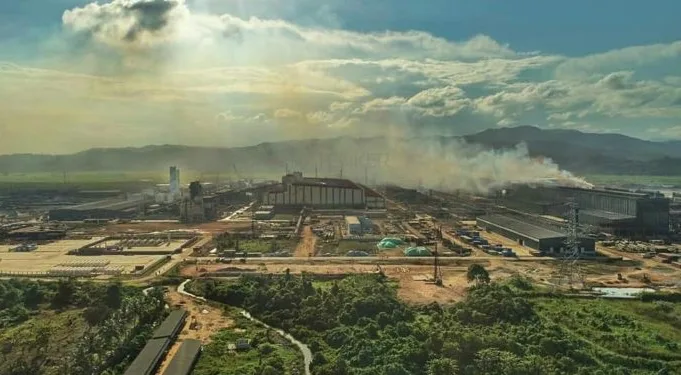
Chinese investors committed billions of dollars to developing integrated industrial parks, smelters, power plants, and downstream processing facilities across Sulawesi and North Maluku.
The approach was remarkably comprehensive.
Instead of simply purchasing Indonesian ore, Chinese companies relocated industrial capacity directly to Indonesia, allowing them to secure long-term supplies while expanding global manufacturing leadership.
Today, much of Indonesia’s nickel processing capacity has been developed through this industrial partnership, making China the country’s most significant strategic investor in the nickel sector.
The United States Responds
Washington watched these developments with growing concern.
The United States recognized that the future competitiveness of its electric vehicle industry depended on secure access to critical minerals.
Dependence on supply chains dominated by geopolitical competitors was increasingly viewed as a strategic vulnerability.
In response, the U.S. introduced sweeping industrial initiatives, including the Inflation Reduction Act (IRA), designed to encourage domestic manufacturing while promoting diversified and resilient critical mineral supply chains among trusted partners.
The legislation signaled a profound shift in American industrial policy.
Critical minerals were no longer treated merely as commercial commodities.
They became essential components of national security.
The objective extended beyond mining itself.
It encompassed batteries, electric vehicles, semiconductors, and advanced manufacturing—industries expected to define global economic leadership for decades to come.
Europe Pursues Strategic Autonomy
The European Union faces a similar dilemma.
Europe remains one of the world’s largest automobile manufacturing regions, yet it possesses limited domestic reserves of many critical minerals needed for the energy transition.
Consequently, European policymakers have intensified efforts to diversify supply sources while reducing dependence on single-country supply chains.
The EU’s Critical Raw Materials strategy reflects this broader objective.
At the same time, Brussels has introduced increasingly ambitious environmental regulations, including the Carbon Border Adjustment Mechanism (CBAM), aimed at ensuring imported industrial products meet stringent climate standards.
These evolving regulatory frameworks carry significant implications for countries exporting processed nickel and battery materials.
Indonesia’s future competitiveness will depend not only on production volumes but also on the environmental performance of its industrial sector.
Indonesia Finds Itself at the Center of Global Competition
Few countries have experienced such a rapid rise in geopolitical importance.
Indonesia’s mineral wealth now places it at the intersection of competing strategic interests.
China seeks to maintain its dominant position across battery manufacturing and electric vehicle supply chains.
The United States aims to diversify global supply networks while strengthening domestic industrial resilience.
Europe wants secure, sustainable, and environmentally responsible access to critical raw materials.
Japan and South Korea continue expanding investments to support their globally competitive automotive industries.
Each actor pursues different objectives.
Yet all require access to Indonesian nickel.
This unprecedented convergence has elevated Indonesia from a resource-rich developing nation to one of the world’s most strategically significant economies in the clean-energy era.
Opportunity—and Responsibility
Indonesia’s strategic position presents extraordinary opportunities.
Competition among major economies increases foreign investment, creates employment, expands industrial capacity, and strengthens the country’s bargaining position in international negotiations.
For perhaps the first time in modern history, Indonesia possesses substantial leverage in shaping the future architecture of global industrial supply chains.
However, strategic importance also brings greater responsibility.
Indonesia must carefully balance relationships with competing global powers while safeguarding its national interests.
Favoring one geopolitical bloc too heavily risks reducing policy flexibility.
Conversely, maintaining constructive partnerships with multiple economic powers could enhance resilience while maximizing long-term national benefits.
The challenge is not simply attracting capital.
It is preserving strategic autonomy.
The Next Battlefield: Technology
Natural resources alone will not determine future winners.
The next phase of global competition will increasingly revolve around technological leadership.
Battery chemistry continues to evolve.
Manufacturing processes become more sophisticated.
Artificial intelligence, advanced materials, recycling technologies, and circular-economy solutions are reshaping industrial competitiveness.
Countries that control innovation—not merely raw materials—will ultimately capture the greatest economic value.
For Indonesia, this represents both the greatest opportunity and the greatest challenge.
Becoming the world’s largest nickel producer is an extraordinary achievement.
Becoming a global technology leader would represent an even greater transformation.
Achieving that ambition requires sustained investment in research, higher education, engineering capabilities, industrial innovation, and domestic manufacturing ecosystems.
Without those foundations, Indonesia risks remaining an indispensable supplier while others continue capturing the highest-value segments of the global economy.
A Defining Moment in Economic History
The global competition over Indonesian nickel illustrates a broader transformation taking place across the international economy.
Oil defined the geopolitics of the twentieth century.
Critical minerals are shaping the geopolitics of the twenty-first.
Indonesia now occupies a pivotal position in that historic transition.
Its decisions on industrial policy, environmental governance, technological development, and international partnerships will influence not only its own economic future but also the trajectory of the global clean-energy transition.
The world’s attention is no longer focused solely on Indonesia’s mineral wealth.
It is focused on how Indonesia chooses to use it.
To be continued in Part IV: The Hidden Cost of Nickel: Environmental Challenges, Carbon Emissions, and the Sustainability Question Behind Indonesia’s Industrial Boom.
Editor’s Note
This special report is adapted and expanded from a policy paper published by Indonesia’s National Development Planning Agency (Bappenas) on the evolution of the global nickel industry and Indonesia’s strategic position in the critical minerals economy. The analysis is further enriched with publicly available research and data from the International Energy Agency (IEA), the World Bank, the International Monetary Fund (IMF), the Organisation for Economic Co-operation and Development (OECD), the United States Geological Survey (USGS), and other authoritative international sources.
Follow Us at Google News, WA Channel, and LinkedIn