
ASIATODAY.ID, JAKARTA — Indonesia and Belarus are taking a significant step toward reshaping their economic relationship, with both countries seeking to expand cooperation in trade, industrial investment, food security, and technology transfer ahead of Belarusian President Aleksandr Lukashenko’s state visit to Jakarta on July 1–2.
The renewed momentum comes as Indonesia accelerates efforts to diversify its global economic partnerships beyond traditional markets, while Belarus looks to strengthen its presence in Southeast Asia amid shifting geopolitical and trade dynamics.
At the center of the discussions is the planned implementation of the Indonesia–Eurasian Economic Union Free Trade Agreement (I–EAEU FTA), a deal expected to give Southeast Asia’s largest economy greater access to the Eurasian Economic Union (EAEU), a market of around 180 million people with a combined gross domestic product of approximately US$2.56 trillion.
The agreement could also position Indonesia as a strategic gateway for Eurasian businesses seeking deeper access to the rapidly growing ASEAN market.
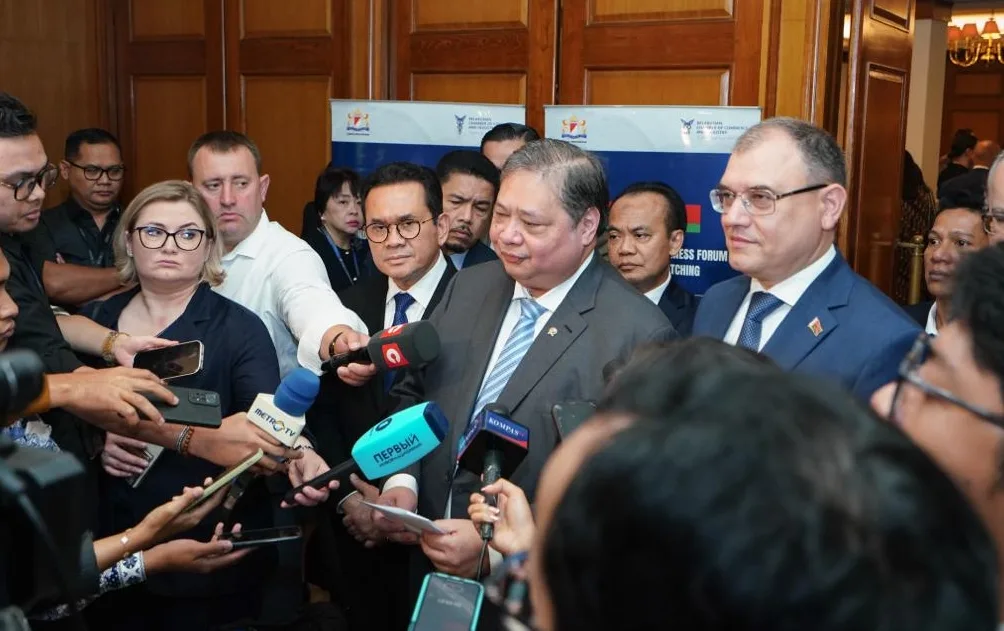
Speaking during the Indonesia–Belarus Business Forum in Jakarta, Coordinating Minister for Economic Affairs Airlangga Hartarto said both governments are committed to transforming diplomatic ties into concrete business partnerships through joint investment, industrial cooperation, and commercially viable projects.
The figures underscore the growing momentum. Bilateral trade reached approximately US$221.3 million in 2025, an increase of nearly 30% from the previous year, although both governments acknowledge that economic exchanges remain well below their long-term potential.
Indonesia aims to increase exports of electronics, fisheries products, natural rubber, cocoa, and palm oil derivatives, while Belarus is seeking broader cooperation in heavy machinery, industrial manufacturing, agricultural equipment, and advanced engineering.
A major focus of the negotiations is industrial collaboration rather than conventional merchandise trade.
Indonesian officials are encouraging Belarusian manufacturers to establish local production and assembly facilities while expanding technology transfer and workforce development. Companies including MAZ, BelAZ, and Minsk Tractor Works (MTZ) have been identified as potential partners in Indonesia’s heavy equipment, mining machinery, transportation, and agricultural sectors.
The strategy aligns with Indonesia’s broader industrial policy of attracting value-added manufacturing and strengthening domestic production capabilities instead of relying solely on imports.
Food security has also emerged as a strategic pillar of the partnership.
Indonesia is exploring closer cooperation with Belarus to secure dairy supplies supporting the government’s nationwide Free Nutritious Meals Program while expanding collaboration on agricultural mechanization, smart farming technologies, and local manufacturing of agricultural machinery.
Healthcare and pharmaceutical industries are also being explored as new areas of bilateral cooperation.
Beyond commerce, both governments are investing in long-term human capital development.
Jakarta and Minsk are discussing student mobility programs and university partnerships focused on science, technology, engineering, mathematics, and medicine (STEMM), with an initial target of 100–200 students annually participating in academic exchanges, joint research, and professional training.
During bilateral meetings, Indonesian and Belarusian officials also advanced discussions on the 2026–2030 Roadmap for the Development of Key Areas of Cooperation, a strategic framework designed to coordinate collaboration across investment, trade, manufacturing, agriculture, education, technology, and innovation over the next five years.
Belarus has also proposed establishing an Indonesia–Belarus Business Council to institutionalize private-sector cooperation and facilitate long-term investment between companies from both countries.
President Lukashenko’s upcoming visit is expected to produce several strategic agreements that will define the next phase of bilateral relations.
For Indonesia, the partnership represents part of a wider strategy to diversify export destinations, attract advanced industrial technology, and strengthen its role as Southeast Asia’s manufacturing and investment hub.
For Belarus, closer ties with Indonesia offer access not only to one of Asia’s fastest-growing major economies but also to the broader ASEAN market, reinforcing its efforts to expand economic engagement beyond its traditional trading partners.
As global supply chains continue to evolve amid geopolitical uncertainty, the Indonesia–Belarus partnership illustrates how emerging economies are building new economic corridors based on industrial cooperation, market diversification, and long-term strategic investment rather than traditional trade alone. (AT Network)
Follow Us at Google News, WA Channel, and LinkedIn