
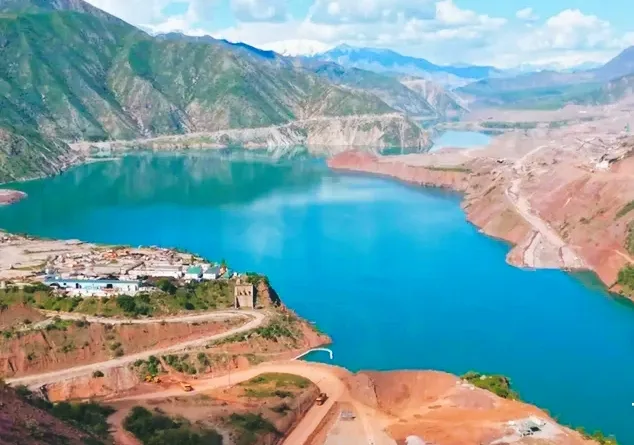
ASIATODAY.ID, WASHINGTON — The World Bank has approved US$300 million in second-phase financing for Tajikistan’s Rogun Hydropower Plant (Rogun HPP), advancing one of Central Asia’s largest renewable energy projects as the region seeks to strengthen energy security, expand cross-border electricity trade, and accelerate low-carbon economic growth.
Approved by the World Bank’s Board of Executive Directors, the financing will support the construction of the flagship hydropower facility, which is expected to create more than 30,000 direct and indirect jobs while improving access to affordable, reliable, and sustainable electricity for approximately 10 million people across Tajikistan.
Once completed, the Rogun Hydropower Plant is projected to generate around 14,400 gigawatt-hours (GWh) of renewable electricity annually—equivalent to roughly 60% of Tajikistan’s current electricity generation. The additional capacity is expected to significantly reduce chronic winter power shortages, improve energy reliability, support industrial development, and strengthen the country’s long-term economic resilience.
The project also carries strategic importance for Central Asia by enabling larger electricity exports to Kazakhstan and Uzbekistan. Increased cross-border power trade is expected to improve regional energy connectivity, optimize the use of electricity resources, and reinforce energy security across the region.
“In addition to reducing chronic power shortages, increased access to reliable electricity from the Rogun HPP will help power economic transformation and create jobs in Tajikistan,” said Najy Benhassine, the World Bank’s Regional Director for Central Asia on June 30, 2026.
Charles Cormier, the World Bank’s Regional Director for Infrastructure in Europe and Central Asia, said the project would help revitalize regional electricity markets by enabling countries to use their energy resources more efficiently while improving supply reliability and regional energy security.
The financing is provided through a grant from the International Development Association (IDA). The funding will support civil works, installation of electromechanical equipment, project implementation, quality assurance, safety systems, environmental and social safeguards, as well as resettlement and livelihood restoration programs for affected communities.
The project also includes investments in reservoir management, hydrological monitoring, and flood forecasting to improve water resource management and reduce flood risks for downstream communities.
The Government of Tajikistan has committed to implementing a Benefit-Sharing Program, allocating a portion of future project revenues to support vulnerable communities and strengthen the country’s social protection system.
The World Bank is coordinating international financing through the Rogun Coordination Group (RCG), which includes major development partners such as the Asian Development Bank (ADB), Asian Infrastructure Investment Bank (AIIB), European Investment Bank (EIB), Islamic Development Bank (IsDB), the European Commission, the OPEC Fund for International Development, the Saudi Fund for Development, the Qatar Fund for Development, the Kuwait Fund for Arab Economic Development, and the Abu Dhabi Fund for Development.
As Central Asia moves to expand renewable energy capacity and deepen regional electricity integration, the Rogun Hydropower Plant is expected to become a cornerstone of Tajikistan’s energy strategy, supporting sustainable economic growth while strengthening long-term energy security across the region. (AT Network)
Follow Us at Google News, WA Channel, and LinkedIn