
ASIATODAY.ID, JAKARTA — Indonesia is strengthening its industrial competitiveness by transforming vocational education into a global-standard talent development system, supported by strategic partnerships with Switzerland and Germany.
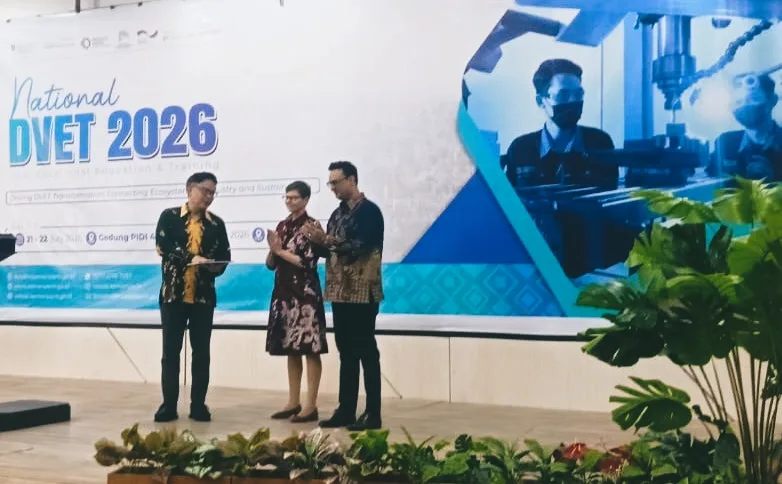
Through the National Dual Vocational Education and Training (DVET) 2026, Indonesia’s Ministry of Industry is bringing together government institutions, industries, education providers and international partners to accelerate the development of skilled workers capable of supporting the future of manufacturing.
The initiative reflects Indonesia’s broader strategy to secure a competitive industrial workforce amid rapid changes driven by artificial intelligence, automation, digital manufacturing, green transition and shifting global supply chains.
Minister of Industry Agus Gumiwang Kartasasmita said strengthening industrial human resources is a key priority to maintain manufacturing growth and achieve the vision of Golden Indonesia 2045.
“Strengthening vocational education and training is a national priority and the foundation for developing competent industrial human resources,” Agus said in Jakarta.
He emphasized that future industries require workers who are not only technically skilled but also adaptive, innovative and committed to continuous learning.
Long-Term Partnership with Switzerland and Germany
Indonesia’s Ministry of Industry, through the Industrial Human Resources Development Agency (BPSDMI), has established long-term cooperation with Switzerland through the State Secretariat for Economic Affairs (SECO) and Swisscontact, as well as Germany through Deutsche Gesellschaft für Internationale Zusammenarbeit (GIZ) GmbH.
The collaboration aims to align Indonesia’s vocational education system with international standards and strengthen industry-driven training models.
The partnership has been running since 2018 through several initiatives, including the Skills for Competitiveness (S4C) program with SECO and Germany’s support for TVET System Reform.
The cooperation continues through S4C Phase 2 with Swisscontact and the Green Jobs for Social Inclusion and Sustainable Transformation (GESIT) program supported by GIZ.
BPSDMI Head Doddy Rahadi said the partnership has generated significant progress in Indonesia’s vocational ecosystem, including modern training facilities, improved capacity of educators and students, and stronger institutional frameworks aligned with manufacturing needs.
“Schools and industries can no longer operate separately. They must become equal partners in preparing future talent,” Doddy said.
Preparing Talent for Industry 4.0 and Green Economy
BPSDMI continues to expand industry engagement through the implementation of the dual vocational education system, workplace instructor training (In-Company Trainer), Career Development Centers and digital transformation of vocational services.
The approach is designed to ensure graduates possess skills directly relevant to industrial demand and are ready to participate in global manufacturing supply chains.
The National DVET 2026, held from 21–23 July, serves as a platform to strengthen collaboration and exchange international best practices in vocational education.
The forum focuses on five strategic areas: In-Company Trainer, Teaching Factory, Industrial-Based Curriculum, Structured Internship, and Green Jobs.
Investing in Skills, Investing in Competitiveness
SECO Head of Cooperation for Economic Cooperation and Development Violette Ruppanner highlighted the importance of industry participation in shaping future talent.
“Investing in skills means investing in people, businesses and economic competitiveness,” she said.
She stressed that companies must play an active role in developing curricula, providing structured internships and supporting workforce preparation.
Meanwhile, GIZ Deputy Country Director Shameer Khanal said workforce readiness is essential for achieving a successful green transformation.
“No green transition can succeed without workers equipped with the right knowledge, skills and opportunities,” he said.
Indonesia’s Industrial Future
BPSDMI Secretary Sidik Herman said National DVET 2026 represents a collective movement to create a vocational ecosystem that is adaptive, inclusive, sustainable and globally competitive.
He encouraged wider collaboration between government, education institutions and industries to expand successful vocational models across Indonesia.
“The challenges of developing industrial talent in the future are becoming increasingly complex and can only be addressed through strong partnerships,” Sidik said.
With stronger cooperation with Switzerland and Germany, Indonesia is positioning vocational education as a strategic pillar to support high-value manufacturing, green industries and its ambition to become a major player in global supply chains. (AT Network)
Follow Us at Google News, Instagram and LinkedIn