
ASIATODAY.ID, JAKARTA — Indonesia is strengthening its role as a guardian of ocean biodiversity by combining marine protection, scientific research, and coastal economic development through its blue economy strategy.
Recent efforts to respond to stranded dolphins and whales, together with a coral reef restoration initiative in Bali that has created thousands of jobs, reflect Indonesia’s broader mission to protect marine ecosystems while ensuring coastal communities benefit from sustainable ocean resources.
As the world’s largest archipelagic nation, Indonesia sits at the center of the Indo-Pacific’s most diverse marine region. Its waters host extraordinary biodiversity, provide habitats for protected species, and support millions of people whose livelihoods depend on healthy oceans.
Protecting Marine Species Through Science
Indonesia’s Ministry of Marine Affairs and Fisheries (KKP) recently moved quickly after receiving reports of a stranded Indo-Pacific bottlenose dolphin (Tursiops aduncus) in the waters of Rempanga Village, Loa Kulu District, Kutai Kartanegara, East Kalimantan.
Working with local authorities and communities, KKP teams carried out searches, documentation, biological sampling, and the proper handling of the marine mammal.
The dolphin was identified as a male Indo-Pacific bottlenose dolphin measuring approximately 223 centimeters in length.
KKP Director General of Marine Management Koswara said every marine mammal stranding provides valuable scientific information to improve Indonesia’s understanding and management of marine ecosystems.
“Each stranding provides important data to strengthen marine mammal management and support long-term protection efforts,” Koswara said.
The team collected tissue samples for DNA analysis to confirm species information and expand Indonesia’s marine mammal database. The samples were transferred to the Conservation Foundation RASI for further study and preservation.
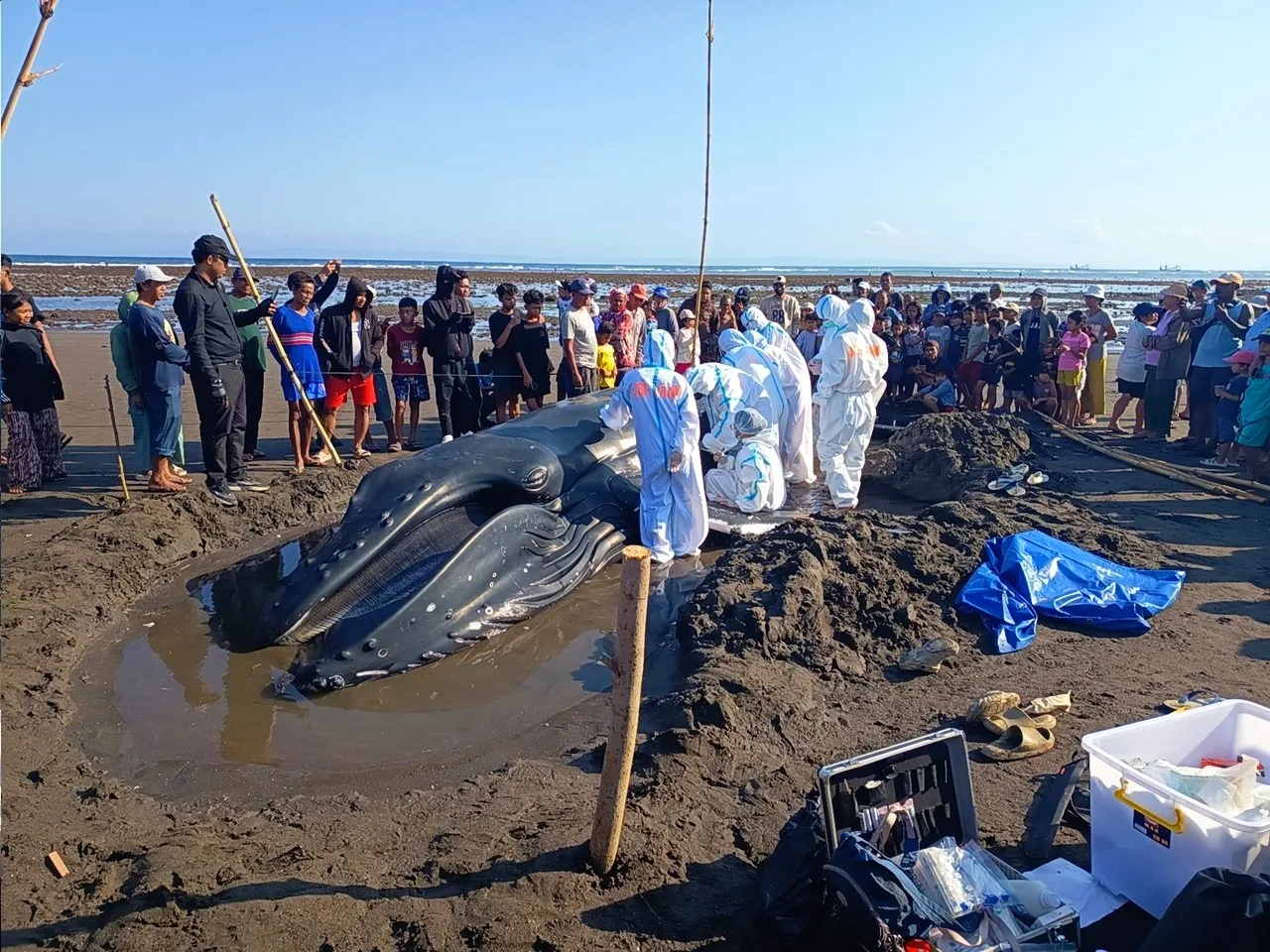
A similar response was carried out in Bali after a humpback whale (Megaptera novaeangliae) measuring around 7.7 meters was found stranded at Perancak Beach, Jembrana.
The rescue effort involved government agencies, fishermen, marine experts, and local communities. Despite attempts to guide the whale back into deeper waters, coastal conditions and rapidly changing tides prevented a successful rescue.
Experts later conducted a necropsy to collect scientific information about the whale’s condition and investigate possible causes of death before completing the final handling process according to conservation standards.
Humpback whales are among the world’s most significant migratory marine mammals, and Indonesian waters form part of their migration routes across the Indo-Pacific.
Restoring Coral Reefs, Empowering Coastal Communities
Indonesia’s ocean strategy goes beyond responding to marine wildlife incidents. The country is also investing in restoring critical habitats that sustain biodiversity and coastal economies.
Through the Indonesia Coral Reef Garden (ICRG) program, KKP has restored approximately 72 hectares of coral reef ecosystems across five regencies and cities in Bali.
The initiative has involved around 11,250 workers, demonstrating that marine restoration can deliver both environmental and economic benefits.
KKP Director General of Marine Management Koswara said coral reef recovery, community-based marine tourism, and the development of marine products must be advanced together.
“Protecting ecosystems must go hand in hand with creating economic opportunities, employment, and improving the welfare of coastal communities,” Koswara said.
The program has encouraged sustainable marine tourism and community-based businesses around restoration areas, creating a stronger connection between healthy ecosystems and local prosperity.
At Pantai Mengiat, Nusa Dua, Bali, KKP and Commission IV of Indonesia’s House of Representatives reviewed marine ecosystem management involving government institutions, businesses, and community groups.
The initiative supports Bali’s vision of maintaining the ocean as a source of life, culture, and sustainable economic growth.
Building a Resilient Ocean Future
Marine biodiversity around the world is facing growing challenges from climate change, pollution, habitat degradation, and increasing pressure on ocean resources.
For Indonesia, protecting the ocean is not only an environmental responsibility but also a strategic investment in food security, economic resilience, and the future of coastal communities.
Through its blue economy framework, Indonesia is integrating ecosystem protection, scientific research, sustainable resource management, and community participation.
From protecting marine mammals in East Kalimantan and Bali to restoring coral reefs, Indonesia is demonstrating that a healthy ocean can support both biodiversity and human prosperity.
As global attention turns toward sustainable ocean governance, Indonesia continues to strengthen its position as a key maritime nation shaping the future of marine conservation in Asia and beyond. (AT Network)
Follow Us at Google News, Instagram and LinkedIn