
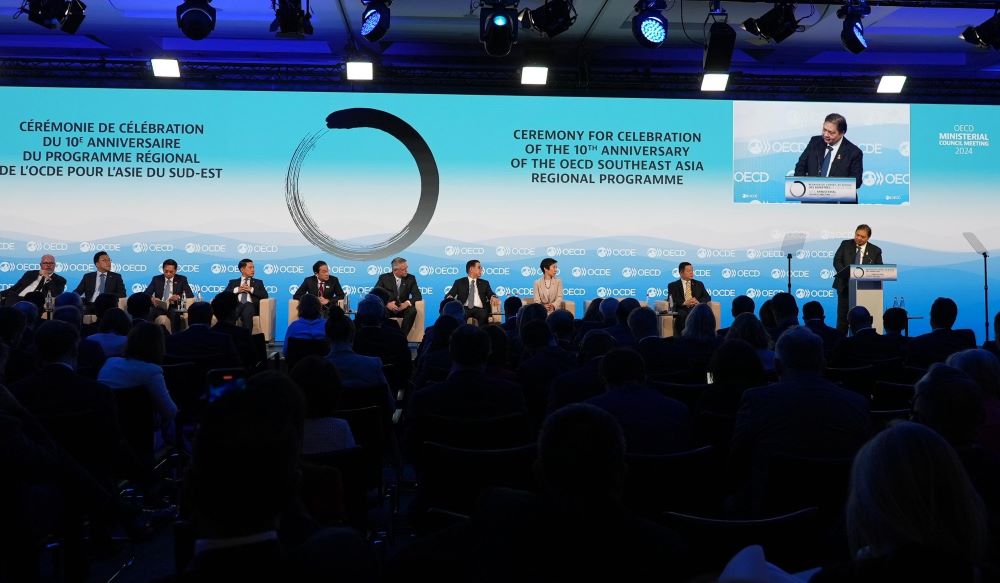
ASIATODAY.ID, PARIS – The Organization for Economic Cooperation and Development (OECD) appreciates Indonesia’s leadership in Southeast Asia.
This appreciation emerged at the Ministerial Meeting of the Organization for Economic Co-operation and Development (OECD) in Paris, France, on 2-3 May 2024, to coincide with the 10th anniversary of the OECD South East Regional Program (OECD SEARP).
OECD SEARP was first launched in 2014, initiated by OECD Secretary General Angel Gurria and Japanese Prime Minister Shinzo Abe. The forum was formed to support domestic priorities in regional areas, policy reform and regional integration.
“Indonesia is proud to have inaugurated the Regional Program, and ten years later to be the first country in the region to launch the OECD Accession Roadmap. “Looking back, Indonesia has certainly benefited from hosting the OECD and ASEAN regional offices, which seek to encourage strong evidence-based policy making towards a stable and prosperous region,” said Indonesia’s Coordinating Minister for Economic Affairs, Airlangga Hartarto on the occasion.
Through this forum, the OECD and ASEAN partnership is getting closer, amidst the influence of global uncertainty.
Minister Airlangga appreciated the visionary approach from the OECD by embracing the Southeast Asia region in its strategic plan. As the country with the largest economy in one of the fastest growing regions, becoming an OECD member will not only support Indonesia’s transformation, but also deepen regional integration by increasing cross-border trade and investment.
Indonesia itself held joint leadership of OECD SEARP together with Japan in 2014–2017. As the largest economy in Southeast Asia, Indonesia’s leadership has received appreciation from OECD members. This model of shared leadership between OECD and ASEAN countries ensures integration and dialogue between the two organizations.
Southeast Asia is one of the main drivers of global growth, with more than 600 million people and the third largest workforce in the world. Currently joint leadership of OECD SEARP is held by Vietnam and Australia.
Indonesia Accepts OECD Membership Accession Roadmap
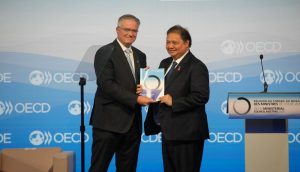
Representing the Indonesian Government, Minister Airlangga Hartarto received the Roadmap for Indonesia’s OECD Membership Accession at the opening of the OECD Ministerial Level Meeting in Paris, France, 2 May 2024. This procession marks the further process of the stages of Indonesia’s joining the OECD.
This accession process is in line with Indonesia’s efforts to increase collaboration with all OECD members. Close cooperation between the two parties in the accession process aims to enable better policies for better lives, as per the OECD motto “Better Policies for Better Lives”.
“Representing 80% of world trade and investment, OECD membership and standards are critical to ensuring an inclusive and sustainable global economy. “Becoming a member of the OECD allows Indonesia to strengthen its constitutional commitment to participate in the world order, to advance freedom, lasting peace and social justice,” said Airlangga.
With Indonesia joining, there are currently 7 countries with accession candidate status, namely Argentina, Brazil, Bulgaria, Indonesia, Croatia, Peru and Romania.
The relationship between Indonesia and the OECD has been going on since 2007, when Indonesia joined as a key partner of the OECD.
The OECD itself has become Indonesia’s strategic partner in improving policies and standards, both for society, government governance and the business world.
ASEAN support
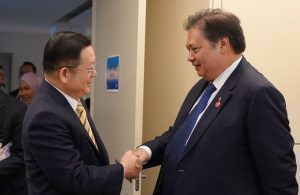
ASEAN Secretary General Kao Kim Hourn expressed support for Indonesia’s achievements in accepting the OECD Accession Roadmap.
“This success is also felt by all ASEAN members. “We hope that other ASEAN countries will also follow Indonesia’s steps, so that they can increase the representation of ASEAN countries’ interests in the OECD,” said Kao.
Kao also expressed hope for Indonesia’s support in exploring free trade negotiations between the ASEAN-GCC FTA region. It is believed that this agreement can encourage economic growth and provide benefits for both regions.
Minister Airlangga gave a positive response to this initiative.
“Indonesia-UAE CEPA can be a benchmark for ASEAN in realizing an FTA between these regions,” he said.
In the discussion between Airlangga and Kao, they also touched on the development of regional digitalization initiatives, where ASEAN is currently negotiating the Digital Economy Framework Agreement (DEFA) which is projected to increase the value of the region’s digital economy to US$2 trillion by 2030.
The launch of ASEAN DEFA negotiations in 2023 is one of the economic priorities pushed by Indonesia during its ASEAN Chair last year and is targeted for completion in 2025.
Airlangga also encouraged increased collaboration between ASEAN and the OECD Southeast Asia Regional Program (SEARP), especially to become a platform for sharing experiences and best practices on regulatory and policy issues to encourage economic growth in the region. (ATN)
Check out other news and articles at Google News and WA Channel