
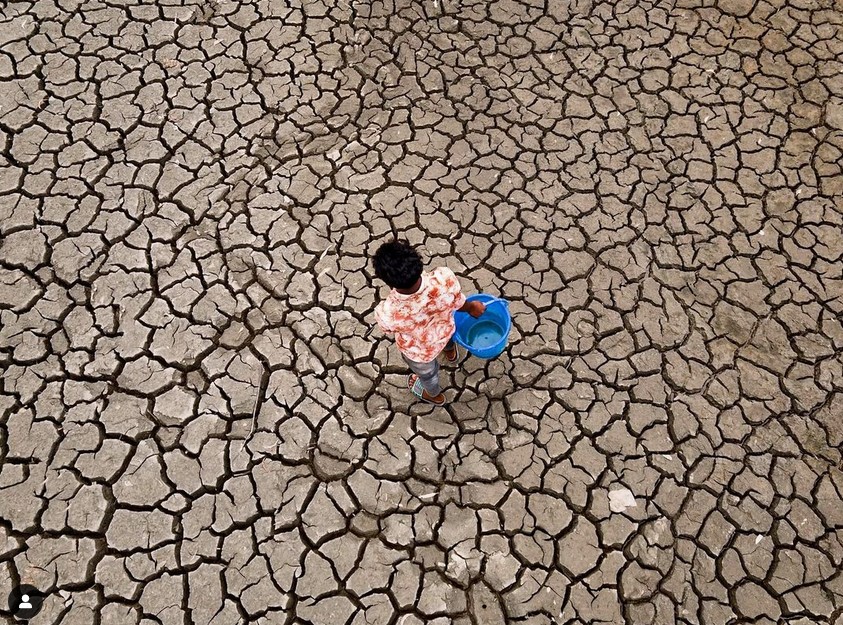
ASIATODAY.ID, JAKARTA – The Asian continent will be the region worst affected by disasters in 2023 due to extreme weather and climate change. This is according to the latest report from the World Meteorological Organization (WMO). Storms and floods are the worst disasters to hit this area.
With warming trends nearly doubling since the 1960-1990 period, Asia is warming faster than the global average, with increasing death tolls and economic losses from more severe floods, storms and heat waves.
In 2023, sea surface temperatures in the northwestern Pacific Ocean reached the highest ever recorded. Even the Arctic Ocean is experiencing marine heat waves. In many areas of the region, including the Arabian Sea, the southern Kara Sea and the southeastern Laptev Sea, sea levels are warming three times faster than globally. The Barents Sea has also been identified as a climate change hotspot.
Driven by thermal expansion and melting of glaciers and ice sheets, sea levels continue to rise globally. However, in Asia, the rate of increase is higher than the global average over the period 1993-2023.
Last year, the continent experienced 79 water-related disasters, with more than 80 percent related to floods and storms, resulting in more than 2,000 fatalities and directly impacting nine million people, according to the Emergency Events Database.
According to the WMO report, many areas in the region will experience extreme heat in 2023. The average annual temperature in Asia is the second highest on record at 0.91 degrees Celsius above the 1991-2020 average. Very high temperatures were observed from western Siberia to central Asia, and from eastern China to Japan. Japan and Kazakhstan experienced their hottest years on record.
“Meanwhile, rainfall levels were below normal in most of the Lowlands of Turkmenistan, Uzbekistan, Kazakhstan, the Hindu Kush (Afghanistan, Pakistan) and the Himalayas, as well as around the Ganges River and the lower reaches of the Brahmin River,” the report said as quoted by UN, Tuesday, 7 May 2024.
The Arakan Mountains in Myanmar and the lower reaches of the Mekong River also experienced lower rainfall than usual. Meanwhile Southwest China is experiencing drought, with below normal rainfall levels almost every month in 2023.
Despite lower overall rainfall, some extreme events occurred, such as heavy rains in Myanmar in May; floods and storms in India, Pakistan and Nepal in June and July, and record hourly rainfall in Hong Kong in September.
Home to the largest volume of ice outside the polar regions, the Asian High Mountains region, with the Tibetan Plateau at its center, has about 100 thousand square kilometers of glaciers. Over the past few decades, most of these glaciers have melted, and at an increasingly rapid rate.
The report also shows that from 1970 to 2021, there were 3,612 disasters caused by extreme weather, climate and water, with 984,263 deaths and economic losses of 1.4 trillion US dollars. The region accounts for 47 percent of all reported deaths from natural disasters worldwide, with tropical cyclones the leading cause of reported deaths.
To mitigate these impacts, WMO and its partners advocate for robust early warning and disaster risk reduction systems to save lives and prevent future economic crises exacerbated by climate change.
“Early warning and better preparedness have saved thousands of lives,” said Armida Salsiah Alisjahbana, Executive Secretary of the UN Economic and Social Commission for Asia and the Pacific (ESCAP), who partnered in producing the report.
Sustainable Forest Management
The 19th session of the UN Forum on Forests (UNFF19) opened on Monday with focus on achieving Global Forest Goals and increasing progress towards sustainable development by 2030.
The UNFF serves as a body under the UN Economic and Social Council (ECOSOC) and aims to support the goals of the International Arrangement on Forests (IAF) and to advance other international forest-related instruments, processes, commitments and objectives.
At the forum’s opening ceremony, Juliette Biao, Director of the UNFF Secretariat, said the world currently faces numerous natural disasters, worsening climate change as well as conflict, growing poverty and unemployment, among other crises.
She said making a difference amidst these global challenges can be achieved by meeting Global Forests Goals (GFG) by 2030, however, they remain off track.
To get back on target, Ms. Biao said countries need to “bolster political commitment and partnerships” in support of the GFGs.
“We want a world where all types of forests are sustainably managed. A world where healthy forests are recognised as powerful nature-based solutions to most of the sustainable development challenges we face today,” she said.
Peter Gondo, inter-regional adviser of the UN’s Department of Economic and Social Affairs (DESA), said that this year’s session, running through 10 May, will include a high-level segment and a review of the IAF in hopes of “assessing progress and identifying gaps” in achieving the Sustainable Development Goals (SDGs) by the 2030 deadline.
“The key outcomes will be a high-level segment declaration and an omnibus resolution, which will include the outcome of the midterm review and the Quadrennial Programme of Work of the Forum for 2025-2028,” Mr. Gondo said.
UNFF19 precedes the fourth session of the Small Island Developing States Conference (SIDS4) occurring from 27 to 30 May in Antigua and Barbuda.
Each SIDS conference focuses on assessing the ability of sustainable development in small islands.
Mr. Gondo said forests and trees are important for SIDS’s wellbeing.
He said that forests play a critical role in the availability and quantity of freshwater, in coastal protection from waves caused by extreme weather such as hurricanes, in the conservation of biological diversity, in particular endemic species and genetic variability, and economic development through trade in wood and non-wood forest products.
Mr. Gondo said that a DESA-managed financing network – the Global Forest Financing Facilitation Network (GFFFN) – has supported many SIDS with sustainable forest management (SFM) which he said is an “integral part of the 2030 Agenda, which recognises forests are critical for life on land”.
“This has included support in designing national forest programmes and national forest financing strategies aligned to national sustainable development frameworks as well as strengthening the capacity of national experts in accessing forest financing from multilateral and other sources,” he said.
Some SIDS supported thus far include Jamaica, Fiji, Papua New Guinea, Guinea Bissau, Dominica, Saint Kitts and Nevis.
Triple planetary crisis
The UN climate secretariat, UNFCCC, has considered climate change, pollution and biodiversity loss as the triple planetary crisis facing humanity today.
Mr. Gondo said forests play a “pivotal role” in addressing this crisis since a healthy well-managed forest helps to regulate climate, clean the air and provide livelihood and food security.
He said investments in forest-based solutions can offer “a cost-effective way to generate multiple biodiversity and social benefits”. (UN News)
Check out other news and articles at Google News and WA Channel