
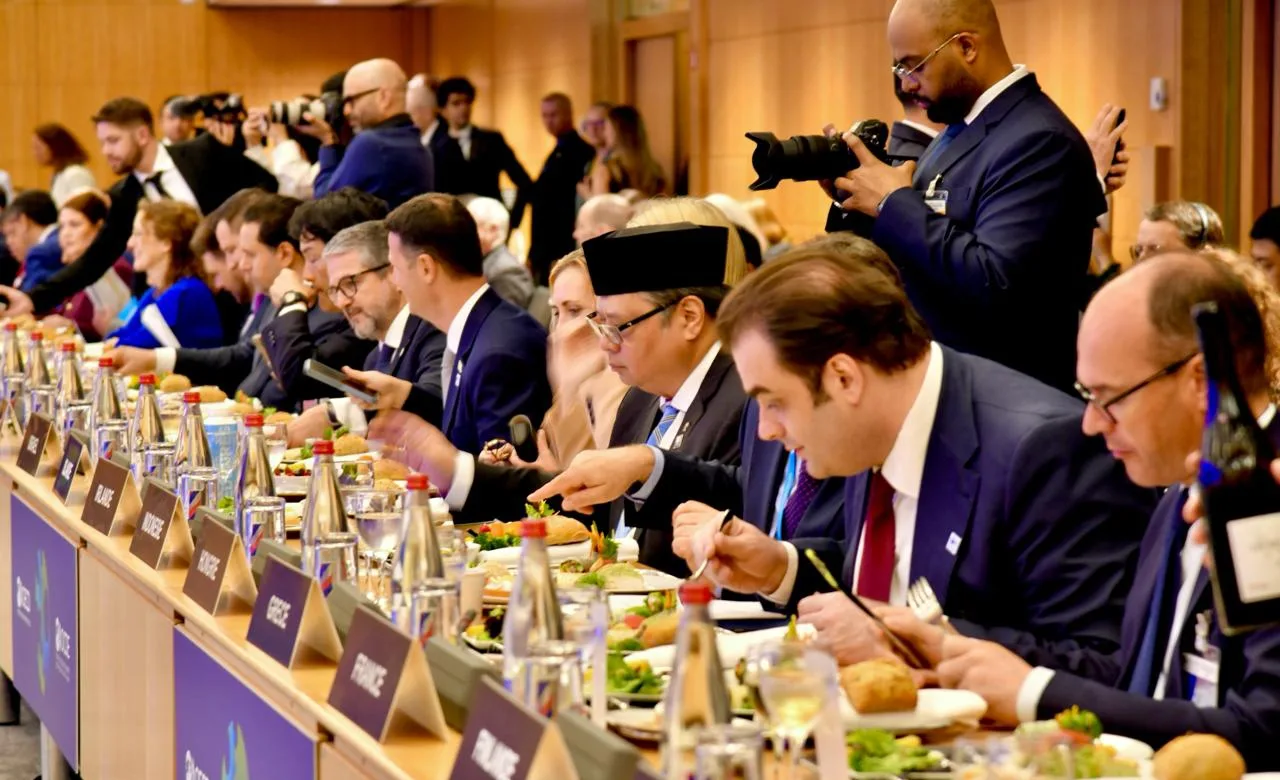
ASIATODAY.ID, PARIS – Indonesia has emerged as one of the most active players at the 2026 OECD Ministerial Council Meeting in Paris, securing broad international support for its accession to the Organisation for Economic Co-operation and Development (OECD), strengthening its bid to join the Comprehensive and Progressive Agreement for Trans-Pacific Partnership (CPTPP), and expanding strategic partnerships across technology, energy, critical minerals, and global trade.
Leading a series of high-level bilateral meetings, Coordinating Minister for Economic Affairs Airlangga Hartarto advanced Indonesia’s economic diplomacy agenda at a time of growing geopolitical uncertainty, trade fragmentation, and slowing global productivity growth.
Growing International Support for Indonesia’s OECD Ambitions
One of the most significant outcomes of the Paris meetings was the reaffirmation of support from several advanced economies for Indonesia’s goal of becoming a full OECD member by 2028.
Finland, Australia, Japan, Switzerland, and the United Kingdom all expressed strong backing for Indonesia’s accession process, while OECD Secretary-General Mathias Cormann praised Jakarta’s progress in aligning domestic regulations with OECD standards.
Indonesia has now entered the technical review stage of accession after submitting its Initial Memorandum covering 240 OECD legal instruments across 26 policy areas.
According to Airlangga, Indonesia has already achieved substantial progress, particularly in environmental governance, where approximately 60 percent of national policies are now aligned with OECD standards.
“We remain optimistic that meeting OECD standards will accelerate Indonesia’s economic transformation while enabling the country to contribute more significantly to an inclusive and resilient global economic architecture,” Airlangga said.
Finland, Japan, and the UK Target Indonesia’s Future Industries
Technology and industrial cooperation featured prominently throughout the meetings.
Finland reaffirmed its commitment to expanding cooperation in advanced technologies, including 5G and 6G networks, quantum computing, semiconductors, artificial intelligence, Internet of Things applications, and smart-city development. Finnish companies are also playing a growing role in Indonesia’s downstream mineral processing strategy, including copper smelting projects that produce high-grade cathodes for global manufacturing supply chains.
Japan, meanwhile, pledged deeper collaboration in electric vehicle ecosystems, renewable energy development, geothermal projects, shipbuilding, and next-generation nuclear technologies such as Small Modular Reactors (SMRs).
The United Kingdom expanded its partnership with Indonesia in semiconductor development through collaboration with sovereign wealth fund Danantara, while also supporting higher education investments through the establishment of academic programs involving King’s College London and the University of Liverpool.
Australia and Switzerland Deepen Critical Minerals and Energy Cooperation
Indonesia and Australia agreed to strengthen cooperation in critical minerals, combining Indonesia’s vast nickel resources with Australia’s expertise and reserves in lithium.
The two countries also discussed plans for strategic oil storage facilities near the Malacca Strait as part of broader efforts to enhance regional energy security.
Switzerland, for its part, pledged continued support for Indonesia’s OECD accession process and committed €3 million toward capacity-building initiatives focused on state-owned enterprise governance, responsible business conduct, and anti-corruption reforms.
Both countries also expanded cooperation on smart-grid technologies and battery storage systems aimed at accelerating Indonesia’s clean-energy transition.
Indonesia Calls for a New Global Industrial Policy Framework
At the OECD Ministerial Council Meeting, Indonesia positioned itself as a leading voice among emerging economies advocating for a balanced approach to industrial policy.
Airlangga highlighted Indonesia’s downstream industrialization strategy, which helped increase mineral and steel export values from approximately US$5 billion in 2016 to US$30 billion in 2025.
Indonesia urged OECD members to design industrial policies that promote innovation, competitiveness, and sustainability while avoiding excessive subsidy programs that distort global markets and undermine productivity.
“The global industrial transformation must move hand in hand with a just energy transition. International cooperation is no longer optional—it is essential for ensuring inclusive and sustainable growth,” Airlangga said.
Indonesia Pushes for WTO Reform
On the sidelines of the OECD gathering, Airlangga also participated in an informal ministerial meeting of the World Trade Organization (WTO), where he called for reforms that would make the multilateral trading system more effective without sacrificing inclusiveness.
Indonesia argued that WTO modernization should strengthen the organization’s ability to deliver meaningful outcomes while preserving development priorities for emerging and developing economies.
“The WTO will remain relevant not only if it becomes more efficient in decision-making, but also if those decisions address the needs of all members and contribute to inclusive development,” Airlangga stated.
Trade Breakthrough with the United States
Perhaps the most tangible economic achievement came from Indonesia’s bilateral discussions with the Office of the United States Trade Representative (USTR).
Washington recognized Indonesia as one of only six priority countries receiving favorable consideration under its trade review framework, citing significant progress in labor-law enforcement and efforts to eliminate forced labor from supply chains.
As a result, Indonesia secured a lower tariff rate of 10 percent under the Section 301 review process, compared with 12.5 percent imposed on most other countries.
The USTR also indicated its intention to approve 18 tariff-exclusion requests submitted by Indonesia, a move expected to reduce export costs and strengthen the competitiveness of Indonesian products in the U.S. market.
Indonesia Expands Its Global Economic Footprint
The intensive series of meetings in Paris underscored Indonesia’s increasingly ambitious role in global economic diplomacy.
Beyond trade and investment, Jakarta is actively pursuing partnerships in advanced technology, critical-mineral supply chains, clean energy, industrial modernization, education, and institutional reform.
With growing international support for its OECD and CPTPP ambitions, Indonesia appears to be gaining momentum in its effort to position itself as a major economic force in the Indo-Pacific and a more influential player in shaping the future global economic order. (Midwan)
Follow Us at Google News and WA Channel