
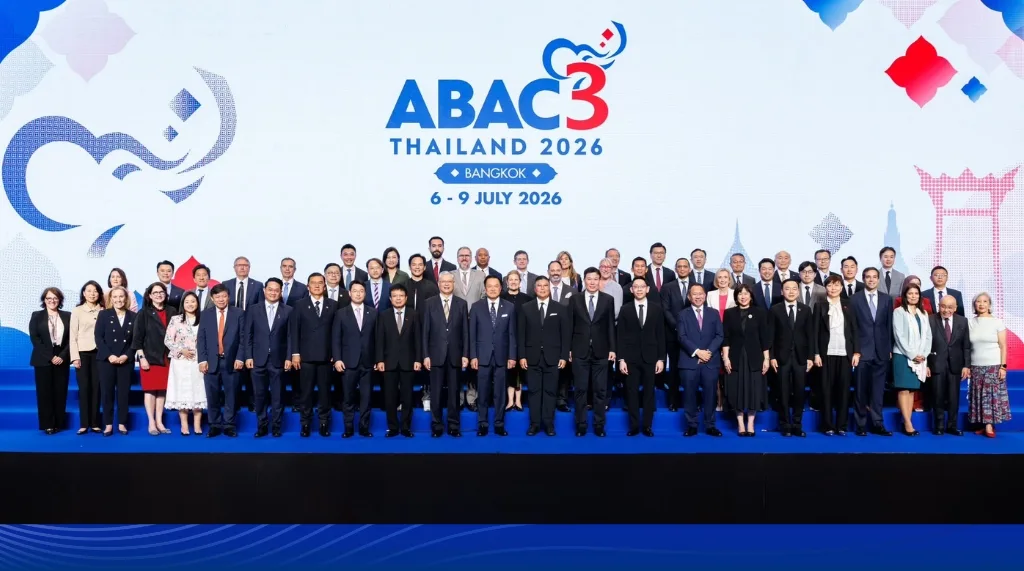
ASIATODAY.ID, BANGKOK — The APEC Business Advisory Council (ABAC) has called on Asia-Pacific economies to reinforce open trade, regional connectivity and innovation-driven growth, warning that closer cooperation is essential to sustain economic resilience amid mounting geopolitical tensions, technological disruption and global market uncertainty.
Meeting in Bangkok, ABAC finalized its 2026 Report to APEC Economic Leaders, outlining the private sector’s recommendations to strengthen the region’s long-term competitiveness through freer trade, resilient supply chains, digital transformation and greater public-private collaboration.
ABAC 2026 Chair Li Fanrong said the Asia-Pacific must preserve an open, transparent and predictable trade and investment environment while embracing the opportunities created by artificial intelligence (AI), frontier technologies and the global energy transition.
“Our region’s long-term prosperity will depend on economies working together to preserve an open and predictable environment for trade and investment while harnessing the opportunities presented by artificial intelligence and other frontier technologies,” Li said.
Under the theme “Openness, Connectivity and Synergy,” ABAC urged APEC to reaffirm its commitment to free, open, fair, non-discriminatory and predictable trade and investment, while accelerating business-led progress toward the Free Trade Area of the Asia-Pacific (FTAAP).
The report recommends reducing non-tariff barriers to food trade, establishing coherent digital trade rules, expanding women’s economic participation through the voluntary ABAC Equal Pay Framework, and strengthening resilient, low-carbon transport infrastructure and regional supply chains. It also calls for wider adoption of paperless trade through the APEC Centre of Excellence for Paperless Trade (ACCEPT), improved logistics and renewed cooperation under an Open Skies agenda.
Highlighting the transformative potential of emerging technologies, ABAC urged governments to establish innovation-friendly regulatory frameworks for artificial intelligence and quantum technologies while ensuring developing economies and micro, small and medium-sized enterprises (MSMEs) have access to digital infrastructure, financing and digital skills.
The council further called for increased private investment through innovative public-private partnerships to finance infrastructure, clean energy, healthcare, water security and climate resilience. It also advocated stronger regional cooperation on food security, energy security, pandemic preparedness, disaster resilience and sustainable mining.
Thailand’s Prime Minister Anutin Charnvirakul welcomed ABAC members to Bangkok and reaffirmed Thailand’s commitment to strengthening regional economic cooperation through APEC, emphasizing the private sector’s central role in advancing sustainable growth.
During the meeting, ABAC also endorsed policy letters to APEC ministers responsible for Digital and AI, SMEs, Energy, Food Security, Transport and Finance, alongside policy statements on Quantum Technology, Health and Sustainable Mining.
ABAC will hold its final meeting of 2026 in Shenzhen, China, before presenting its recommendations to APEC Economic Leaders later this year. (AT Network)
Follow Us at Google News, Instagram, WA Channel, and LinkedIn