
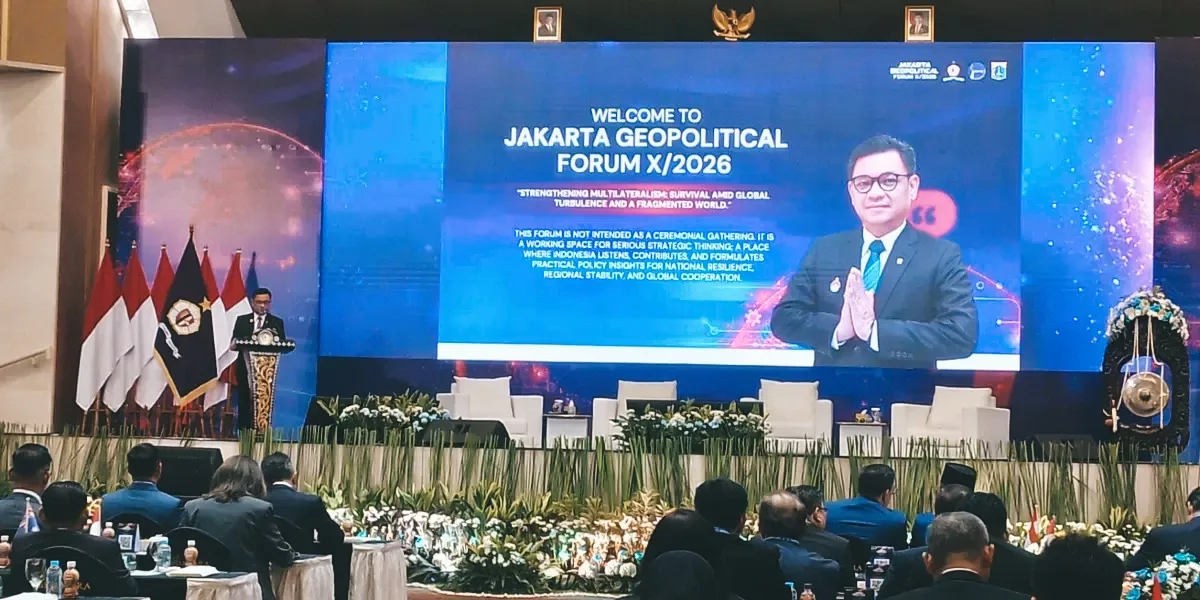
ASIATODAY.ID, JAKARTA — As strategic competition between the United States and China reshapes global trade, technology, and security, Indonesia used the 10th Jakarta Geopolitical Forum (JGF) 2026 to present a comprehensive strategic vision for navigating an increasingly fragmented international order. Bringing together senior policymakers, diplomats, military leaders, business executives, academics, and international experts, the forum highlighted Jakarta’s efforts to strengthen its strategic autonomy through diplomacy, economic resilience, technological capability, and value-added industrialization.
Held under the theme “Strengthening Multilateralism: Survival Amid Global Turbulence and a Fragmented World,” the annual forum, organized by Indonesia’s National Resilience Institute (Lemhannas RI), examined the future of global governance at a time when intensifying geopolitical rivalry, technological competition, supply-chain realignment, and strategic protectionism are reshaping the international landscape.
Now in its tenth year, the Jakarta Geopolitical Forum has established itself as one of Southeast Asia’s leading strategic dialogue platforms, providing a venue where policymakers and experts assess how middle powers can safeguard their interests while contributing to regional and global stability.
Strategic Autonomy in a Multipolar World
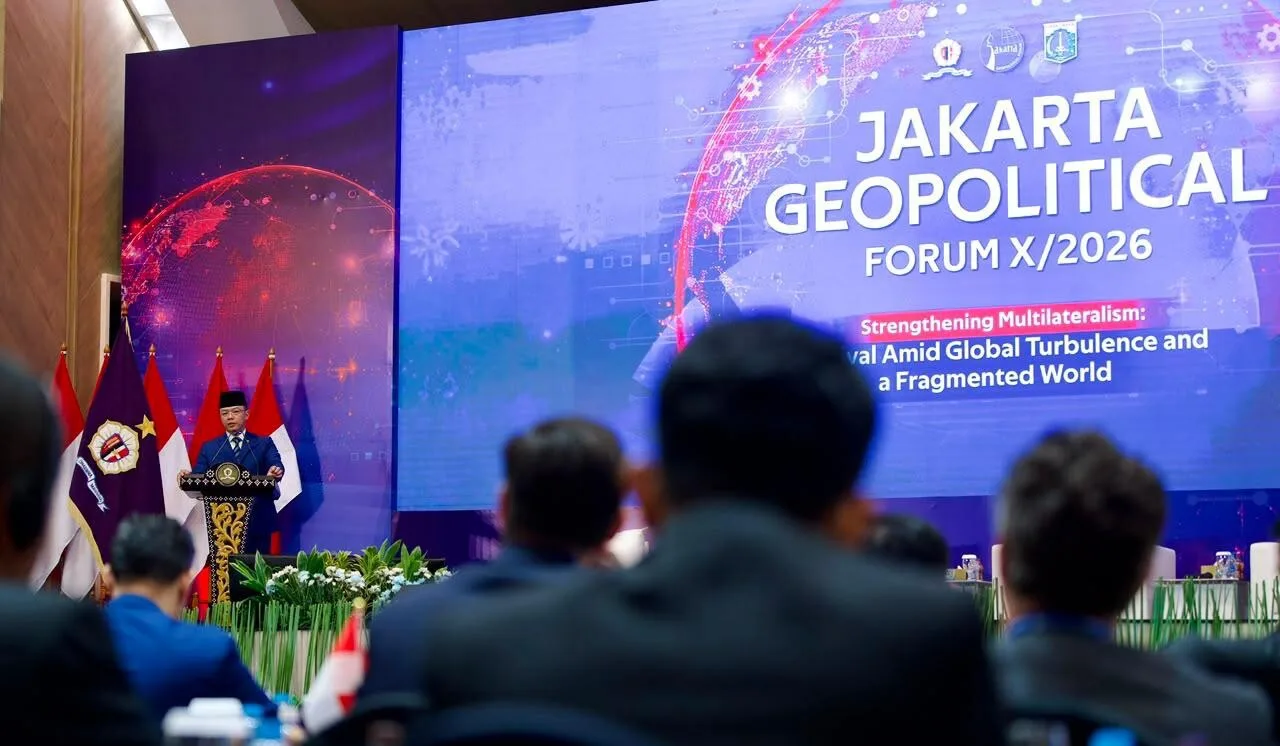
Opening the forum, Foreign Minister Sugiono argued that Indonesia’s long-standing “independent and active” (bebas aktif) foreign policy has become increasingly relevant amid accelerating geopolitical fragmentation.
Rather than aligning itself with competing power blocs, Indonesia seeks to preserve its strategic autonomy while remaining actively engaged in promoting peace, stability, and international cooperation.
“Being independent and active does not mean being passive or neutral. Indonesia will not be drawn into exclusive blocs. Instead, we will continue building bridges and expanding our strategic space,” Sugiono said.
He stressed that weaknesses in today’s multilateral system should not justify abandoning it. Instead, international institutions must be reformed to become more representative, transparent, inclusive, and effective in responding to twenty-first century challenges.
Indonesia will continue advancing that agenda through ASEAN, the G20, BRICS, the D-8, the Global South, and its accession process to the OECD.
“Multilateralism can still work—but it cannot run on autopilot,” he said.
Critical Minerals and Chip Diplomacy
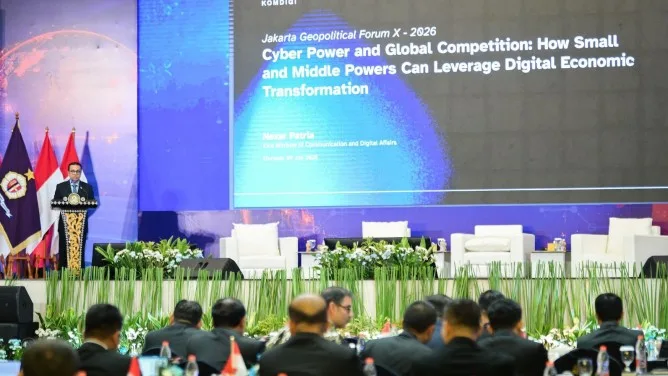
Among the forum’s most consequential proposals was Deputy Minister of Communication and Digital Affairs Nezar Patria’s concept of “chip diplomacy,” positioning Indonesia’s critical mineral resources as strategic assets in the global race for artificial intelligence and semiconductor leadership.
Rather than remaining primarily an exporter of raw materials, Indonesia aims to leverage its resource endowment to secure access to advanced computing capacity, semiconductor technology, technology transfer, and high-value manufacturing partnerships.
“Indonesia should use its critical minerals to negotiate better access to computing capacity, technology transfer, and advanced manufacturing partnerships,” Nezar said.
Indonesia possesses the world’s largest nickel reserves, is the second-largest producer of cobalt, and ranks among the world’s leading exporters of copper—minerals that have become indispensable for electric vehicle batteries, semiconductors, AI infrastructure, and hyperscale data centers.
According to Nezar, those advantages provide Indonesia with an opportunity to become an integral player in the global AI ecosystem rather than remaining at the lower end of global value chains.
To realize that ambition, the government is prioritizing chip diplomacy, expanded energy infrastructure for data centers, AI and semiconductor talent development, stronger data governance, and AI solutions tailored to Indonesia’s national priorities.
“Digital power is ultimately not just about technology. It depends on political will, institutional strength, policy continuity, and a long-term national strategy,” he said.
Building Trade Resilience
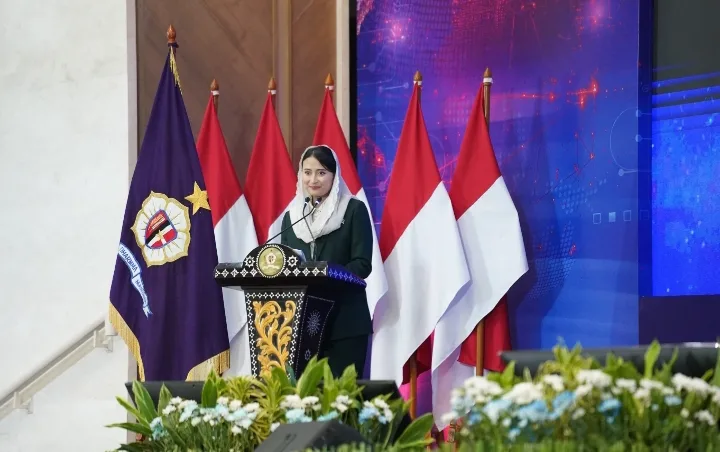
Deputy Minister of Trade Dyah Roro Esti Widya Putri focused on the economic implications of geopolitical fragmentation, arguing that rising protectionism and supply-chain disruptions require Indonesia to diversify export markets, investment partners, and strategic economic relationships.
She reaffirmed Indonesia’s commitment to an open, rules-based international trading system while reducing dependence on single markets, technologies, and supply chains.
Indonesia is strengthening its economic diplomacy through ASEAN, the World Trade Organization (WTO), APEC, the G20, BRICS, and the OECD accession process.
For Jakarta, trade should remain a bridge for international cooperation rather than another arena of geopolitical confrontation.
Redefining National Resilience
Discussions throughout the forum highlighted that national resilience is no longer measured solely by military capability or economic size. Increasingly, it is determined by a country’s ability to secure critical supply chains, develop advanced technologies, strengthen human capital, safeguard energy and food security, and build institutions capable of responding to rapidly evolving global risks.
The forum’s three plenary sessions examined the erosion of multilateralism, the rise of strategic protectionism, and intensifying competition in artificial intelligence, cybersecurity, and digital transformation—issues that are redefining the strategic environment for both major and middle powers.
Participants broadly agreed that countries such as Indonesia must pursue integrated strategies that combine diplomacy, industrial policy, technological development, and international cooperation to remain competitive in an increasingly uncertain world.
A Strategic Vision for Indonesia’s Future
Taken together, the discussions at the 10th Jakarta Geopolitical Forum illustrated how Indonesia is integrating foreign policy, trade, digital transformation, industrial development, and critical mineral strategy into a broader framework of national resilience. Rather than treating these as separate policy agendas, Jakarta is increasingly presenting them as interconnected pillars of its long-term geopolitical and economic strategy.
As the international order enters a period defined by strategic competition, technological rivalry, supply-chain realignment, and mounting pressure on multilateral institutions, Indonesia is seeking to expand its strategic options without compromising its long-standing independent and active foreign policy.
The Jakarta Geopolitical Forum demonstrated that Southeast Asia’s largest economy is positioning itself not only to adapt to a changing world, but also to contribute to shaping a more resilient, inclusive, and rules-based regional and global order. (AT Network)
Follow Us at Google News, Instagram, WA Channel, and LinkedIn