
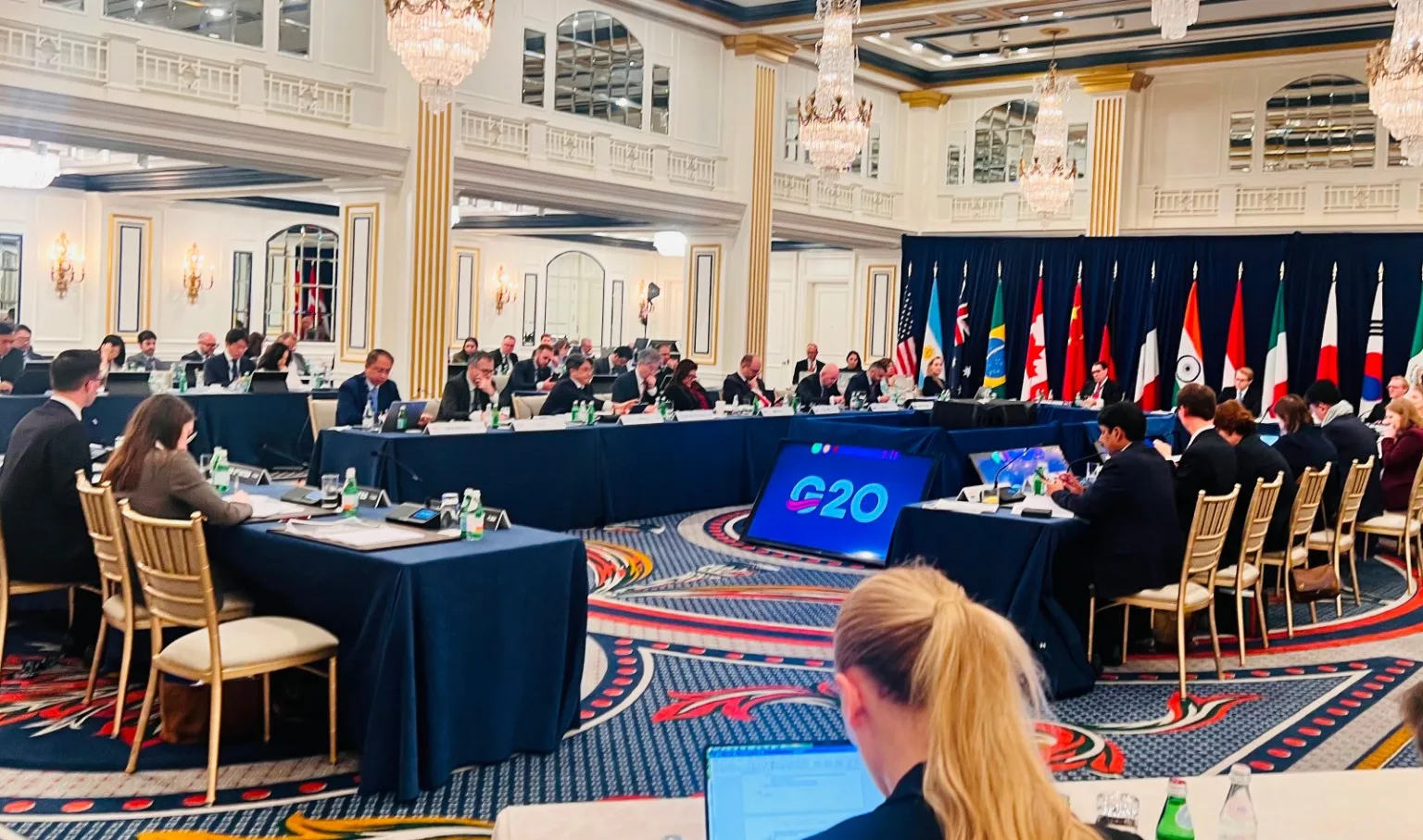
ASIATODAY.ID, WASHINGTON — Indonesia is stepping up its global economic diplomacy, using the 2026 G20 Sherpa Meeting to advocate reforms to international trade, energy security, sovereign debt governance, and artificial intelligence (AI) regulation as the world’s largest economies confront geopolitical tensions, economic fragmentation, and slowing growth.
At the second G20 Sherpa Meeting under the U.S. Presidency, Indonesia positioned itself as a bridge between advanced and emerging economies, arguing that the next phase of global economic governance must be more resilient, inclusive, and responsive to the needs of developing countries.
Leading Indonesia’s delegation, G20 Sherpa Edi Prio Pambudi said future global economic policies must deliver tangible benefits while ensuring emerging economies become active architects—not merely rule takers—of international trade, finance, technology, and sustainable development.
Trade reform dominated the opening session as G20 members debated four contentious issues reshaping the global economy: forced labor in supply chains, the future of the Most Favored Nation (MFN) principle, industrial overcapacity, and the weaponization of food exports.
Indonesia highlighted its domestic reforms through Trade Ministerial Regulation No. 9/2026, which restricts imports linked to forced labor, while reaffirming its commitment to international labor standards through the ratification of nine ILO Fundamental Conventions.
Energy security also emerged as a central priority. G20 members advanced principles aimed at improving affordability, diversifying energy supplies, strengthening electricity grids, enhancing cyber resilience, and encouraging regulatory innovation.
Indonesia supported wider recognition of LPG as a practical clean-cooking solution for developing economies and backed stronger cooperation on critical minerals, sustainable water management, and circular economy initiatives.
On the second day, Indonesia reinforced its role as a consensus builder after the International Monetary Fund projected global economic growth of just 3.1% in 2026 amid persistent geopolitical uncertainty and elevated energy prices.
During the Finance Track, Indonesia supported regulatory simplification through its Debottlenecking Task Force and highlighted Danantara’s role in mobilizing long-term private investment. At the same time, Jakarta stressed that deregulation must not weaken labor rights, social protections, or environmental standards.
Indonesia also called for a fairer sovereign debt framework, welcomed greater transparency under the Paris Club’s Common Framework, and urged equitable treatment between official bilateral lenders and private creditors.
In discussions on digital innovation, Indonesia promoted cross-border QR payment connectivity to reduce transaction costs for migrant workers and small businesses, while calling for stronger international cooperation against cross-border cryptocurrency fraud.
Jakarta also urged stronger safeguards against the unauthorized use of copyrighted content for AI model training and emphasized that international AI governance must fully respect national data protection laws and digital sovereignty.
As Indonesia finalizes its National AI Roadmap and ethical guidelines, Edi argued that global AI standards should remain flexible and inclusive rather than becoming new compliance burdens for developing countries and small businesses.
He added that emerging economies should help shape global AI rules instead of simply adopting standards written elsewhere, while encouraging greater investment in data centers and cloud infrastructure to ensure developing nations become innovation partners rather than merely suppliers of data.
The outcomes of the Sherpa Meeting are expected to influence negotiations ahead of the 2026 G20 Leaders’ Summit, reinforcing Indonesia’s ambition to play a larger role in shaping a more balanced, resilient, and inclusive global economic order. (AT Network)
Follow Us at Google News, WA Channel, and LinkedIn