
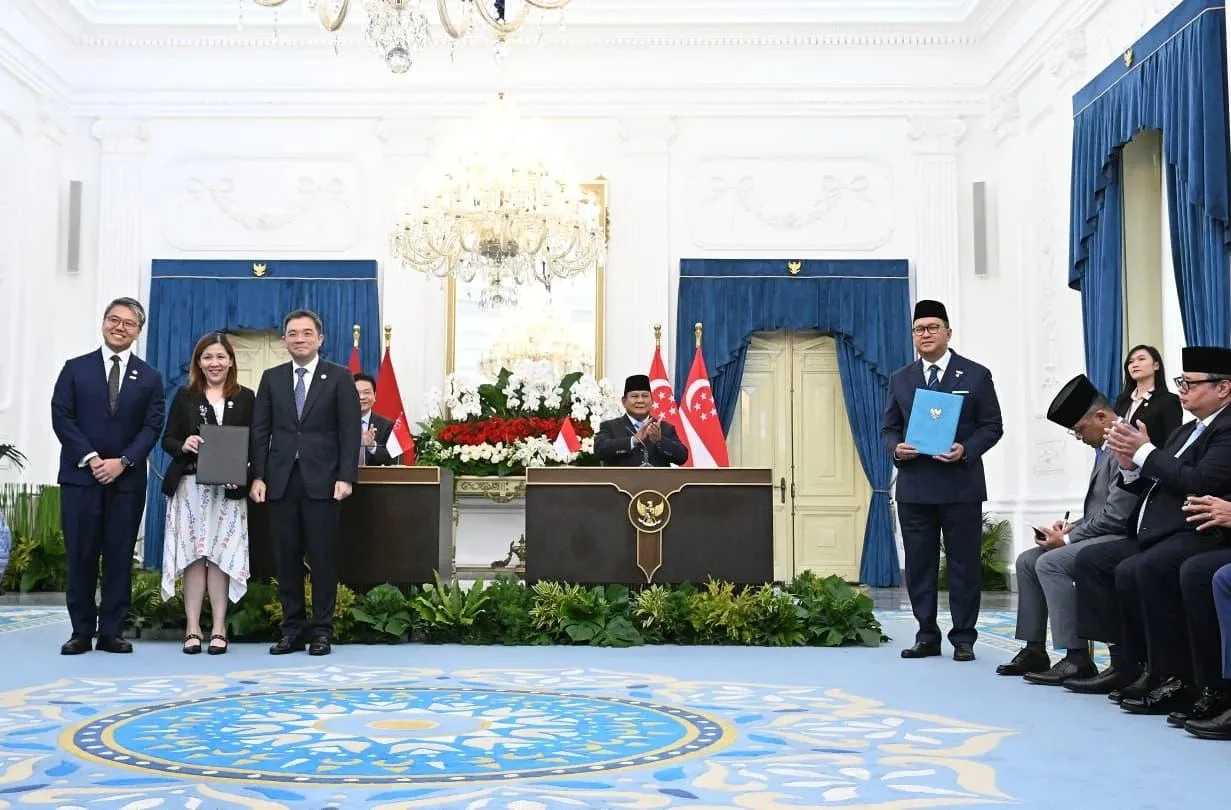
ASIATODAY.ID, JAKARTA — Indonesia and Singapore have set an ambitious target to bring at least 3.4 gigawatts (GW) of cross-border renewable electricity projects into commercial operation by 2035, marking one of Southeast Asia’s most significant clean energy partnerships and a major step toward realizing the ASEAN Power Grid.
The commitment was reaffirmed during the Singapore–Indonesia Leaders’ Retreat, where Prabowo Subianto and Lawrence Wong agreed to accelerate cross-border electricity trade (CBET), strengthen regional energy security, and deepen bilateral cooperation in support of Southeast Asia’s low-carbon transition.
To drive the initiative, the Indonesian government has designated Danantara Indonesia to spearhead the country’s cross-border electricity trade strategy, placing the state investment body at the center of Indonesia’s ambition to become a regional clean energy leader.
Through its investment arm, Danantara Investment Management (DIM), Danantara signed Memoranda of Understanding (MoUs) with Keppel Electric and Sembcorp Utilities to explore long-term offtake arrangements for imported low-carbon electricity. A separate MoU with Singapore Energy Interconnections will facilitate technical cooperation and information sharing on the development of cross-border transmission infrastructure.
The agreements highlight Singapore’s growing demand for imported renewable electricity while opening new opportunities for large-scale investment in Indonesia’s renewable power generation, transmission networks, battery energy storage systems, and green industrial development.
Singapore’s Minister-in-charge of Energy and Science & Technology, Tan See Leng, and Indonesia’s Minister of Investment and Downstream Industry as well as Chief Executive Officer of Danantara Indonesia, Rosan Perkasa Roeslani, welcomed the agreements and reaffirmed both governments’ commitment to bringing the projects into commercial operation by 2035.
The initiative is expected to enhance regional energy security, diversify Singapore’s low-carbon electricity supply, attract billions of dollars in clean energy investment, create thousands of skilled jobs across Indonesia’s renewable energy sector, and accelerate the country’s green industrial transformation.
To support implementation, Indonesia and Singapore will develop aligned regulatory frameworks, investment policies, and technical standards governing cross-border electricity trade. Both governments will also establish a Cross-Border Renewable Energy Certificate (REC) Framework, aligned with international standards, to ensure transparent tracking and accounting of renewable electricity before commercial power exports begin.
Minister Tan said several Indonesian electricity export projects had already made substantial progress and expressed confidence that strong political commitment and close bilateral coordination would enable the remaining regulatory and technical challenges to be resolved before the end of the decade.
He said the initiative would strengthen regional energy resilience, improve sustainability, create new economic opportunities, and move ASEAN significantly closer to establishing an integrated regional electricity market.
Minister Rosan said Indonesia is fully committed to completing the regulatory reforms and infrastructure needed to deliver the projects on schedule. He emphasized that the electricity designated for export would come from new renewable generation capacity, separate from the country’s domestic electricity supply, ensuring Indonesia’s energy security remains protected.
He described the Singapore interconnection as a strategic catalyst for Indonesia’s broader economic transformation—accelerating green industrialisation, attracting global capital, expanding high-value manufacturing, and strengthening the country’s role in the regional clean energy economy.
If successfully delivered, the 3.4GW initiative will position Indonesia among Southeast Asia’s leading exporters of renewable electricity while strengthening Singapore’s long-term energy security.
More importantly, it could become a cornerstone of the ASEAN Power Grid, providing a practical model for regional cross-border electricity trade and demonstrating how clean energy cooperation can simultaneously advance decarbonisation, economic growth, and long-term energy resilience across Southeast Asia. (AT Network)
Follow Us at Google News, WA Channel, and LinkedIn