
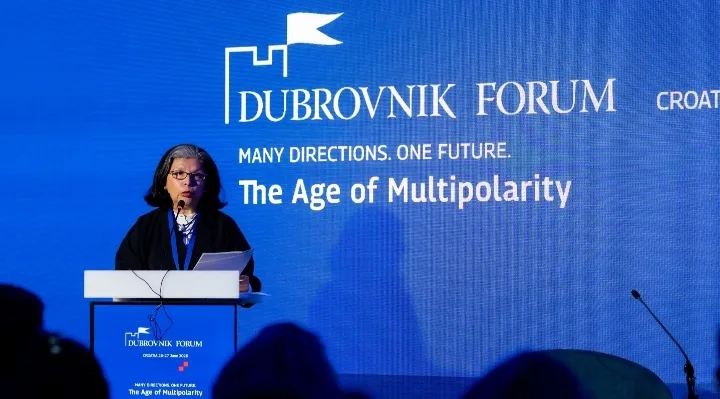
ASIATODAY.ID, DUBROVNIK — Countries that fail to adapt to sweeping shifts in technology, energy and global supply chains risk falling behind in the next era of economic development, the United Nations Industrial Development Organization (UNIDO) warned as it unveiled its flagship Industrial Development Report (IDR) 2026, outlining the forces expected to reshape global industry through 2050.
Launched during the Dubrovnik Forum 2026, the report argues that industrial policy has become a strategic imperative—extending far beyond manufacturing to encompass economic security, supply-chain resilience, technological leadership and long-term competitiveness.
Presenting the report’s findings, Cecilia Ugaz Estrada said governments must fundamentally rethink industrial strategies to remain competitive in an increasingly volatile global economy.
“Industrial policy is no longer just a technical issue. It has become strategic, tied to economic security, supply-chain resilience and long-term competitiveness,” she said.
UNIDO identifies five global megatrends that will shape industrial development over the coming decades: the green transition, artificial intelligence and digitalization, the reconfiguration of global value chains, demographic change, and the transformation of food systems.
According to the report, these converging forces are reshaping global production, investment and trade, creating unprecedented opportunities for countries that adapt while widening the competitive gap for those that fail to modernize.
The report’s regional chapter on Eastern Europe and Central Asia concludes that the region holds considerable industrial potential but must overcome structural bottlenecks, uneven digital adoption, productivity gaps and limited innovation financing to capitalize on the next wave of industrial transformation.
In a video message, Gerd Müller reaffirmed the organization’s commitment to helping countries convert global disruption into inclusive and sustainable industrial growth through stronger international cooperation and strategic policy support.
Croatia’s State Secretary for Trade and Development Cooperation, Zdenko Lučić said sustainable industrialization is essential for strengthening economic resilience, creating quality jobs, accelerating technological innovation and deepening regional cooperation.
Panelists also stressed the urgency of expanding renewable energy deployment, accelerating digital transformation among micro, small and medium-sized enterprises (MSMEs), strengthening innovation ecosystems and reinforcing multilateral cooperation as geopolitical uncertainty and shifting supply chains continue to reshape the global economy.
UNIDO concluded that the defining challenge is no longer whether industrial transformation will occur, but whether governments and businesses can move quickly enough to secure their place in the next generation of global manufacturing and value creation.
Now in its 13th edition, the Industrial Development Report 2026 concludes that coordinated industrial policies could increase manufacturing value added in developing economies by around 60% while lifting more than 500 million people out of poverty by 2050—underscoring that the global industrial race is accelerating, and that countries investing in innovation, resilience and sustainable manufacturing will be best positioned to lead the economy of the future. (AT Network)
Follow Us at Google News, WA Channel, and LinkedIn