
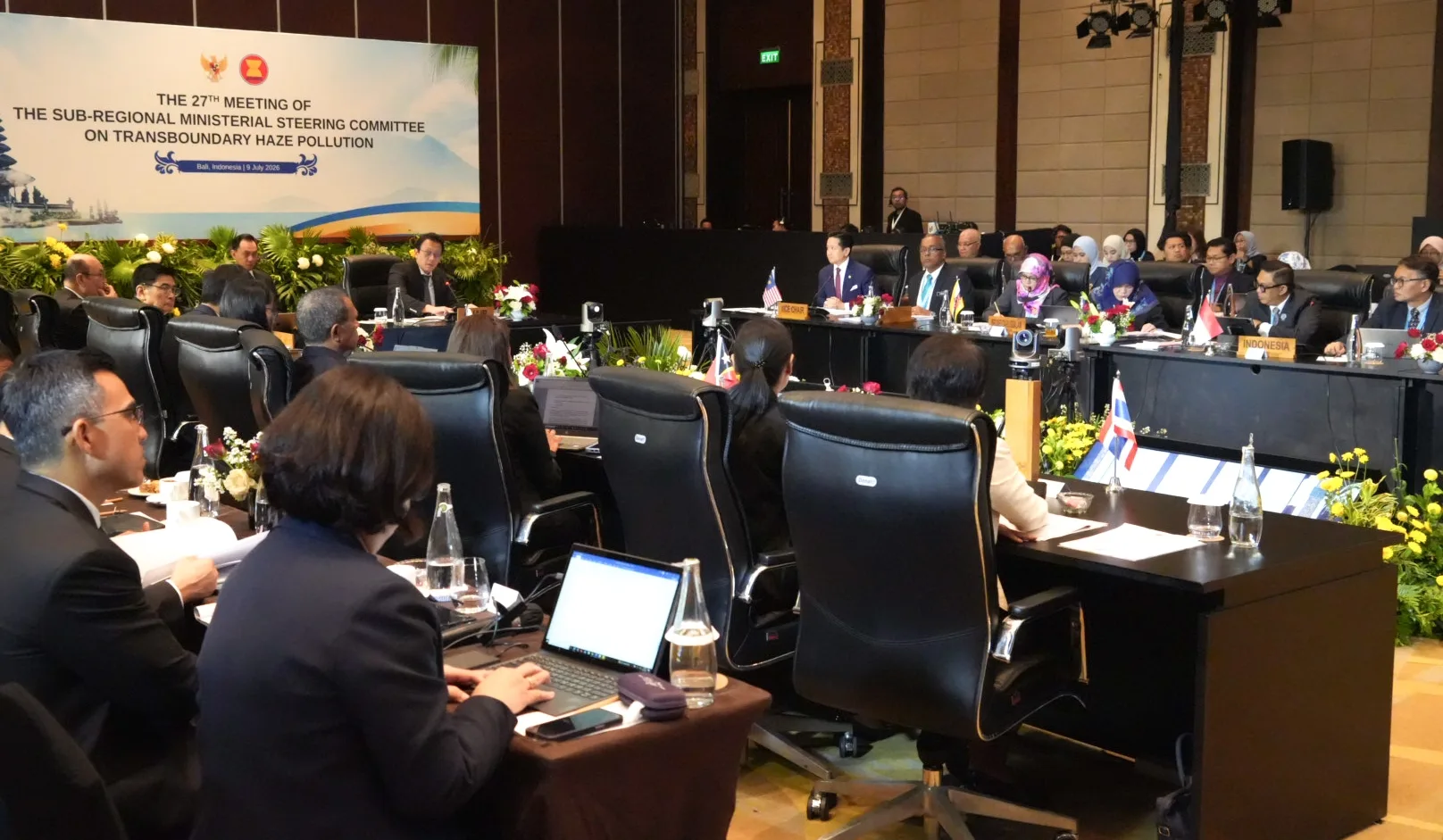
ASIATODAY.ID, BALI — ASEAN member states have reaffirmed their commitment to strengthen regional cooperation against forest and land fires as climate change and the anticipated impacts of El Niño threaten to intensify dry-season conditions across Southeast Asia.
The commitment was reinforced during the 27th Sub-Regional Ministerial Steering Committee (MSC) on Transboundary Haze Pollution, held in Bali on 9 July. Hosted by Indonesia, the meeting brought together environment ministers and senior officials from Brunei Darussalam, Indonesia, Malaysia, Singapore, Thailand, Timor-Leste, and the ASEAN Secretariat to coordinate regional strategies for preventing transboundary haze.
The ministerial session followed the 27th Technical Working Group (TWG) meeting, where delegates reviewed progress in implementing the ASEAN Agreement on Transboundary Haze Pollution (AATHP) and discussed measures to strengthen regional preparedness through improved monitoring, early warning systems, and coordinated emergency response.
Opening the meeting, Indonesia’s Minister of Environment and Head of the Environmental Control Agency, Moh Jumhur Hidayat, said Southeast Asia must respond collectively to increasingly unpredictable climate conditions.
“The potential impacts of El Niño and climate variability require ASEAN to reinforce preparedness, strengthen early warning systems, improve monitoring, and ensure rapid regional coordination to prevent large-scale forest and land fires,” he said.
Indonesia presented its 2026 wildfire mitigation strategy, which includes reactivating the national Forest and Land Fire Coordination Desk, declaring emergency preparedness in five fire-prone provinces, expanding technology-based hotspot surveillance, strengthening integrated ground patrols, increasing community awareness, conducting aerial water-bombing missions, and implementing weather modification operations to reduce wildfire risks before they escalate.
A major outcome of the Bali meeting was renewed momentum for establishing the ASEAN Coordinating Centre for Transboundary Haze Pollution Control (ACCTHPC), which is expected to become the region’s central platform for coordinating wildfire prevention, haze monitoring, information sharing, and emergency response.
Indonesia reported significant progress in completing its domestic ratification process while preparing operational guidelines, office facilities, and advanced monitoring systems for the centre. Jakarta also reiterated its readiness to support the centre’s initial operations, including the possible appointment of its first Executive Director, while upholding ASEAN’s principle of equitable representation.
Delegates welcomed Indonesia’s leadership in advancing the operationalisation of the ACCTHPC and acknowledged Viet Nam for submitting its instrument of approval for the agreement. They also called on all ASEAN member states to accelerate ratification so the centre can begin full operations and strengthen regional cooperation in preventing transboundary haze.
Malaysia’s Minister of Natural Resources and Environmental Sustainability, Dato’ Sri Arthur Joseph Kurup, stressed that preventive action remains the region’s most effective defence against large-scale forest fires.
He highlighted the importance of continuous field monitoring, early intervention in high-risk areas, and rapid suppression of emerging hotspots to minimise the risk of transboundary haze affecting neighbouring countries.
Meanwhile, San Lwin, ASEAN Deputy Secretary-General for the ASEAN Socio-Cultural Community, warned that evolving El Niño conditions could bring a hotter and longer dry season across Southeast Asia, increasing the likelihood of severe wildfire outbreaks.
He urged ASEAN member states to strengthen political commitment and deepen regional cooperation to safeguard public health, biodiversity, economic activity, and environmental sustainability from the impacts of transboundary haze.
Beyond emergency preparedness, the Bali meeting underscored ASEAN’s broader ambition to strengthen regional environmental governance in response to climate change. Participants agreed that closer cooperation, faster information exchange, integrated monitoring systems, and stronger institutional coordination will be essential to protecting communities and ecosystems from increasingly complex climate-related disasters.
The meeting concluded with a renewed commitment to accelerate the operationalisation of the ACCTHPC and reinforce collective action under the ASEAN Agreement on Transboundary Haze Pollution. As climate risks continue to grow, ASEAN is positioning itself to build a more resilient, sustainable, and haze-free region through deeper regional cooperation, shared responsibility, and coordinated climate action. (Midwan)
Follow Us at Google News, Instagram, WA Channel, and LinkedIn