
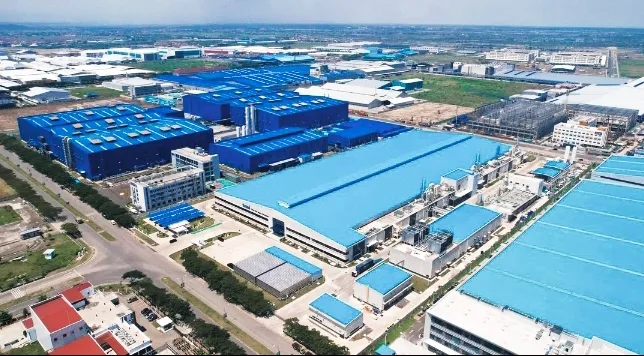
ASIATODAY.ID, EKATERINBURG — Indonesia is stepping up its campaign to attract Russian and Eurasian investment by offering 180 industrial estates as production and manufacturing hubs during INNOPROM 2026, one of Eurasia’s largest industrial exhibitions.
Appearing as the event’s Official Partner Country, Indonesia showcased a broad portfolio of investment-ready industrial zones backed by integrated infrastructure, business-friendly regulations, fiscal incentives, and strategic logistics, underscoring its ambition to become one of Asia’s leading manufacturing destinations.
Minister of Industry Agus Gumiwang Kartasasmita said industrial estates are at the heart of Indonesia’s industrial transformation strategy, serving as integrated ecosystems that accelerate downstream industries, generate higher value-added production, create employment, and strengthen the country’s position in global supply chains.
“Industrial estates are a strategic instrument for accelerating Indonesia’s industrial transformation while improving national competitiveness and supporting sustainable economic growth,” he said during the Business Talk – Dialogue between Russian and Indonesian SEZs and Industrial Estates in Yekaterinburg.
Indonesia’s industrial expansion has continued to gain momentum. As of the second quarter of 2026, the country had developed 180 industrial estates hosting nearly 12,000 companies. In 2025 alone, these estates attracted IDR6,744.58 trillion (approximately US$415 billion) in investment, up 9.26 percent from the previous year, while supporting around 2.35 million jobs.
To enhance its appeal to international manufacturers, the government is offering a comprehensive package of fiscal and non-fiscal incentives, including risk-based business licensing, tax holidays and tax allowances, super tax deductions for research and vocational training, customs exemptions for imported machinery and raw materials, preferential natural gas pricing for eligible industries, industrial equipment restructuring programs, and enhanced investment protection through National Vital Object status.
Director General for Industrial Resilience, Regional Development and International Industrial Access Tri Supondy said closer regulatory alignment between Indonesia and Russia would help create a more transparent, efficient, and predictable investment climate.
He said the dialogue was expected to lay the foundation for long-term cooperation extending beyond investment to include technology transfer, industrial innovation, knowledge exchange, and the development of internationally connected industrial clusters.
Indonesia also highlighted the success of the Kendal Special Economic Zone (Kendal SEZ), jointly developed by Jababeka & Co. and Singapore’s Sembcorp Urban Development. By the end of 2025, the zone had secured cumulative investment of IDR187.05 trillion, generated more than 76,000 jobs, and attracted 142 companies operating in sectors ranging from automotive and electronics to renewable energy and fashion.
Supported by strong investor demand, Kendal SEZ is expanding through a 1,200-hectare Ecosystem Hub that will integrate research and innovation facilities, sustainable industrial zones, commercial districts, and residential communities. The expansion is projected to attract an additional IDR370 trillion in investment and create up to 250,000 jobs, reinforcing its position as one of Southeast Asia’s fastest-growing industrial ecosystems.
Indonesia’s presence at INNOPROM 2026 also produced a strategic milestone with the signing of a Memorandum of Understanding between the Indonesian Industrial Estate Association (HKI) and the Association of Clusters, Technology Parks and Special Economic Zones of Russia. The agreement is expected to deepen bilateral cooperation in industrial estate development, investment promotion, and the creation of globally competitive industrial clusters.
Five leading Indonesian industrial estate developers participated in the exhibition, enabling prospective investors to engage directly with estate operators and explore investment opportunities across Indonesia’s manufacturing sector.
As multinational companies continue to diversify their production networks, Indonesia is positioning itself as more than Southeast Asia’s largest economy. By combining large-scale industrial estates, competitive investment incentives, abundant human resources, and strategic access to regional and global markets, the country is strengthening its credentials as a manufacturing gateway connecting Southeast Asia with the rapidly growing Eurasian economy. (AT Network)
Follow Us at Google News, Instagram, WA Channel, and LinkedIn