
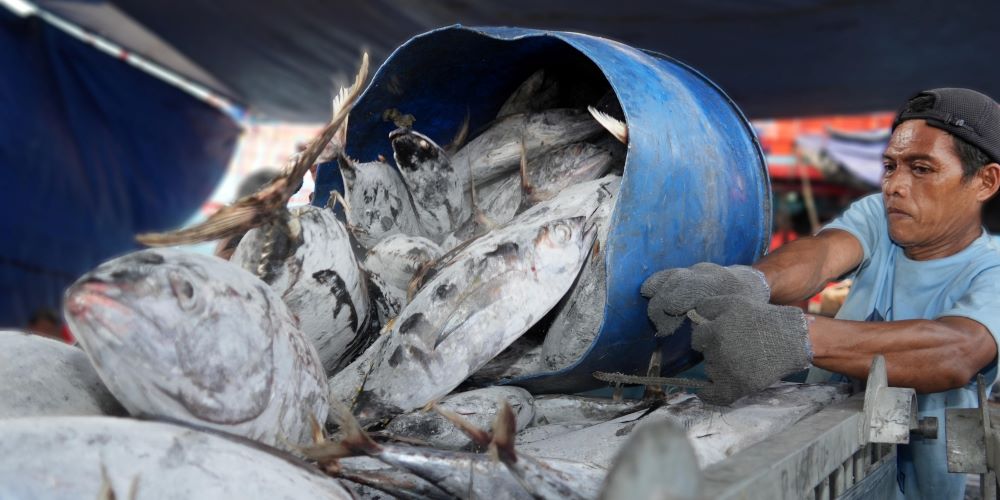
ASIATODAY.ID, JAKARTA – Measured Fishing that requires good fish handling methods on fishing vessels is a crucial factor in increasing the competitiveness of Indonesian fishery products in the global market. This standard is the basis for fulfilling export quality fish with traceability and is proof that fishing is not from illegal activities.
Acting Director General of Capture Fisheries, Ministry of Maritime Affairs and Fisheries of Indonesia, Lotharia Latif revealed that currently there are still practices in handling fish catches that do not meet international standards. As a result, Indonesian fishery products have difficulty penetrating the global market, one of which is the European Union.
“The requirements there are very strict. The quality of the fish must be really good in order to compete and enter the foreign market. In addition, it is also certified,” he explained in an official statement, quoted Saturday, March 22, 2025.
Latif added that to get fish with good quality and according to international standards, it starts from upstream, namely in the form of a fleet of standardized fishing vessels and using appropriate and environmentally friendly fishing gear.
“Next, when the fish have been caught, how to handle them on the fishing vessel, how to store them in the hold, how the crew handles them, until the fish are landed, this must really be considered. We continue to encourage fisheries business actors to implement good fish handling methods comprehensively,” he said.
Socialization and assistance to fishermen and fisheries industry players are important steps in ensuring compliance with established standards.
Farmed Fish Ready to Enter Saudi Arabian Market
Previously, the Ministry of Maritime Affairs and Fisheries together with the Food and Drug Supervisory Agency (BPOM) and the Ministry of Foreign Affairs successfully fought for the interests of the marine and fisheries sector through bilateral diplomacy with Saudi Arabia. The approval of the Saudi Arabian authorities for the export of Indonesian aquaculture products is only a matter of days away.
This indication emerged in negotiations between the competent authorities of the two countries in a virtual bilateral meeting held on Monday, March 17.
“We have completed a virtual bilateral meeting with the Saudi Food and Drugs Authority (SFDA) and thank God the negotiations went smoothly and the SFDA has been convinced and satisfied with the data presented by the Republic of Indonesia Delegation regarding the implementation of upstream-downstream fisheries quality assurance,” said the Head of the Marine and Fisheries Product Quality Control and Supervision Agency Ishartini.
Meanwhile, Indonesia and Saudi Arabia have a bilateral agreement in the field of food quality assurance with the authorized competent authority for Indonesia being BPOM and the executing party for the fishery product quality assurance and safety system being the Ministry of Marine Affairs and Fisheries.
To date, the number of Indonesian fisheries companies registered with SFDA is 58 units, however, products from aquaculture are still constrained by the approval of competent authorities to be able to enter the Saudi Arabian market.
Data on Indonesian fishery product exports to Saudi Arabia in 2022-2024 is dominated by skipjack, tuna, lemuru products processed in the form of canned fish, while other products include shrimp crackers, grouper, mackerel, cockatoo, shrimp paste and various other products.
In 2024, the volume of fishery product exports to Saudi Arabia will be 22,000 tons with a value of US$91 million. (AT Network)
Follow Us at Google News and WA Channel