
ASIATODAY.ID, BRUSSELS – Indonesia and the European Union have reached a major milestone in finalizing the Indonesia-European Union Comprehensive Economic Partnership Agreement (IEU-CEPA).
After nine years of negotiations spanning 19 formal rounds and intensive bilateral dialogues, both parties have confirmed that no unresolved issues remain, paving the way for the agreement’s imminent implementation.
The Government of Indonesia continues to demonstrate its commitment to expanding market access, strengthening domestic industries, and generating employment through key international trade agreements. IEU-CEPA stands as a concrete realization of this strategy.
“All negotiation tasks have been concluded, and various technical issues have been successfully resolved in the final round at the Chief Negotiator level,” said Coordinating Minister for Economic Affairs Airlangga Hartarto during a press conference in Brussels, June 6, 2025.
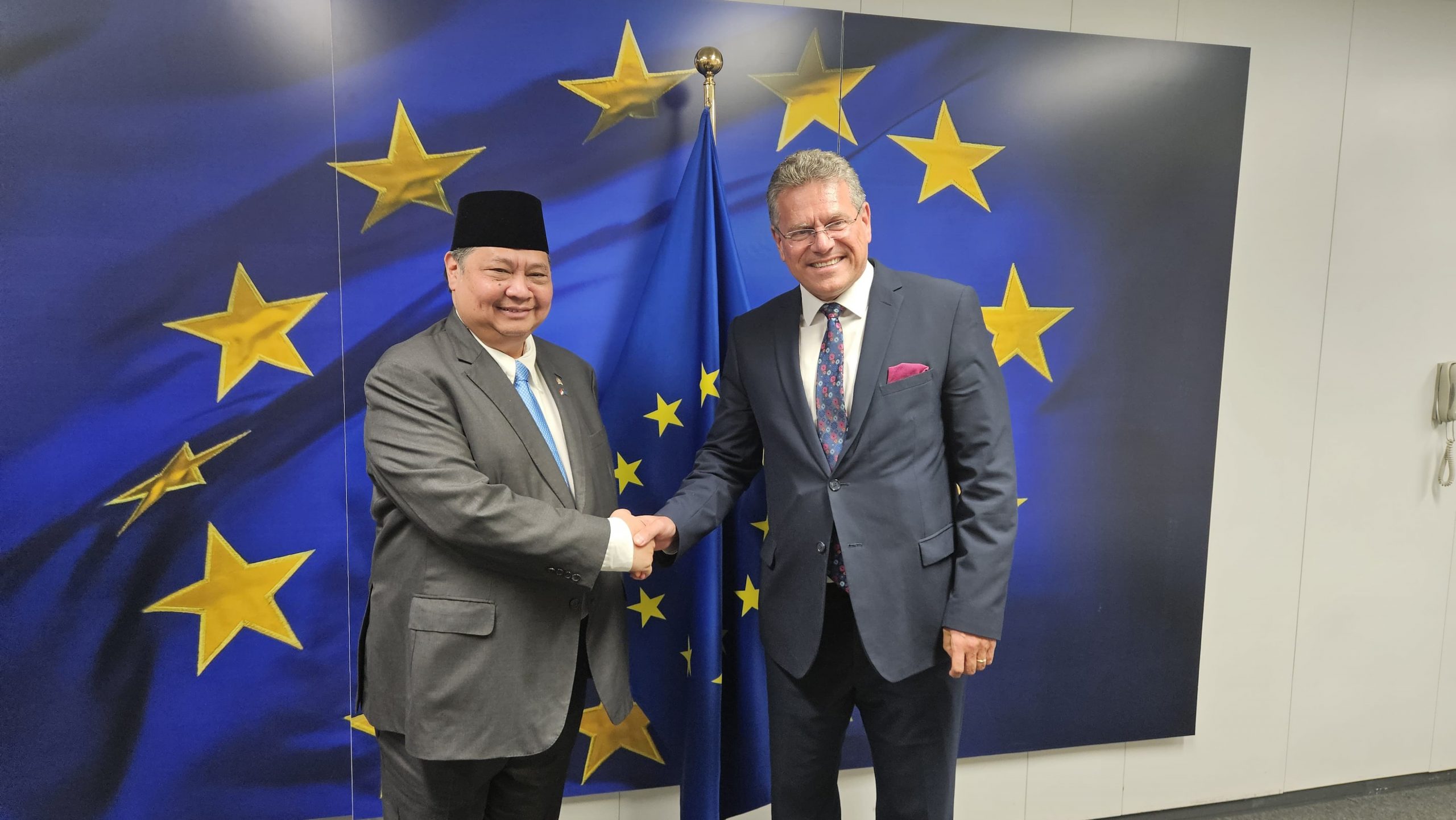
Minister Airlangga also met with EU Commissioner for Trade and Economic Security, Maroš Šefčovič, where both parties agreed to report the finalized outcomes to President Prabowo Subianto and the President of the European Commission.
The European Union is currently Indonesia’s fifth-largest trading partner, with total trade reaching USD 30.1 billion in 2024. Indonesia maintained a strong trade surplus, growing from USD 2.5 billion in 2023 to USD 4.5 billion in 2024.
One of the core benefits of the IEU-CEPA implementation is the elimination of import tariffs. Within 1–2 years of enforcement, approximately 80% of Indonesia’s exports to the EU will enjoy zero tariffs. Priority export commodities such as labor-intensive products (footwear, textiles, garments), palm oil, fisheries, renewable energy, and electric vehicles will receive fairer preferential treatment.
“Our major exports are complementary rather than competitive. This agreement will strengthen global supply chains and significantly enhance Indonesia’s competitiveness,” Minister Airlangga emphasized.
The EU also focused on topics including local content requirements (TKDN), critical minerals, automotive sectors, and investment facilitation mechanisms. Notably, Indonesia called for equal treatment of its fishery exports compared to ASEAN peers such as Thailand and the Philippines.
“The EU has agreed to provide a level playing field for Indonesian fisheries exports,” said Airlangga.
Regarding deforestation policies, Commissioner Šefčovič committed to providing special treatment for Indonesia, a move expected to benefit the country’s forest-based product exports and support sustainable development efforts.
IEU-CEPA and Sustainable Economic Growth
The agreement also highlights a strong emphasis on trade and sustainable growth, aligning with EU policies that support environmentally responsible trade. Indonesia welcomes the EU’s commitment to sustainability and the shared goal of adapting to stricter environmental standards.
“This high-value agreement benefits both Indonesian and European businesses. Its sustainability framework is essential in light of evolving EU policies and helps mitigate future trade risks,” noted Airlangga.
With broader market access and the elimination of tariff and non-tariff barriers, the Indonesian government is optimistic that the IEU-CEPA will boost exports to the EU by over 50% within three to four years.
In addition, the agreement is expected to attract strategic European investments, supported by growing confidence in Indonesia’s legal and policy frameworks.
“Both sides have agreed on the substance and legal procedures. There are no remaining hurdles,” concluded Minister Airlangga. (AT Network)
Follow Us at Google News and WA Channel