
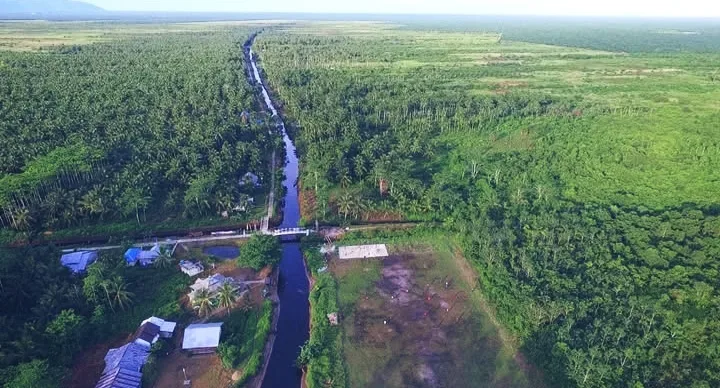
ASIATODAY.ID, RIAU — Indonesia reaffirmed its position as a global leader in climate action and tropical peatland ecosystem restoration.
At the AsiaFlux Conference 2025, a prestigious scientific forum uniting researchers, policymakers, and environmental practitioners from 29 countries, the Ministry of Environment/Environmental Control Agency (KLH/BPLH) showcased tangible achievements and scientific innovations that have made Indonesia a regional center for peatland restoration learning.
“Peatland restoration is not merely a technical task—it is the foundation of our national climate resilience,” said Minister of Environment and Head of BPLH, Hanif Faisol Nurofiq on October 22, 2025.
“True restoration succeeds when science is integrated with local wisdom—when communities are not just beneficiaries, but active stewards of their ecosystems.”
Over the past decade, Indonesia has rehabilitated more than 24.6 million hectares of land, including 4.16 million hectares of rewetted peat ecosystems. The government has also constructed 45,000 canal blocks and reintroduced native species such as jelutung, ramin, and balangeran.
To strengthen the scientific foundation of restoration, KLH/BPLH applies the Peat Hydrological Unit (KHG) approach, supported by the Peatland Ecosystem Protection and Management Information System (SiPPEG) — a real-time digital monitoring platform. This data-driven governance model, when combined with local knowledge, enables adaptive management aligned with social and ecological realities on the ground.
More than an environmental project, peatland restoration in Indonesia has evolved into a nationwide collaborative movement. Through the Peat Care Independent Village Program (Desa Mandiri Peduli Gambut / DMPG), over 1,100 villages now actively manage their ecosystems. Women and youth have become the driving forces of the green economy, developing kelulut honey enterprises, natural fiber crafts, and sustainable ecotourism initiatives.
These efforts align with Indonesia’s 2025–2029 National Mid-Term Development Plan (RPJMN) and the FOLU Net Sink 2030 target, positioning peatland restoration as a pillar of climate, social, and economic resilience. The scientific approaches developed by KLH/BPLH demonstrate that ecosystem restoration is not a cost—but a strategic investment toward a low-carbon and sustainable future.
AsiaFlux Conference 2025 Chair, Chandra S. Desmukh, emphasized the importance of cross-sector collaboration in advancing sustainable land management.
“AsiaFlux is not only about flux towers—it’s about the collaboration among people behind them: scientists, policymakers, and communities. This year, the conference welcomes over 300 participants from 29 countries, representing universities, research institutions, governments, the private sector, and civil society. Such collaboration is a concrete expression of our shared commitment to sustainable land use and to supporting Indonesia’s FOLU Net Sink 2030 and global climate goals,” said Desmukh.
Minister Hanif concluded with a call to action:
“We must not only extract from nature but also bring forth science that strengthens the competitive and sustainable value of Indonesia’s natural wealth.”
With strong vision and concrete commitment, KLH/BPLH is positioning Indonesia at the forefront of global climate action—proving that ecosystem restoration is not just a responsibility, but also a source of pride and opportunity for a sustainable future. (AT Network)
Follow Us at Google News and WA Channel