
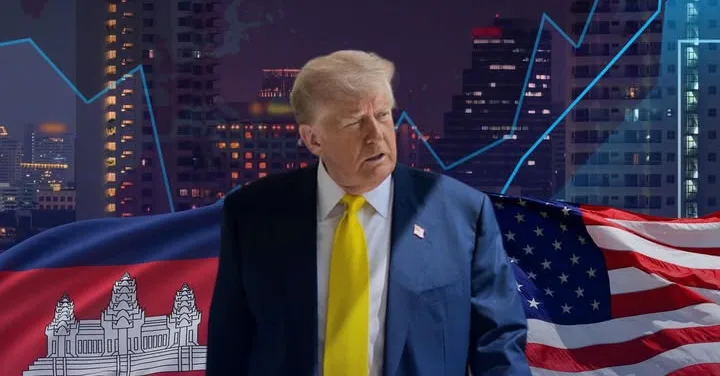
ASIATODAY.ID, JAKARTA — The United States has achieved a major geopolitical victory in Southeast Asia after sealing a series of trade and critical minerals cooperation deals with Malaysia, Thailand, Cambodia, and Vietnam — effectively giving Washington significant influence over one of the world’s most strategic rare earth supply chains.
The landmark agreements mark a new phase in the global race for critical minerals — materials essential for semiconductors, electric vehicles, renewable energy systems, and advanced defense technologies. Analysts say this is a direct challenge to China’s decades-long dominance of the global rare earth industry.
Trump Reasserts America’s Economic Power in the Indo-Pacific
During his visit to Kuala Lumpur for the 47th ASEAN Summit, US President Donald Trump met Malaysian Prime Minister Anwar Ibrahim, where he signed several trade and energy agreements aimed at expanding US economic and strategic presence in the Indo-Pacific region.
Trump concluded reciprocal trade agreements with Malaysia and Cambodia, along with a framework memorandum of understanding (MoU) with Thailand to remove tariff and non-tariff barriers and promote fair, open trade among regional partners.
Under these deals, the US will maintain a 19% tariff on certain exports but will cut tariffs to zero on a wide range of high-value goods, particularly in the technology and clean energy sectors.
A separate framework with Vietnam will see the country increase imports of American goods to narrow its US$123 billion trade surplus with Washington recorded last year.
Malaysia and Thailand at the Core of a New Supply Chain Network
The centerpiece of Trump’s Southeast Asia diplomacy lies in two key bilateral agreements — with Malaysia and Thailand — focusing on critical mineral cooperation and supply chain diversification.
Malaysia’s sovereign wealth fund Khazanah Nasional had previously explored a joint venture with Chinese companies to build a rare earth processing plant. However, the new US deal represents a strategic policy realignment, with Malaysia now committing not to impose export bans or quotas on critical minerals shipped to the United States.
With 16.1 million tons of estimated rare earth reserves, Malaysia is now positioned as one of Washington’s most important partners in the race to build resilient, non-Chinese supply chains for vital materials.
The move complements Washington’s broader plan to reduce reliance on Chinese-controlled processing and secure global mineral independence.
A Direct Challenge to China’s Resource Dominance
China remains the world’s largest producer and processor of rare earth elements. Yet, its tightening of export controls and refining technologies has triggered widespread concern over potential disruptions in global supply.
By securing new partnerships across Southeast Asia, the US has expanded its influence deep into China’s economic sphere and strengthened its ability to steer the global flow of critical minerals essential for next-generation industries.
“Southeast Asia is the heart of the global supply chain,” said President Trump.
“The United States is building partnerships based on openness, fairness, and shared prosperity.”
The agreements mark a turning point in global trade geopolitics, signaling America’s return as the dominant force in the Indo-Pacific and granting it unprecedented leverage over the world’s most strategic resources amid intensifying economic rivalry with Beijing.
US and Australia Build a Critical Minerals Superpower
In a parallel development, the United States and Australia have announced a major partnership on rare earths and critical minerals aimed at countering China’s market control.
President Donald Trump and Australian Prime Minister Anthony Albanese unveiled an US$8.5 billion (A$13 billion) pipeline of “ready-to-go” mining and refining projects to strengthen both nations’ supply resilience.
The framework includes a US$1 billion joint investment within six months and US$2.2 billion in financing from the US Export-Import Bank, including the construction of a 100-ton-per-year advanced gallium refinery in Western Australia.
“This partnership takes our cooperation to the next level,” said Albanese. “It’s a critical step toward mineral independence and economic resilience.”
Following the announcement, Australian rare earth stocks surged — Arafura Rare Earths jumped 7.7%, Iluka Resources gained 3%, and Lynas Rare Earths rose on expectations of increased US investment.
The agreement also commits both countries to coordinate pricing, permitting, and oversight of corporate acquisitions in the critical minerals sector — a move to ensure Western control over essential resources.
The West’s Coordinated Push Against China’s Monopoly
China currently controls around 70% of global rare earth mining and 90% of processing capacity, giving Beijing significant leverage over global technology and defense industries.
The US–Australia–ASEAN alliance now represents a strategic shift in global resource politics — establishing a Western-led network for mineral exploration, extraction, and refining that bypasses Chinese dominance.
Trump reaffirmed that the AUKUS partnership (US–UK–Australia) remains “full steam ahead,” calling it part of a broader strategy to secure Indo-Pacific stability and resource resilience.
“This is about building resilience and independence,” Trump declared.
“The United States and its allies will never again be held hostage by resource dependency.”
US and Japan Sign Critical Minerals Pact Amid Rising Tensions
Shortly after Beijing restricted exports of rare earths and chip-making equipment in response to Trump’s tariffs, the US and Japan signed a new agreement on the production and supply of critical minerals.
The deal was sealed during Trump’s meeting with Japan’s new Prime Minister Sanae Takaichi in Tokyo — their first official encounter.
Both leaders agreed to strengthen cooperation on projects vital to domestic industries and to use coordinated investments and policy tools to accelerate the development of diversified and fair markets for critical minerals.
“We are entering a new golden age of the US–Japan alliance,” Trump said, praising Takaichi as “one of the greatest prime ministers.”
Takaichi pledged to deepen ties, calling the US–Japan partnership “the strongest alliance in the world.”
Indonesia Left Out of the US-Led Critical Minerals Bloc
While the United States expands its alliances across Southeast Asia, Indonesia — home to some of the world’s largest nickel reserves — has been notably excluded from the latest round of critical minerals agreements.
However, during the ASEAN Summit in Kuala Lumpur, Indonesia’s Coordinating Minister for Economic Affairs Airlangga Hartarto met with US Under Secretary of State Jacob Helberg to discuss ongoing cooperation in trade, energy, and technology.
The two sides reviewed developments in reciprocal tariff negotiations, strategic trade management, and new investment opportunities in nickel refining, high-end semiconductors, artificial intelligence (AI), data centers, renewable energy, and even small modular nuclear reactors (SMRs).
“Indonesia remains open to US investment across strategic sectors with strong growth potential,” Airlangga stated.
“Our partnership continues to grow in a spirit of mutual respect and shared benefit.”
He emphasized that Indonesia and the US are at a positive stage in their bilateral economic relations — a crucial momentum to strengthen collaboration in sustainable growth and resilient supply chains. (AT Network)
Follow Us at Google News and WA Channel