
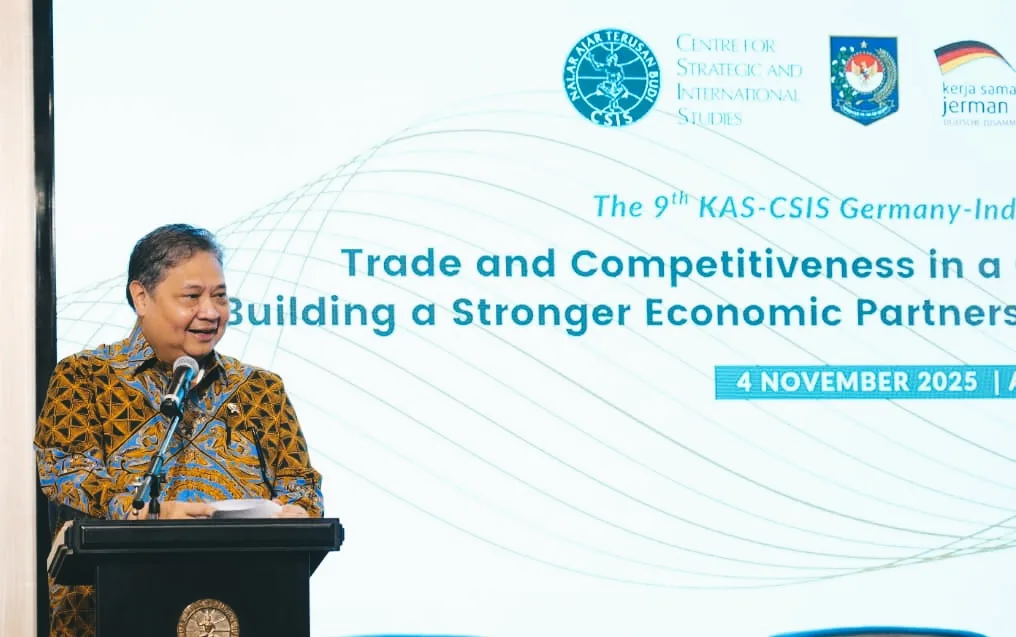
ASIATODAY.ID, JAKARTA — Amid ongoing global economic uncertainty affecting trade flows, supply chains, and investment patterns, Indonesia’s economy continues to demonstrate strong resilience.
With consistent growth above 5%, controlled inflation, and a sustained external surplus, the government is strengthening partnerships with strategic allies, particularly the European Union, through the Indonesia–EU Comprehensive Economic Partnership Agreement (IEU-CEPA).
“The European Union has become one of Indonesia’s top five trading partners, with a trade surplus of around USD 4.5 billion in 2025. The substantive IEU-CEPA agreement, announced in Bali on September 23, covers a wide range of areas including trade, investment, intellectual property, sustainable development, SME cooperation, and the enhancement of digital ecosystems,” said Coordinating Minister for Economic Affairs Airlangga Hartarto during the 9th Konrad-Adenauer-Stiftung (KAS)–CSIS Germany–Indonesia Strategic Dialogue on Tuesday, November 4, 2025.
President Prabowo Subianto has emphasized that strengthening Indonesia’s economic resilience requires expanding market access and accelerating trade cooperation. He reaffirmed Indonesia’s commitment to finalizing IEU-CEPA as one of the key pillars for boosting economic growth and job creation. Through this agreement, Indonesia is projected to increase exports by up to 58%, further enhancing its position in global value chains.
Expanding Market Access and Green Investment
Beyond improving market access, IEU-CEPA also focuses on strengthening investment, enhancing value addition, and boosting competitiveness. The agreement offers regulatory clarity, broader market access, and a shared commitment to sustainability.
European investors are expected to play a major role in supporting Indonesia’s downstream industries and green transition, particularly in sectors involving critical minerals that are vital to global supply chains.
With the completion of IEU-CEPA, the European Union’s role will evolve from being merely a trading partner to becoming a strategic investment partner for Indonesia.
European product standards will now be more accessible to the Indonesian market, including through mutual recognition of halal certification, enabling EU halal products to enter Indonesia directly. Meanwhile, Indonesia’s key export commodities — coffee, cocoa, rubber, palm oil, furniture, and electronics — will enjoy zero import tariffs in EU markets.
Driving National Industrialization
The agreement also opens wider opportunities for Indonesia to import high-quality European products such as pharmaceuticals, industrial machinery, mechanical equipment, and electronics, which will help strengthen the country’s industrial capacity and support its move toward high-value manufacturing.
To optimize the benefits of the agreement, the government is prioritizing domestic readiness and policy coordination, including establishing a special task force to address investment barriers and ensure smooth implementation.
Through investment regulatory reforms and the acceleration of the Online Single Submission (OSS) system, Indonesia aims to create a more efficient, transparent, and business-friendly investment climate.
“The momentum of IEU-CEPA’s completion must be fully leveraged to deepen economic cooperation through closer collaboration between the government, business community, and research institutions like CSIS. The government is open for business and open to ideas,” Minister Airlangga concluded. (AT Network)
Follow Us at Google News and WA Channel