
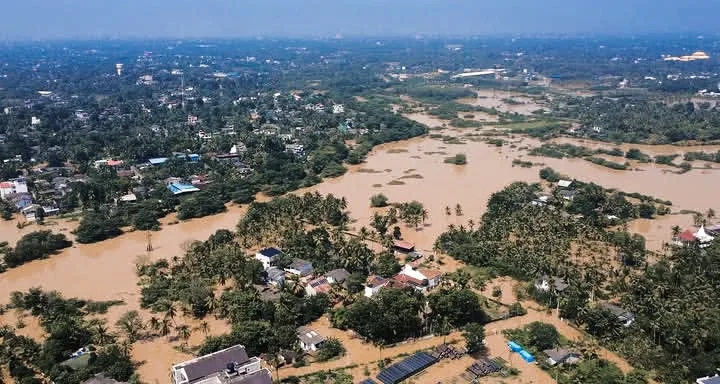
ASIATODAY.ID, COLOMBO — Sri Lanka is grappling with one of the most devastating natural disasters in its recent history after Cyclone Ditwah tore across the island in late November 2025, causing an estimated US$4.1 billion in direct physical damage, according to a new World Bank Group assessment.
The catastrophe has forced the International Monetary Fund (IMF) to step in with US$206 million in emergency financing to help stabilize the country’s fragile economy.
Massive Destruction, Nearly Two Million People Affected
A Global Rapid Post-Disaster Damage Estimation (GRADE) report released on December 22 found that nearly 2 million people and around 500,000 families were affected across all 25 districts of Sri Lanka. Homes, public infrastructure, farmland, and essential services were severely damaged, disrupting livelihoods and economic activity nationwide.
The Central Province emerged as the hardest-hit region, with Kandy District alone suffering losses estimated at US$689 million, largely due to extensive flooding and landslides.
The GRADE assessment estimates direct physical damage only and does not include lost income, production losses, or the full cost of recovery and reconstruction, which are expected to far exceed current figures.
Infrastructure and Housing Take the Heaviest Blow
Infrastructure accounted for the largest share of losses, with damages estimated at US$1.735 billion, or 42 percent of total destruction. Roads, bridges, railways, and water supply systems were badly damaged, cutting off access to markets, healthcare, and education.
Residential buildings and household contents suffered losses of approximately US$985 million, highlighting the vulnerability of housing stock to extreme winds and flooding and underscoring the need for climate-resilient construction standards.
Agriculture Devastated, Food Security at Risk
The agriculture sector recorded estimated damages of US$814 million, affecting paddy fields, vegetable crops, maize, livestock, agricultural infrastructure, and inland fisheries.
The losses pose a serious threat to food security and rural livelihoods, particularly in communities already struggling with poverty and climate stress.
Meanwhile, non-residential buildings—including schools, hospitals, businesses, and industrial facilities located near rivers and creeks—suffered damages estimated at US$562 million, disrupting education, healthcare delivery, and local economic activity.
Vulnerable Groups Bear the Brunt
The World Bank warned that pre-existing socio-economic vulnerabilities—including poverty, limited access to basic services, and exposure to climate risks—are amplifying the disaster’s impact and slowing recovery, especially for women, children, older persons, and female-headed households.
“In districts such as Badulla, Kegalle, and Puttalam, many households were already poor and are now facing some of the highest housing losses,” said Gevorg Sargsyan, World Bank Group Country Manager for Sri Lanka and the Maldives on December 22, 2025.
“In Kandy and Nuwara Eliya, nearly two in four households are headed by women or older persons. Thousands of women and girls have been displaced or remain in unsafe homes.”
IMF Approves US$206 Million in Emergency Financing
As the humanitarian and economic toll mounted, the IMF Executive Board approved SDR 150.5 million (about US$206 million) in emergency assistance under the Rapid Financing Instrument (RFI) on December 19, 2025.
The funds are intended to help Sri Lanka: Address urgent balance-of-payments pressures, Meet immediate fiscal and humanitarian needs, Preserve macroeconomic stability following the disaster.
Cyclone Ditwah is reported to have killed more than 600 people and displaced over 100,000 residents, as flooding and landslides swept through large parts of the country.
IMF Program Review Deferred
The cyclone struck just as Sri Lanka was nearing completion of the Fifth Review under its Extended Fund Facility (EFF) program. The IMF announced that the review has been deferred until early 2026 to allow time for a full assessment of the disaster’s economic impact and to recalibrate policy priorities.
Despite the setback, the IMF emphasized that Sri Lankan authorities remain committed to fiscal discipline, transparency, and debt sustainability.
“The cyclone hit as Sri Lanka was emerging from a deep economic crisis,” said Kenji Okamura, IMF Deputy Managing Director.
“While the recovery has gained traction, the economy remains vulnerable and has not yet returned to its pre-crisis level.”
Recovery Costs Expected to Soar
The World Bank cautioned that recovery and reconstruction needs will significantly exceed the initial damage estimates.
Long-term recovery will require a comprehensive strategy focused on: Humanitarian relief and social protection, Restoring livelihoods and food systems, Rebuilding climate-resilient housing and infrastructure, Integrating disaster and climate risk into development planning.
Cyclone Ditwah has become more than a natural disaster—it is a stark reminder of Sri Lanka’s exposure to climate extremes and a critical test of its economic resilience as the country struggles to consolidate recovery from years of financial turmoil. (AT Network)
Follow Us at Google News and WA Channel