
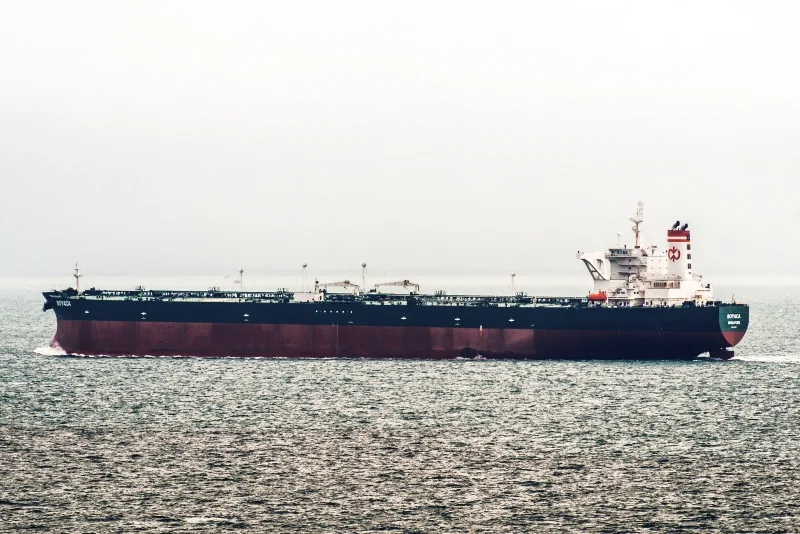
ASIATODAY.ID, JAKARTA – Geopolitical tensions between the United States and China are escalating once again after two Chinese-flagged supertankers continued operating near Venezuelan waters, openly defying Washington’s announcement of a full blockade against the South American nation in mid-December.
The movements of the vessels are widely seen as a direct test of U.S. sanctions enforcement and a bold signal that Beijing remains committed to securing Venezuelan crude despite mounting Western pressure.
Maritime tracking data cited by Worldoil shows that the Very Large Crude Carrier (VLCC) Thousand Sunny is still sailing toward Jose Terminal, one of Venezuela’s main oil export hubs. Notably, the tanker has maintained its speed and course since U.S. President Donald Trump declared a total blockade on Venezuela on December 16, 2025.
The Thousand Sunny has reportedly been regularly transporting Venezuelan crude to China for nearly five years, making it a critical link in Beijing’s energy supply chain amid tightening sanctions.
Another Chinese tanker, Xing Ye, has been spotted offshore near French Guiana, where it is believed to be awaiting loading instructions. The vessel last carried Venezuelan crude in August.
Although neither tanker is currently listed under U.S. sanctions and both sail under the Chinese flag, analysts warn that any attempt by Washington to intercept them could trigger a serious diplomatic confrontation.
Industry sources note that both vessels were previously owned by China National Petroleum Corporation (CNPC) before being sold to undisclosed buyers in 2020. The transactions are widely believed to be part of a sanctions-evasion strategy, allowing Venezuelan oil exports to China to continue while also serving as a mechanism for repaying Caracas’ debt to Beijing.
External pressure is now taking a visible toll on Venezuela’s oil sector. State-owned oil company PDVSA has reportedly begun shutting down several wells in the Orinoco Belt since late December, citing nearly full storage capacity. Production in the region is expected to fall by at least 25% to around 500,000 barrels per day, representing a 15% cut in national output.
The move underscores the deepening crisis facing President Nicolás Maduro’s government, as oil revenues remain the backbone of Venezuela’s economy.
Analysts describe the well closures as a last resort, given the high operational costs and technical risks associated with restarting production.
In response, Venezuela has reportedly stepped up security along its oil export routes. Coast guard vessels are said to be escorting tankers departing from eastern ports, though protection remains largely confined to territorial waters. Several shipments bound for Asian markets in mid-December allegedly sailed with naval protection, highlighting growing fears of interdiction.
The dispute has spilled onto the global stage. During an emergency session of the UN Security Council, both China and Russia sharply criticized Washington’s actions.
Beijing argued that the blockade violates international law, while Moscow condemned it as an act of outright aggression.
Adding to the complexity, U.S. energy giant Chevron continues to export Venezuelan crude to the United States under a special license granted by Washington—a move that underscores the contradictions and competing interests shaping the global energy market amid rising geopolitical tensions. (AT Network)
Follow Us at Google News and WA Channel