
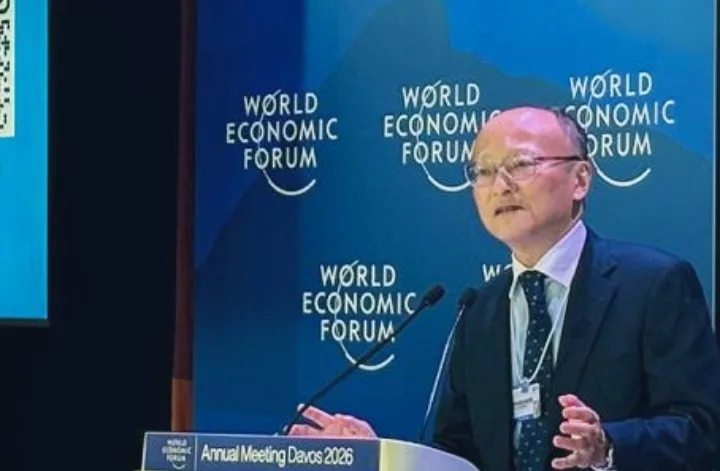
ASIATODAY.ID, DAVOS – Asian Development Bank (ADB) President Masato Kanda used the global stage of the World Economic Forum (WEF) Annual Meeting 2026 to deliver a blunt message: ASEAN must accelerate regional integration and unlock private sector investment—or risk falling behind in an increasingly competitive global economy.
Kanda’s participation marked ADB’s return to the World Economic Forum after a six-year absence, underscoring the bank’s renewed push to position Asia and the Pacific as a pillar of stability amid global economic fragmentation.
“Global fragmentation is not inevitable—it is a policy choice,” Kanda said in Davos.
“Across Asia and the Pacific, countries are choosing deeper regional cooperation because they understand that shared prosperity is the foundation of lasting stability.”
Yet he stressed that ambition alone will not be enough.
“Public finance by itself cannot unlock the region’s vast potential. Bridging policy frameworks with private capital is essential if strong ideas are to become bankable, investable projects.”
Turning Private Capital into a Growth Engine
A central outcome of ADB’s Davos engagement was the launch of the High-Level Private Sector Advisory Group, a strategic body tasked with identifying market bottlenecks and recommending concrete actions to scale up institutional investment for sustainable growth, economic resilience, and digital transformation across Asia and the Pacific.
Rather than focusing on headline targets, the group aims to tackle structural barriers that have long constrained private capital mobilisation in emerging markets.
ASEAN’s Momentum Under Scrutiny
Kanda reinforced ADB’s regional growth agenda during several high-profile sessions, including the public panel “Is ASEAN Moving Fast Enough?”.
He warned that sustaining ASEAN’s growth momentum will depend on tackling digital infrastructure gaps and energy security as interconnected priorities.
In a separate discussion on the ASEAN Power Grid, Kanda reaffirmed ADB’s readiness to commit up to $10 billion over the next decade, positioning cross-border energy integration as a cornerstone of regional competitiveness and energy transition.
High-Level Political and Corporate Engagements
Throughout the week, Kanda held meetings with heads of government and senior policymakers, including Sri Lanka’s Prime Minister Harini Amarasuriya, Canadian Prime Minister Mark Carney, Mongolian Prime Minister Zandanshatar Gombojav, Thailand’s Deputy Prime Minister and Finance Minister Ekniti Nitithanprapas, and Pakistan’s Finance Minister Muhammad Aurangzeb.
Private sector discussions focused on scaling collaboration in digital and green infrastructure. In talks with Grab CEO Anthony Tan, Kanda highlighted digital platforms as critical economic infrastructure, exploring partnerships in smarter urban mobility and resilient food supply chains. He also exchanged views with Boston Consulting Group Global Chair Rich Lesser on the evolving global investment and geopolitical landscape.
Asia at a Strategic Crossroads
Kanda also engaged with leaders of major international institutions, including the International Monetary Fund (IMF), OECD, International Finance Corporation (IFC), European Investment Bank (EIB), and Inter-American Development Bank (IDB), reinforcing ADB’s role as a convening force in multilateral development finance.
Meetings with leading academics and university presidents from Tufts University, Keio University, the University of Tokyo, UC Berkeley, the University of Cape Town, and others highlighted the growing importance of research, innovation, and policy alignment in shaping Asia’s long-term competitiveness.
As geopolitical tensions and economic fragmentation deepen, ADB’s message from Davos was clear: ASEAN cannot afford complacency. Speed, integration, and private capital will determine whether the region leads—or lags—in the next phase of global growth. (AT Network)
Follow Us at Google News and WA Channel