
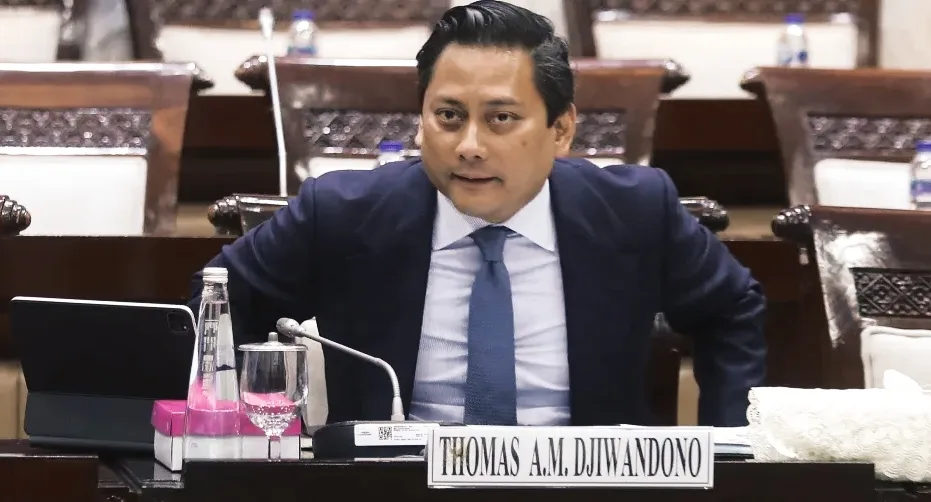
ASIATODAY.ID, JAKARTA — Indonesia’s House of Representatives (DPR) has officially approved Thomas Djiwandono as Deputy Governor of Bank Indonesia (BI) for a five-year term, following a consensus decision by Commission XI after a fit and proper test held on Monday, January 26, 2026.
The decision was announced by Commission XI Chairman Mukhamad Misbakhun, who said all eight parliamentary factions represented in the commission unanimously agreed to appoint Djiwandono to replace Juda Agung, who resigned earlier this month.
“Through deliberation and consensus, Commission XI has decided to appoint Mr. Thomas Djiwandono as Deputy Governor of Bank Indonesia,” Misbakhun told reporters at the Parliament Complex in Jakarta.
Misbakhun noted that the internal deliberation process took approximately 30 minutes, reflecting broad agreement among lawmakers after reviewing candidates’ presentations and credentials.
The vacancy emerged following Juda Agung’s resignation on January 13, 2026.
President Prabowo Subianto, in coordination with the Governor of Bank Indonesia, had nominated three candidates for the post: Solikin M. Juhro, Dicky Kartikoyono, and Thomas Djiwandono. Solikin underwent the fit and proper test on January 23, while Dicky and Djiwandono were tested on January 26.
Advocating Fiscal-Monetary Synergy
During the parliamentary hearing, Djiwandono—currently serving as Vice Minister of Finance—emphasized the importance of strengthening coordination between fiscal and monetary policy, while firmly safeguarding the independence of Bank Indonesia as the country’s central bank.
Drawing on his experience in fiscal policymaking, Djiwandono said effective policy alignment is essential to keep Indonesia’s economic growth on track amid global uncertainty.
“Synergy between fiscal and monetary authorities must be continuously strengthened, but within a framework that fully preserves central bank independence,” he said.
He stressed that coordination with the government, the Financial Services Authority (OJK), and other financial institutions would not compromise BI’s autonomy in executing its mandate.
Five Strategic Pillars
Djiwandono outlined five thematic strategies that would guide his tenure as Deputy Governor:
– Strong and credible governance,
– Effective policymaking,
– Enhanced financial system resilience,
– Accelerated fiscal-monetary-financial sector coordination, and
– Sustained financial sector transformation.
He described the framework as the “Gerak” strategy, designed to support adaptive and sustainable economic growth in line with Indonesia’s Financial Sector Development and Strengthening Law (Law No. 4/2023).
“These five pillars form a solid foundation for long-term, agile, and resilient economic growth,” Djiwandono said.
Resilient Economic Outlook
Djiwandono also highlighted Indonesia’s economic resilience despite ongoing global volatility. He cited 5.04 percent economic growth in the third quarter of 2025, alongside well-contained core inflation at 2.9 percent.
Indonesia’s external position remains strong, with a consistent balance of payments surplus over the past seven months and foreign exchange reserves approaching record highs, he added.
“Core inflation is very low—around 1.46 percent excluding gold—which provides policy space, particularly for stronger fiscal-monetary coordination going forward,” Djiwandono said. (AT Network)
Follow Us at Google News and WA Channel