
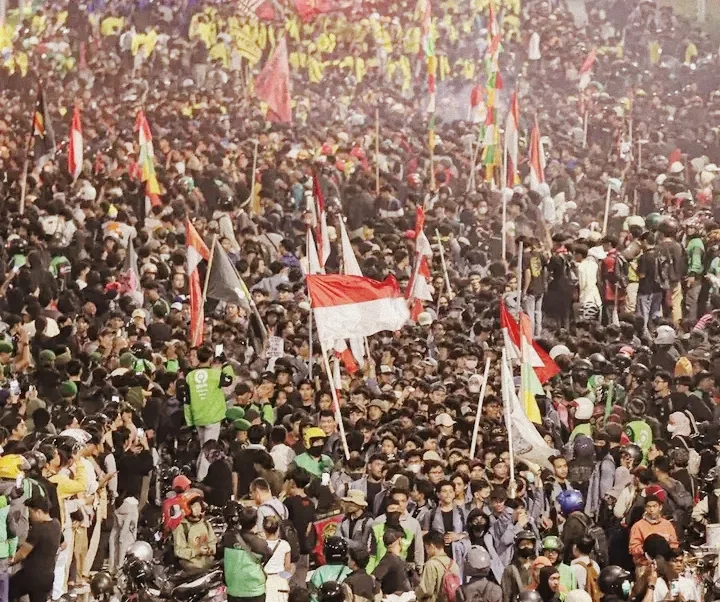
ASIATODAY.ID, JAKARTA – A growing wave of student-led demonstrations swept across Indonesia on Monday, June 15, increasing public pressure on President Prabowo Subianto and his administration over a range of economic, political, and governance issues.
Protests were reported in Jakarta, Yogyakarta, Medan, Bandung, Semarang, and Makassar, with thousands of students taking to the streets to voice concerns over rising living costs, fuel price increases, police reform, and several flagship government programs.
In the capital, demonstrations centered around the National Monument (Monas), the House of Representatives (DPR), and other strategic locations. Authorities deployed approximately 5,955 police personnel to secure the protests and manage traffic disruptions.
One of the largest demonstrations was organized by the Student Executive Board of Bung Karno University (BEM UBK), which gathered in the Medan Merdeka Selatan area.
Protesters presented six key demands, including a comprehensive review of the government’s Free Nutritious Meals (MBG) program and the Merah Putih Village Cooperative initiative, revisions to the National Police Law, an end to what they described as increasing militarization in civilian affairs, and stronger measures to stabilize the national economy amid pressure on the rupiah and rising household expenses.
Students also called on the government to improve access to affordable and quality education and reconsider recent fuel price policies that they argue have increased the financial burden on ordinary Indonesians.
Protesters Temporarily Blocked by Police
Tensions briefly emerged in Jakarta when several groups of students were stopped by police near Tugu Tani and the Semanggi interchange.
Authorities initially prevented demonstrators from marching toward Medan Merdeka Selatan and the Arjuna Wijaya statue area, commonly known as “Patung Kuda,” a traditional gathering point for political protests in the capital.
Following negotiations, however, protesters were eventually allowed to continue to designated demonstration sites.
Police officials said the restrictions were implemented to maintain public order, ensure traffic flow, and accommodate state activities taking place in central Jakarta.
Traffic diversions were also introduced in several areas affected by the demonstrations, with residents advised to avoid major protest routes and seek alternative travel options.
Similar Demands Echo Across the Country
The movement extended far beyond Jakarta.
In Yogyakarta, students from the Islamic University of Indonesia (UII) demanded the suspension of the MBG and Merah Putih Village Cooperative programs, lower fuel and staple food prices, police reform, and an end to military involvement in civilian affairs.
Protesters argued that current government policies have failed to adequately address economic hardships faced by many Indonesians.
In Medan, hundreds of students from the University of North Sumatra joined civil society groups in a rally titled “Towards a Failed Indonesia” outside the North Sumatra Regional Legislative Council.
Demonstrators highlighted concerns over energy prices, the national economy, security regulations, education funding, environmental issues, and agrarian conflicts.
Meanwhile, student organizations in Bandung staged protests at the West Java Provincial Parliament and the regional office of Bank Indonesia. In Semarang, members of the Islamic Students Association (HMI) organized demonstrations at several key locations across the city.
In Makassar, HMI activists staged protests beneath the Pettarani Flyover, burning tires and partially blocking traffic while calling for a review of the MBG program and the termination of several government initiatives they described as fiscally wasteful.
Growing Concerns Over Economy and Democracy
The expanding student movement reflects broader concerns among Indonesia’s younger generation regarding the country’s economic direction and democratic governance.
Rising fuel prices, increasing costs of basic goods, pressure on the rupiah, and concerns over public spending have become central themes of the protests.
Beyond economic issues, demonstrators have also raised questions about democratic accountability, police reform, and the protection of civil liberties.
With coordinated actions taking place across multiple provinces, the current wave of protests represents one of the largest student mobilizations in recent years.
Analysts say the demonstrations underscore growing public scrutiny of government policies and highlight mounting demands for greater transparency, accountability, and responsiveness from the administration.
Student groups have pledged to continue their actions until their concerns receive what they describe as a meaningful response from the government. (AT Network)
Follow Us at Google News and WA Channel