
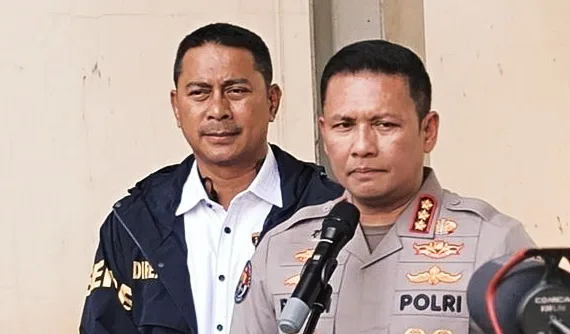
ASIATODAY.ID, JAKARTA — A major corruption investigation in Indonesia has entered a new international phase after the Federal Bureau of Investigation (FBI) and the U.S. Secret Service joined efforts to verify foreign currencies seized in a case involving former senior prosecutor Febrie Adriansyah.
The involvement of U.S. law enforcement agencies has elevated the case from a domestic corruption investigation into a broader regional issue, highlighting the increasingly international nature of financial crimes and illicit asset flows across Asia.
Indonesian authorities said representatives from the FBI and the U.S. Secret Service visited the Jakarta Metropolitan Police’s Criminal Investigation Directorate to examine seized U.S. dollar banknotes. The verification process was conducted alongside coordination with the U.S. Embassy, Singapore authorities, and Bank Indonesia.
The move reflects growing cooperation among law enforcement agencies as governments across Asia strengthen efforts to combat corruption, money laundering, and the movement of illegal funds across borders.
A Case Involving Strategic Sectors
The investigation involves allegations of corruption and money laundering connected to three strategic areas of Indonesia’s economy: coal supply management for the national electricity sector, the management of state-owned insurer PT ASABRI, and financial transactions involving PT Krakatau Steel-related obligations.
Febrie Adriansyah, former Attorney General for Special Crimes (Jampidsus), has been named a suspect by Indonesia’s Anti-Corruption Criminal Investigation Corps (Kortastipidkor), along with a private sector individual identified as Don Ritto.
Authorities said the investigation followed extensive evidence gathering, including witness examinations, expert analysis, financial tracing, and searches at several locations in Jakarta and Bogor.
Assets Worth Hundreds of Billions Seized
The scale of the seized assets has become one of the most closely watched aspects of the investigation.
Authorities confiscated 74 kilograms of gold bars, millions of dollars in foreign currency, Indonesian rupiah, electronic devices, and documents during a series of searches.
At a location in Cipete, Jakarta, investigators seized: SGD 3.13 million, USD 889,965, IDR259 million, documents and electronic devices.
The total estimated value of assets recovered from the location reached approximately IDR60 billion.
From a money changer facility, investigators secured 71 pieces of evidence involving 16 foreign currencies valued at approximately Rp7.2 billion.
At a residence in Sentul, Bogor, authorities discovered: 74 kilograms of gold bars, USD 4.76 million, SGD 14.08 million, IDR100 million, additional documents and electronic evidence.
The total value of assets seized from the location was estimated at around IDR476 billion.
Investigators are continuing to examine the ownership and origins of the assets as part of a wider money laundering investigation.
Political Shock and Public Trust
The case has triggered strong political reactions in Indonesia.
Members of Parliament have demanded the investigation proceed transparently and have called for the toughest punishment for anyone proven guilty, arguing that corruption involving law enforcement officials represents a serious breach of public trust.
The House of Representatives has established a special monitoring mechanism to oversee the process and ensure that the investigation remains focused on individual accountability rather than institutional rivalry.
Indonesia’s Corruption Eradication Commission (KPK) is also supervising aspects of the investigation.
Why Asia Is Watching
The case has become a significant test of Indonesia’s anti-corruption institutions at a time when the country is seeking to strengthen its position as a major destination for global investment.
Across Asia, corruption and illicit financial flows remain among the biggest challenges facing emerging economies. International investors increasingly view governance quality, transparency, and legal certainty as essential factors when assessing long-term market confidence.
The participation of global law enforcement agencies in Indonesia’s investigation demonstrates how corruption cases involving large financial assets are no longer confined within national borders.
For Indonesia, the final outcome will be measured not only by the legal process but also by whether institutions can demonstrate independence, accountability, and equal treatment under the law.
For Asia, the case represents another critical reminder that economic growth and investment credibility depend on a fundamental principle: public power must remain accountable. (AT Network)
Follow Us at Google News, Instagram, WA Channel, and LinkedIn