
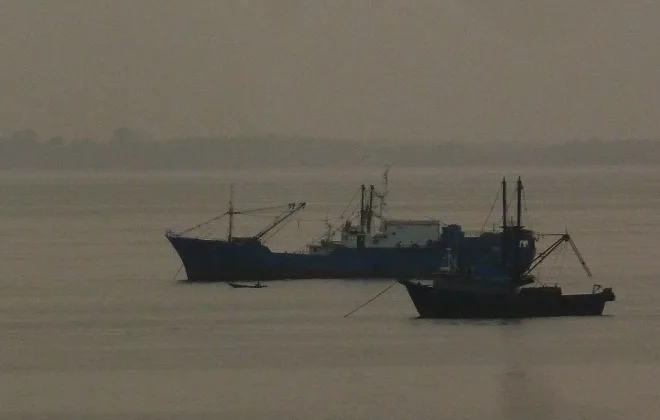
ASIATODAY.ID, JAKARTA – Indonesia’s parliament has issued a stark warning over modern slavery and human trafficking at sea, exposing what lawmakers describe as systemic failures in maritime law enforcement in the Arafura Sea, a strategic fishing zone in the Indo-Pacific that borders Australia.
During a parliamentary hearing with the National Police Chief on Monday, January 26, 2026, Mercy Chriesty Barends, a member of Parliament’s Commission III, said Indonesia risks breaching its international obligations under the ILO Forced Labour Convention, the UN Convention against Transnational Organized Crime (UN TOC) and its Trafficking in Persons Protocol, as well as commitments to combat illegal, unreported, and unregulated (IUU) fishing under the FAO framework.
“Maritime human trafficking and forced labor remain largely invisible because enforcement is still focused on land-based cases,” Barends told lawmakers.
Forced Labor at Sea and Global Supply Chain Risks
Barends highlighted severe abuses suffered by Indonesian and migrant fishing crews operating in Fisheries Management Area (WPP) 718, covering the Arafura Sea, Aru Sea, and eastern Timor Sea. The area hosts over 3,200 fishing vessels, many operating far offshore for long periods—conditions widely recognized by the ILO as high risk for forced labor and human trafficking.
“In recent months, crew members have been thrown overboard from fishing vessels, both foreign-flagged and Indonesian-flagged. Many died; others survived with serious illness and trauma,” she said.
Lawmakers warned that unchecked forced labor at sea poses significant reputational and trade risks, particularly as global seafood supply chains face increased scrutiny under labor due-diligence and import controls in major markets.
IUU Fishing, Trafficking, and Maritime Security
The parliamentarian also linked labor exploitation to IUU fishing, noting that vessels engaged in illegal fishing often rely on coerced or trafficked labor to cut costs and evade oversight—an issue repeatedly flagged by the FAO and regional fisheries bodies.
Indonesia’s vast maritime domain, she said, has also been exploited for transnational smuggling networks.
She cited a 2025 case in which nine Chinese nationals entered Indonesian waters via the Tanimbar Islands before being smuggled toward Australia, underscoring vulnerabilities along key Indo-Pacific maritime corridors.
“If foreign nationals can be smuggled through these waters, it exposes serious enforcement gaps. Indonesian citizens are even more vulnerable,” Barends said.
Implications for Australia and the Indo-Pacific
Given the Arafura Sea’s proximity to northern Australia, lawmakers stressed the need for closer regional cooperation on maritime surveillance, law enforcement, and labor protection, warning that trafficking and forced labor at sea are cross-border threats that cannot be addressed unilaterally.
Experts have long warned that failures to address forced labor in one jurisdiction can spill over into regional fisheries, migration routes, and security dynamics across the Indo-Pacific, affecting Australia, Southeast Asia, and the Pacific Islands.
Call for Maritime-Focused Reform
Commission III urged Indonesia’s National Police to reform anti-trafficking strategies by integrating maritime-specific indicators, strengthening inter-agency coordination with fisheries, immigration, and naval authorities, and aligning enforcement with international legal standards.
“The state must not lose control of its seas,” Barends said.
“Indonesia cannot allow slavery, trafficking, and IUU fishing to thrive in its waters—especially in a region central to Indo-Pacific security and global seafood supply chains.” (AT Network)
Follow Us at Google News and WA Channel