
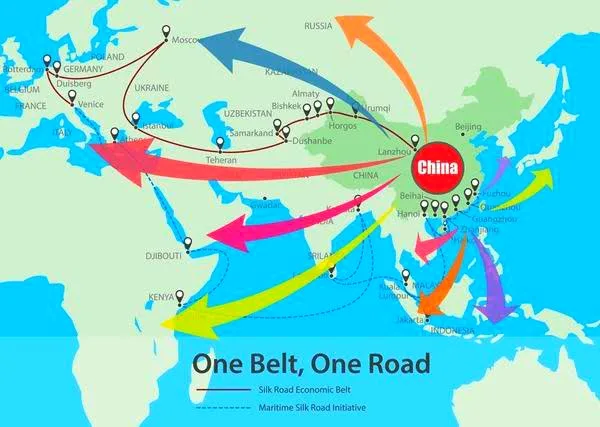
ASIATODAY.ID, JAKARTA – Indonesia’s decision to use its state budget to service debt linked to the Jakarta–Bandung High-Speed Railway (Whoosh) places the country within a broader regional narrative: how Southeast Asian and South Asian economies manage large-scale Chinese infrastructure financing under the Belt and Road Initiative (BRI).
While each case differs in political, economic, and contractual structure, comparisons with Sri Lanka’s Hambantota Port, Malaysia’s East Coast Rail Link (ECRL), and Laos–China Railway reveal important distinctions — and shared risks.
Sri Lanka: The Debt Distress Case
Sri Lanka is often cited as the most prominent example in debates over “debt trap diplomacy.”
The Hambantota Port project, financed largely through Chinese loans, struggled to generate sufficient revenue.
Facing mounting external debt and a severe balance-of-payments crisis, Sri Lanka in 2017 agreed to lease the port to a Chinese state-owned enterprise for 99 years.
However, subsequent research shows Sri Lanka’s overall debt distress was driven more by international sovereign bonds than by Chinese loans alone. Even so, the Hambantota case became a powerful geopolitical symbol.
Key Lessons for Indonesia:
– Revenue projections matter. Overestimation can trigger restructuring pressure.
– Foreign currency exposure increases vulnerability.
– Debt distress often stems from macroeconomic mismanagement, not a single project.
Indonesia differs significantly: it maintains stronger macroeconomic fundamentals, lower debt-to-GDP ratios, and a more diversified financing base. There is no indication of asset seizure or loss of control in the Whoosh case.
Malaysia: Renegotiation without Rupture (ECRL)
Malaysia’s East Coast Rail Link (ECRL) offers a different model. After a change in government in 2018, Kuala Lumpur temporarily suspended the China-backed rail project, citing excessive costs.
Rather than canceling it outright, Malaysia renegotiated the contract with China, reducing the overall project cost by roughly one-third and adjusting certain terms.
The project resumed under revised conditions.
Key Lessons for Indonesia:
– Renegotiation is possible without collapsing bilateral relations.
– Political transitions can reshape infrastructure diplomacy.
– Transparency in cost review can strengthen domestic legitimacy.
Indonesia has not suspended Whoosh, but the internal debate over APBN usage suggests that recalibration — rather than confrontation — is the preferred approach.
Laos: High Exposure, Strategic Gamble
The Laos–China Railway, inaugurated in 2021, represents one of the most ambitious BRI rail projects in mainland Southeast Asia.
The project cost nearly half of Laos’ GDP at the time of construction. Financing relied heavily on Chinese loans, placing significant pressure on Laos’ external debt position.
Laos has since faced mounting debt challenges and currency pressures, though the railway has begun stimulating trade and tourism.
Key Lessons for Indonesia:
– Scale relative to GDP is critical.
– Smaller economies face higher systemic risk.
– Long-term economic spillovers may take years to materialize.
Indonesia’s economy is far larger and more diversified than Laos’, making systemic risk comparatively lower. However, the fiscal exposure still requires careful management.
Where Indonesia Stands
Indonesia’s Whoosh case falls somewhere between Malaysia’s renegotiation model and Laos’ high-exposure gamble — but far from Sri Lanka’s crisis scenario.
Unlike Sri Lanka:
Indonesia is not in sovereign default.
Debt levels remain within statutory limits.
No strategic assets are being transferred.
Unlike Malaysia:
There has been no major suspension or cost renegotiation announcement.
The state has opted for budgetary absorption rather than structural overhaul.
Unlike Laos:
The railway represents a small fraction of Indonesia’s GDP.
Macroeconomic buffers remain relatively strong.
Broader Regional Implications
Indonesia’s move may signal a new phase in BRI implementation across Southeast Asia:
1. Greater Sovereign Backstopping
Governments may increasingly absorb risks initially labeled “commercial.”
2. Shift from Expansion to Consolidation
Focus may move toward optimizing existing projects rather than launching new mega-infrastructure ventures.
3. Hybrid Financing Models
Future projects could blend Chinese loans with multilateral, domestic, or private capital to reduce concentration risk.
Not a Debt Trap, but a Fiscal Test
Indonesia’s decision to use its national budget does not resemble Sri Lanka’s crisis model. Instead, it reflects a policy choice: prioritizing fiscal credibility, project continuity, and diplomatic stability.
However, the case underscores a structural reality facing emerging economies:
Large-scale infrastructure financed through external borrowing inevitably intersects with sovereign fiscal responsibility — especially when projections fall short.
The Whoosh railway may ultimately prove economically beneficial. But in geopolitical terms, it demonstrates that participation in the Belt and Road Initiative is less about dependency narratives and more about risk management, negotiation leverage, and long-term fiscal governance.
For Indonesia, the challenge is not escaping a debt trap — but ensuring that infrastructure ambition remains aligned with sustainable macroeconomic strategy. (AT Network)
Follow Us at Google News and WA Channel