
ASIATODAY.ID, SINGAPORE — A deepening energy crisis triggered by geopolitical tensions in the Gulf is exposing Asia’s structural dependence on fossil fuels.
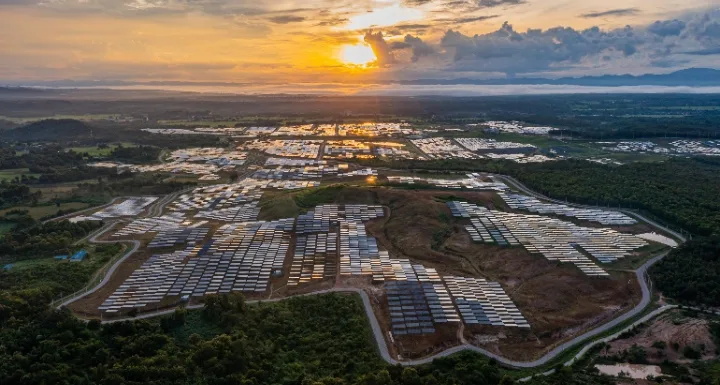
A new analysis by global energy think tank Ember reveals a striking conclusion: solar power could meet ASEAN’s growing electricity demand at roughly half the cost of gas, potentially saving the region up to US$67 billion.
The report estimates that ASEAN’s planned expansion of gas-fired power could cost as much as US$109 billion, while generating the same amount of electricity from solar would require only about US$42 billion.
Gas Dependence: Asia’s Energy Time Bomb
Under ASEAN’s energy transition scenario for 2030, gas capacity is projected to surge to nearly 200 gigawatts (GW)—almost double the current 106 GW. At today’s LNG price levels, electricity generation from gas could cost around US$71 billion annually, rising to as much as US$109 billion under future price projections.
By contrast, solar power offers a far more cost-effective pathway, delivering equivalent electricity for approximately US$42 billion per year.
Dr. Dinita Setyawati, Senior Energy Analyst for Asia at Ember, warned that repeated crises highlight the risks of fossil fuel import dependence.
“Reliance on imported fossil fuels undermines energy security. Scaling up domestically sourced renewables offers a critical buffer against future price shocks,” she said quoted on March 31, 2026.
Hormuz Disruption Sends Shockwaves Across Asia
The disruption of shipping through the Strait of Hormuz and a halt in Qatari LNG production have sent shockwaves through energy markets across Southeast and East Asia.
The report warns that prolonged disruption could: Drive sustained energy price spikes, Intensify competition in LNG spot markets and Trigger geopolitical fragmentation.
Countries with high gas reliance are already under pressure. In Singapore, gas-fired electricity costs could climb to around US$260.8/MWh, nearly double levels recorded in February 2026.
Inflation Risks and Economic Fallout
The economic impact extends far beyond the energy sector. Rising fossil fuel prices—largely denominated in US dollars—are expected to:
– Weigh on Asian currencies
– Slow industrial output
– Push inflation higher
During the Russia-Ukraine conflict, similar energy shocks drove inflation to 8.5% in Singapore and 6.1% in Thailand in 2023. The current crisis could match or even exceed those levels, particularly in emerging economies with limited fiscal buffers.
Japan and ASEAN at the Epicentre of Risk
Japan faces particularly acute exposure, importing more than 90% of its crude oil from the Middle East. Oil prices have already climbed to around US$100 per barrel, with a potential rise to US$110 likely to push consumer prices higher.
Meanwhile, Singapore—where gas accounts for about 95% of electricity generation—has introduced an emergency wholesale electricity price cap to shield consumers from extreme volatility.
Coal Is No Safety Net
The analysis also dismisses coal as a viable short-term fallback. Coal prices have risen by roughly 15% to US$134 per tonne, pushing electricity generation costs to around US$76/MWh—still significantly higher than:
Solar plus battery storage: ~US$40/MWh
In Thailand, running coal plants at full capacity could add approximately 3.2 million tonnes of CO₂ emissions annually, equivalent to about 5% of the country’s 2037 emissions target.
A Turning Point for Asia’s Energy Future
Dr. Muyi Yang, Senior Energy Analyst for Asia at Ember, stressed that reducing fossil fuel dependence requires a fundamental economic transformation.
“Oil and gas are deeply embedded in modern industry. Moving away from them is not just an energy transition—it is a systemic economic shift,” he said.
The report calls for urgent action to: Accelerate renewable energy deployment, Expand grid infrastructure and regional interconnection, Scale up energy storage systems, Avoid locking in long-term LNG import dependence.
Momentum is already building. China’s State Grid Corporation, for example, plans to invest around US$550 billion in transmission and storage infrastructure between 2026 and 2030.
ASEAN at a Strategic Crossroads
ASEAN Economic Ministers have underscored the need to strengthen regional energy security, accelerate the clean energy transition, and deepen cooperation through initiatives such as the ASEAN Power Grid.
As the global energy crisis intensifies, the region faces a multive choice: remain tied to volatile and costly fossil fuels, or pivot toward cheaper, more resilient, and domestically sourced solar power. (AT Network)
Follow Us at Google News and WA Channel