
ASIATODAY.ID, LONDON — Indonesia has delivered a clear message to world leaders, investors and energy executives: the global race toward net-zero emissions cannot come at the expense of nature.
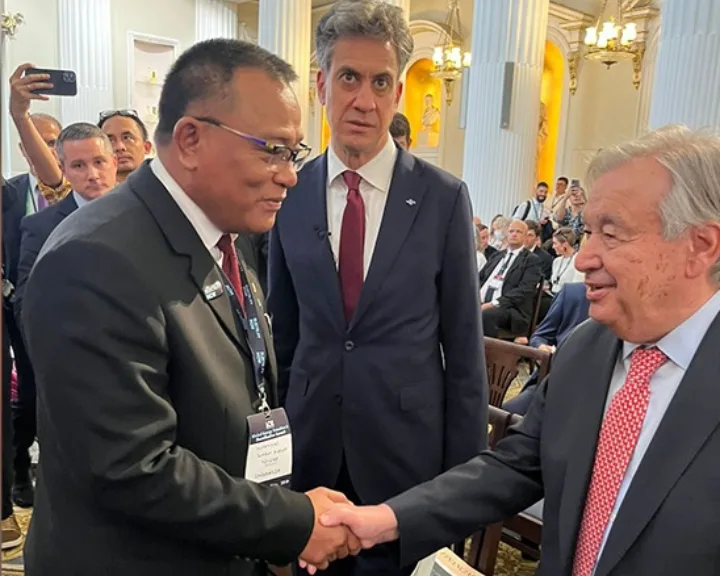
Speaking at two major international forums in London this week, Indonesia’s Minister of Environment and Head of the Environmental Control Agency, Moh Jumhur Hidayat, positioned the country as a leading advocate for a green transition that balances climate action, economic growth and environmental protection.
Addressing the High-Level Ministerial and CEO Dialogue at the Global Electrification and Transition Energy Summit (GETES) 2026, Jumhur stressed that Indonesia’s energy transition strategy would remain firmly anchored in ecological safeguards despite growing global pressure to accelerate decarbonization.

“For Indonesia, transformation must be carried out responsibly,” Jumhur said.
“We ensure that every development step adheres to strict environmental standards and remains aligned with our national climate commitments.”
The remarks come as governments worldwide intensify efforts to expand renewable energy capacity and reduce dependence on fossil fuels. Indonesia, home to some of the world’s largest tropical forests, peatlands and mangrove ecosystems, argues that environmental integrity must remain at the center of the global transition.
As one of the planet’s most biodiverse nations, Indonesia plays a critical role in climate mitigation through its vast natural carbon sinks and rich ecosystems.
Jakarta has increasingly sought to position itself as a bridge between economic development and environmental stewardship, insisting that neither objective should be pursued at the expense of the other.
The Indonesian position echoed calls from United Nations Secretary-General António Guterres, who urged governments and businesses to accelerate an energy transition that is fast, fair and inclusive.
“This transition must benefit everyone, creating opportunity, dignity and sustainable development,” Guterres told participants, emphasizing that clean-energy policies should generate jobs and improve livelihoods while reducing emissions.
Jumhur said Indonesia remains committed to integrating environmental safeguards into every stage of its development strategy.
“Our priority is to ensure that development policies remain integrated with strong environmental guidelines,” he said.
“This approach forms the foundation for maintaining consistency between economic growth and environmental preservation.”
The minister also called for stronger international cooperation based on transparency and mutual trust, arguing that the challenges posed by climate change require collective solutions.
“Indonesia fully commits to strengthening responsible development practices. We welcome strategic partnerships built on trust and transparency to achieve sustainable development goals for all,” he added.
Beyond the energy transition debate, Indonesia used the London gathering to stake out a prominent position in the rapidly emerging global biodiversity-credit market.
At the high-level forum Making Nature Credits Market Work in Asia and the Pacific, held during the London Climate Action Week, Jumhur outlined Indonesia’s vision for a biodiversity-credit framework that prioritizes fairness, transparency and inclusiveness.
He warned that nature-credit markets would fail to gain legitimacy if they overlook the communities and Indigenous peoples who directly protect ecosystems on the ground.
“The foundation of successful biodiversity credits is fair and equitable benefits for local communities and Indigenous peoples undertaking real conservation work,” he said.
Indonesia is currently developing a multi-credit biodiversity framework that goes beyond measuring forest cover. The proposed system would also assign economic value to endemic species and ecosystem protection, linking conservation achievements directly to market-based incentives.
Under the scheme, the protection of endangered wildlife such as orangutans and tigers could become part of a broader economic valuation model for ecosystem services.
International support for Indonesia’s approach was evident during the forum.
Amelia Fawcett, Co-Chair of the International Advisory Panel on Biodiversity Credits (IAPB), described Indonesia as a pivotal player in the future architecture of global nature finance.
“What Indonesia is doing is critically important and extends far beyond its borders,” Fawcett said, praising the country’s efforts to establish a high-integrity and inclusive biodiversity-credit market capable of mobilizing new funding for conservation.
She noted that Indonesia’s tropical forests, coral reefs and mangrove ecosystems represent some of the most irreplaceable natural assets on Earth and could become a model for biodiversity financing worldwide.
Seeking to strengthen regional cooperation, Indonesia also proposed the establishment of an Asia-Pacific Roundtable on Biodiversity Credits, a platform designed to harmonize regulations, exchange technical expertise and ensure that developing countries have a stronger voice in shaping global standards.
The initiative reflects Jakarta’s growing ambition to become a rule-maker in the evolving green economy rather than simply adapting to frameworks created elsewhere.
As climate negotiations and sustainable-finance discussions gain momentum worldwide, Indonesia is increasingly presenting itself as a champion of a development model that links climate action, biodiversity conservation and economic growth.
The message from London was unequivocal: achieving net-zero emissions will require more than clean energy investments. It will also depend on protecting nature, empowering local communities and ensuring that the benefits of the green transition are shared fairly.
For Indonesia, the future of climate action and the future of nature are inseparable. And in a world searching for pathways to sustainable growth, Jakarta is pushing to ensure that environmental integrity remains at the heart of the global green agenda. (Midwan)
Follow Us at Google News and WA Channel